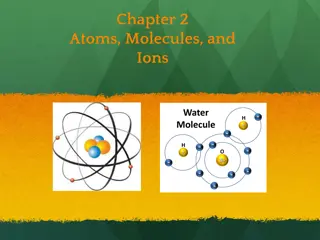
Delve into the fundamental concepts of atoms, molecules, and ions with a journey through Dalton's Atomic Theory, laws of chemical proportions, subatomic particles, and important experiments by renowned scientists like J.J. Thomson and Chadwick. Discover the structure of atoms, the role of the nucleus, and the understanding of different elements and compounds in the realm of chemistry.
Please find below an Image/Link to download the presentation.
The content on the website is provided AS IS for your information and personal use only. It may not be sold, licensed, or shared on other websites without obtaining consent from the author. If you encounter any issues during the download, it is possible that the publisher has removed the file from their server.
You are allowed to download the files provided on this website for personal or commercial use, subject to the condition that they are used lawfully. All files are the property of their respective owners.
The content on the website is provided AS IS for your information and personal use only. It may not be sold, licensed, or shared on other websites without obtaining consent from the author.
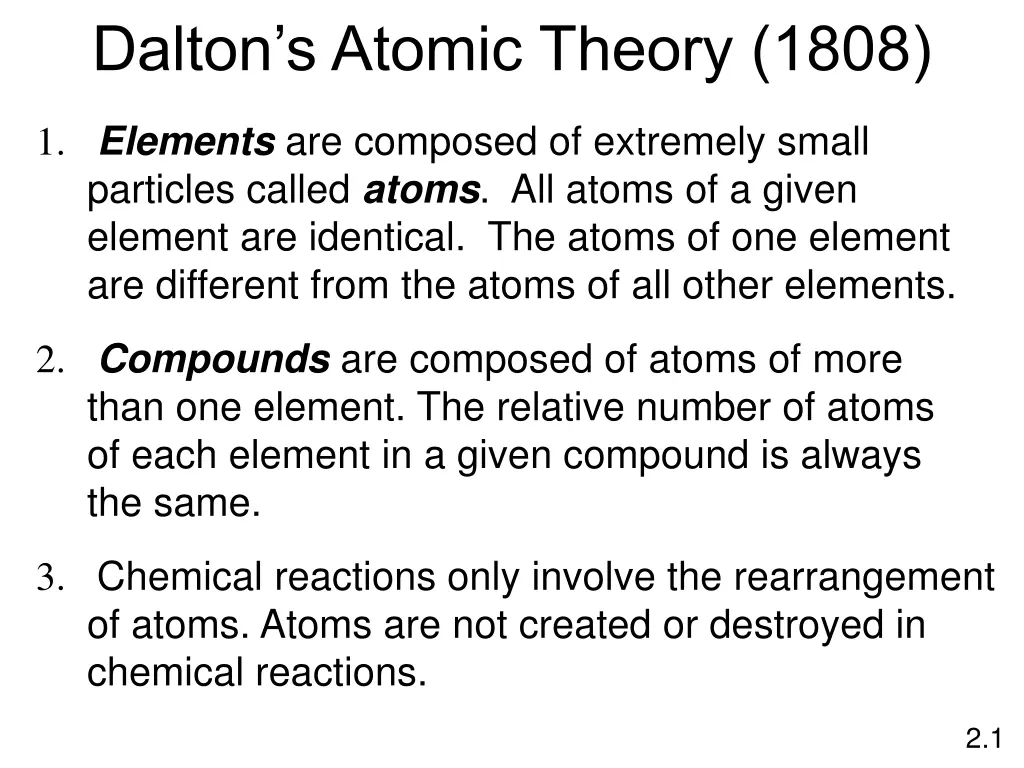
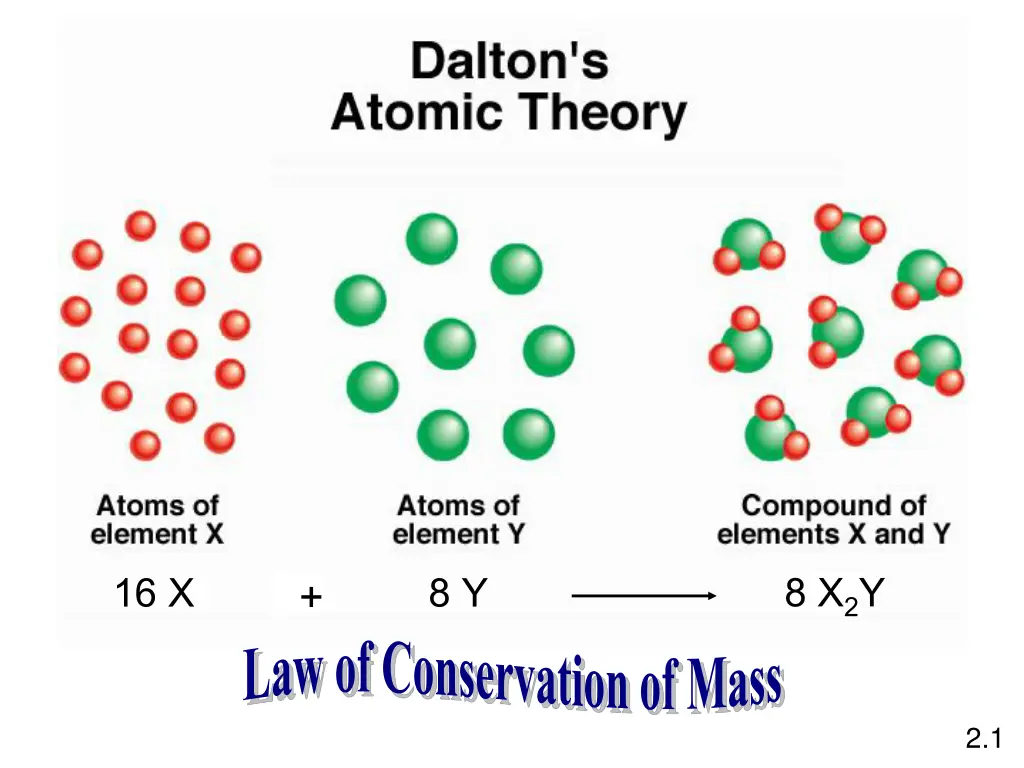
Daltons Atomic Theory (1808) 1. Elements are composed of extremely small particles called atoms. All atoms of a given element are identical. The atoms of one element are different from the atoms of all other elements. 2. Compounds are composed of atoms of more than one element. The relative number of atoms of each element in a given compound is always the same. 3. Chemical reactions only involve the rearrangement of atoms. Atoms are not created or destroyed in chemical reactions. 2.1
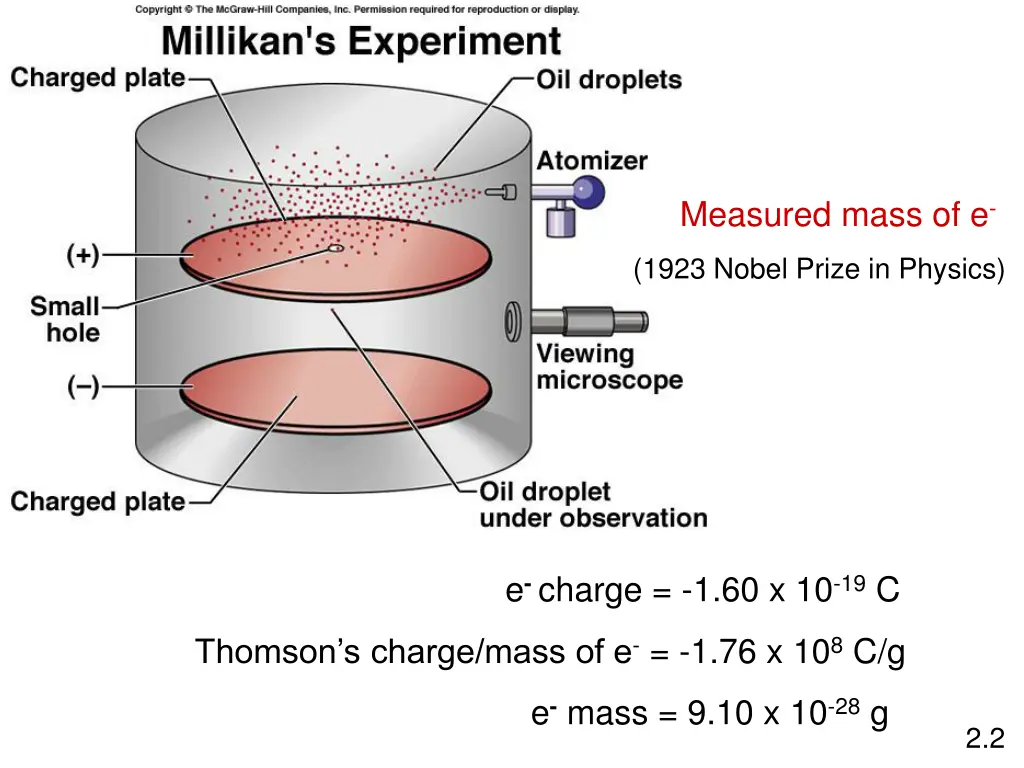
Measured mass of e- (1923 Nobel Prize in Physics) e-charge = -1.60 x 10⁻¹⁹ C Thomson s charge/mass of e- = -1.76 x 10⁸ C/g e- mass = 9.10 x 10⁻²⁸ g 2.2
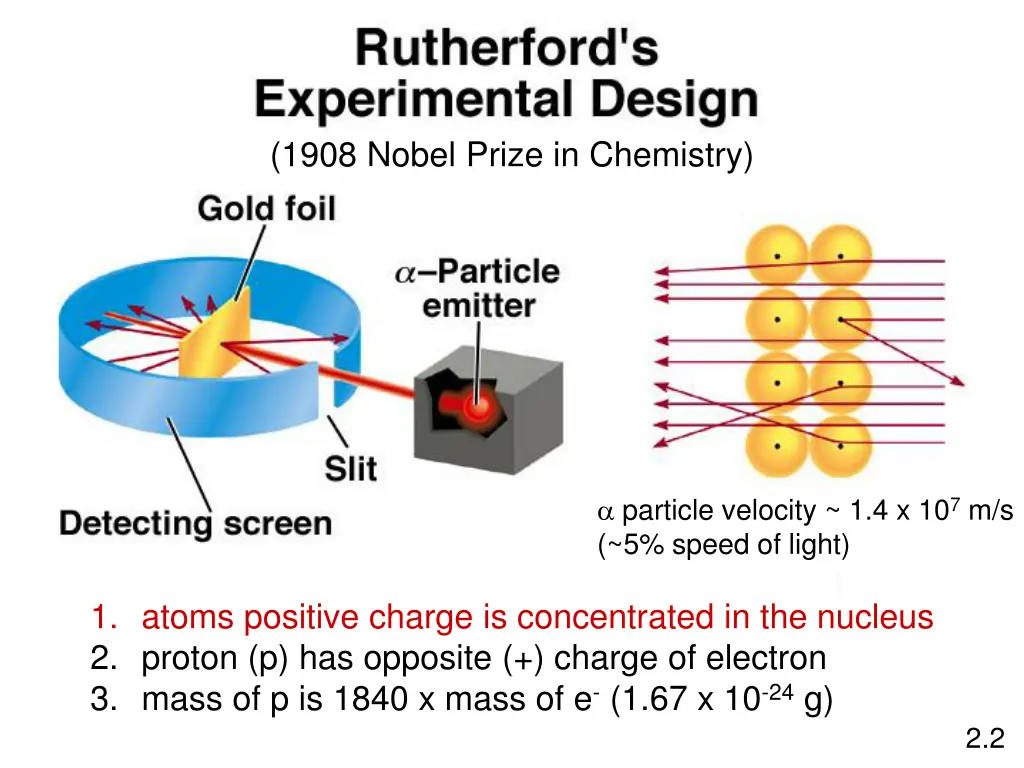
(1908 Nobel Prize in Chemistry) particle velocity ~ 1.4 x 10⁷ m/s (~5% speed of light) 1. atoms positive charge is concentrated in the nucleus 2. proton (p) has opposite (+) charge of electron 3. mass of p is 1840 x mass of e- (1.67 x 10⁻²⁴ g) 2.2
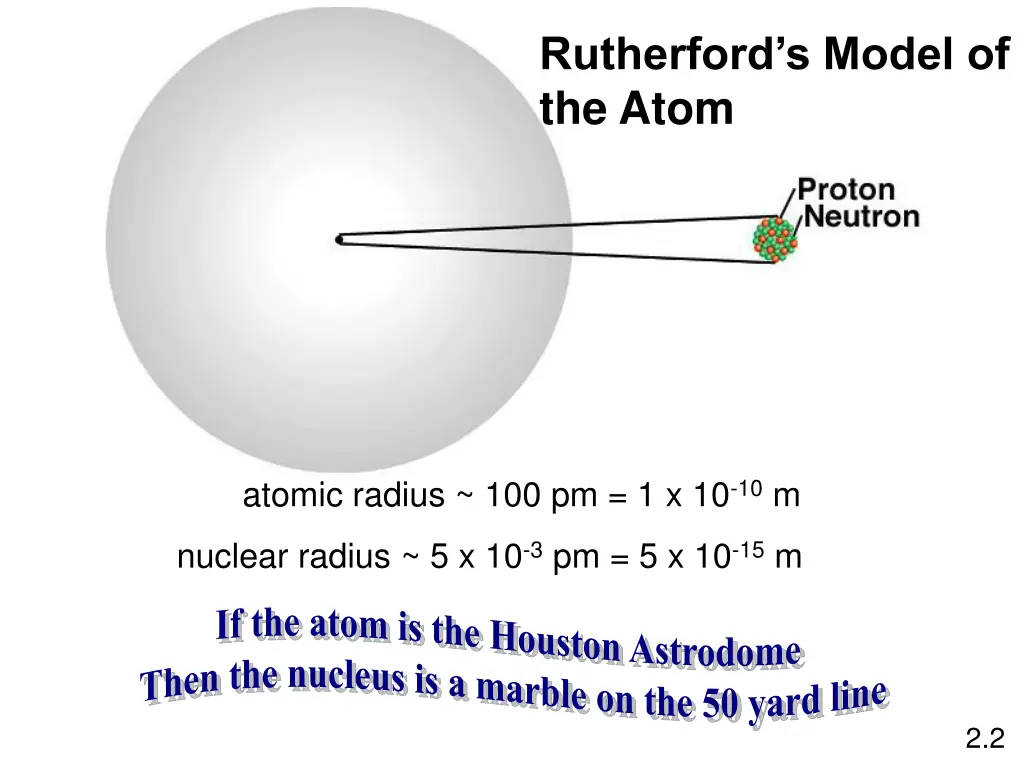
Rutherfords Model of the Atom atomic radius ~ 100 pm = 1 x 10⁻¹⁰ m nuclear radius ~ 5 x 10⁻³ pm = 5 x 10-15 m If the atom is the Houston Astrodome Then the nucleus is a marble on the 50 yard line 2.2
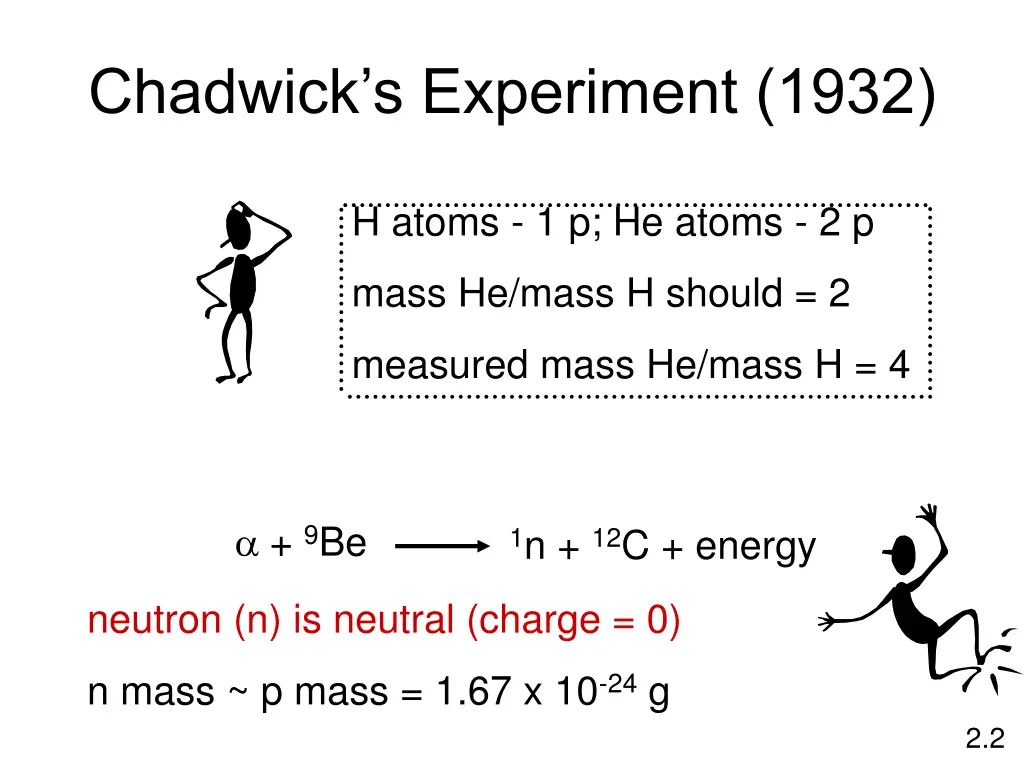
Chadwicks Experiment (1932) H atoms - 1 p; He atoms - 2 p mass He/mass H should = 2 measured mass He/mass H = 4 + 9Be 1n + 12C + energy neutron (n) is neutral (charge = 0) n mass ~ p mass = 1.67 x 10⁻²⁴ g 2.2
Subatomic Particles (Table 2.1) Mass (g) Charge (Coulombs) Charge (units) Particle Electron (e-) 9.1 x 10⁻²⁸ -1.6 x 10⁻¹⁹ -1 1.67 x 10⁻²⁴ +1.6 x 10⁻¹⁹ Proton (p) +1 Neutron (n) 1.67 x 10⁻²⁴ 0 0 mass p = mass n = 1840 x mass e- 2.2
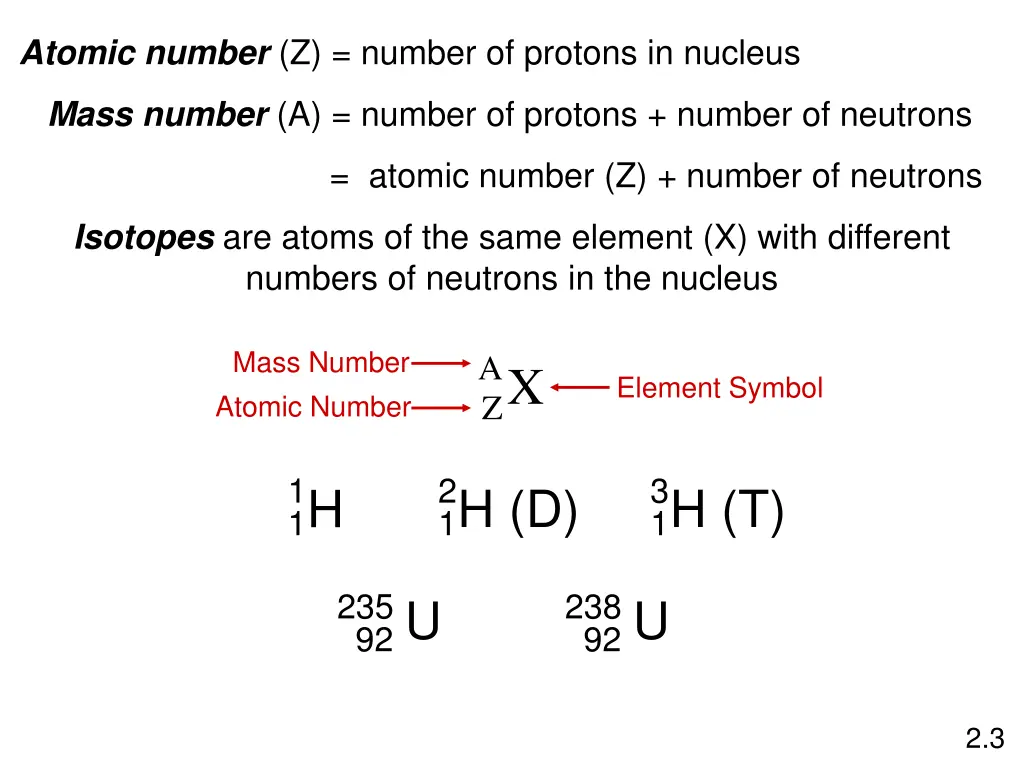
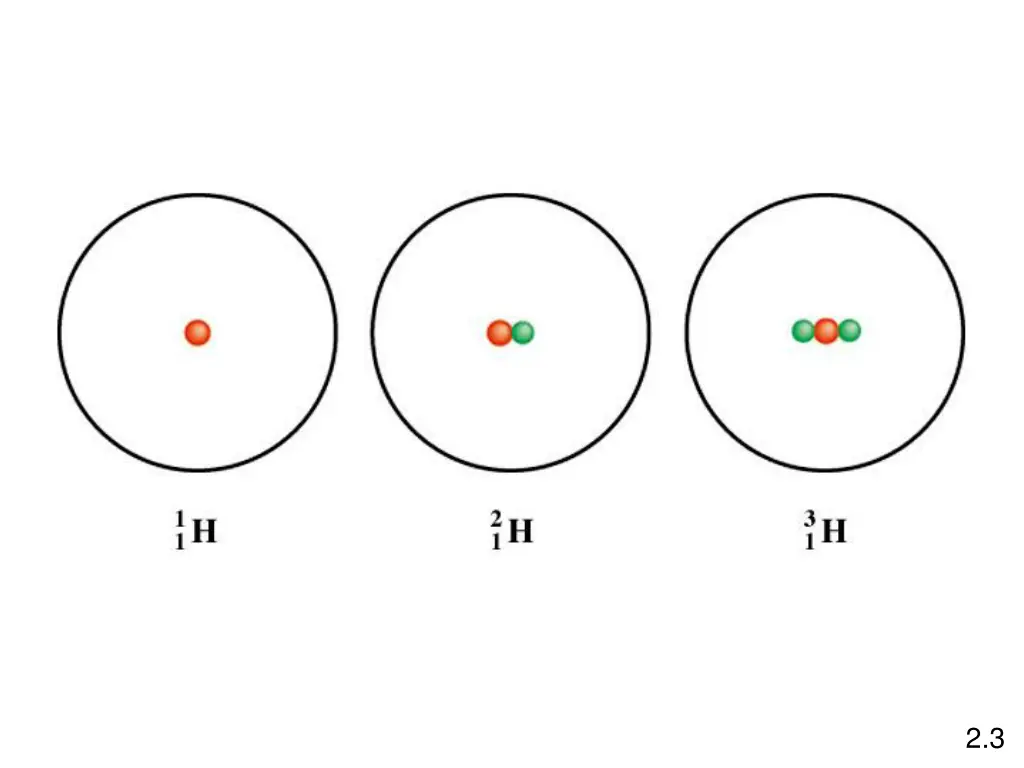
Atomic number (Z) = number of protons in nucleus Mass number (A) = number of protons + number of neutrons = atomic number (Z) + number of neutrons Isotopes are atoms of the same element (X) with different numbers of neutrons in the nucleus Mass Number Atomic Number A Z X Element Symbol 1 1 2 1 3 1 H (D) H (T) H 235 92 238 92 U U 2.3
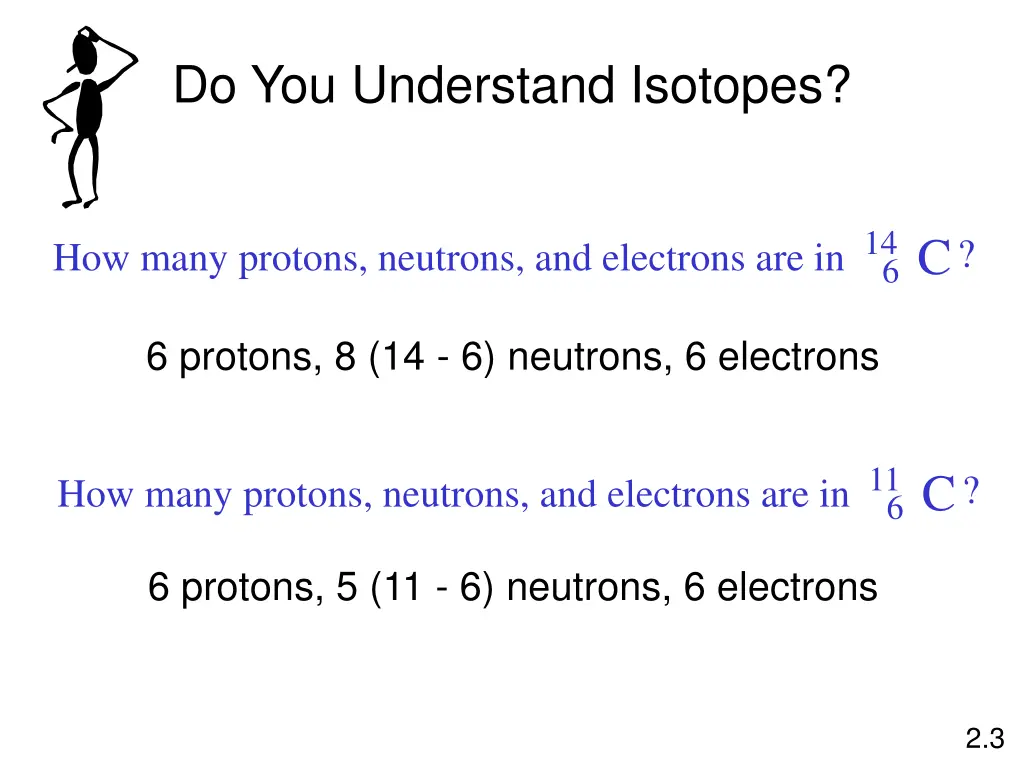
Do You Understand Isotopes? 14 C ? How many protons, neutrons, and electrons are in 6 6 protons, 8 (14 - 6) neutrons, 6 electrons 11 C ? How many protons, neutrons, and electrons are in 6 6 protons, 5 (11 - 6) neutrons, 6 electrons 2.3
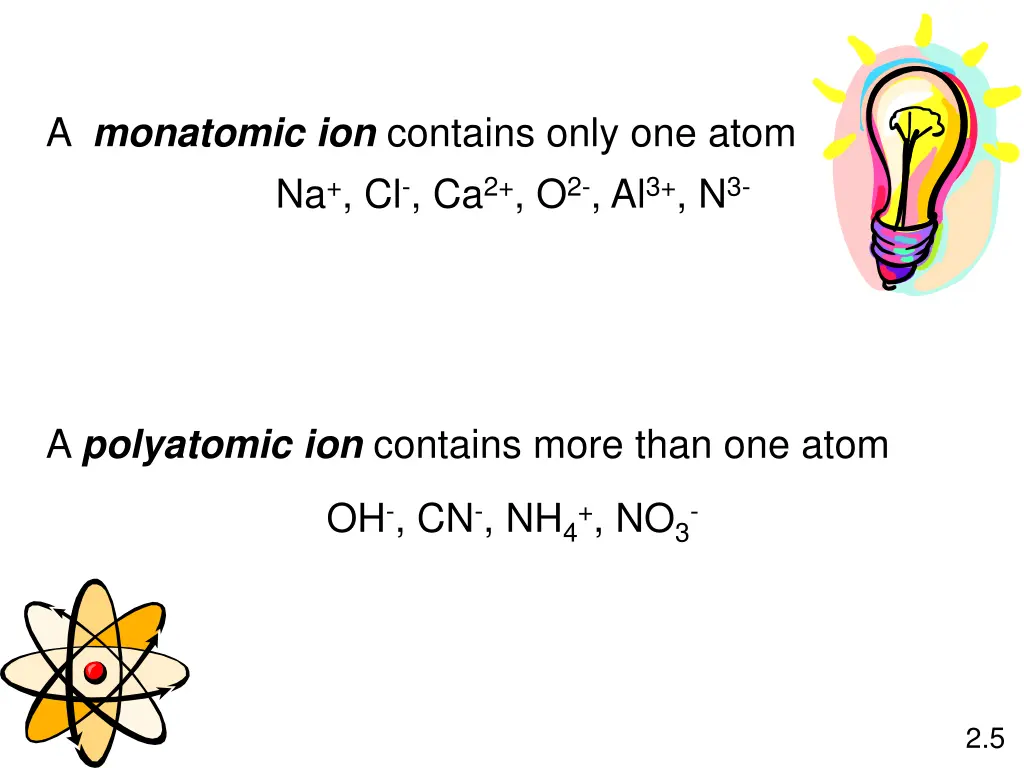
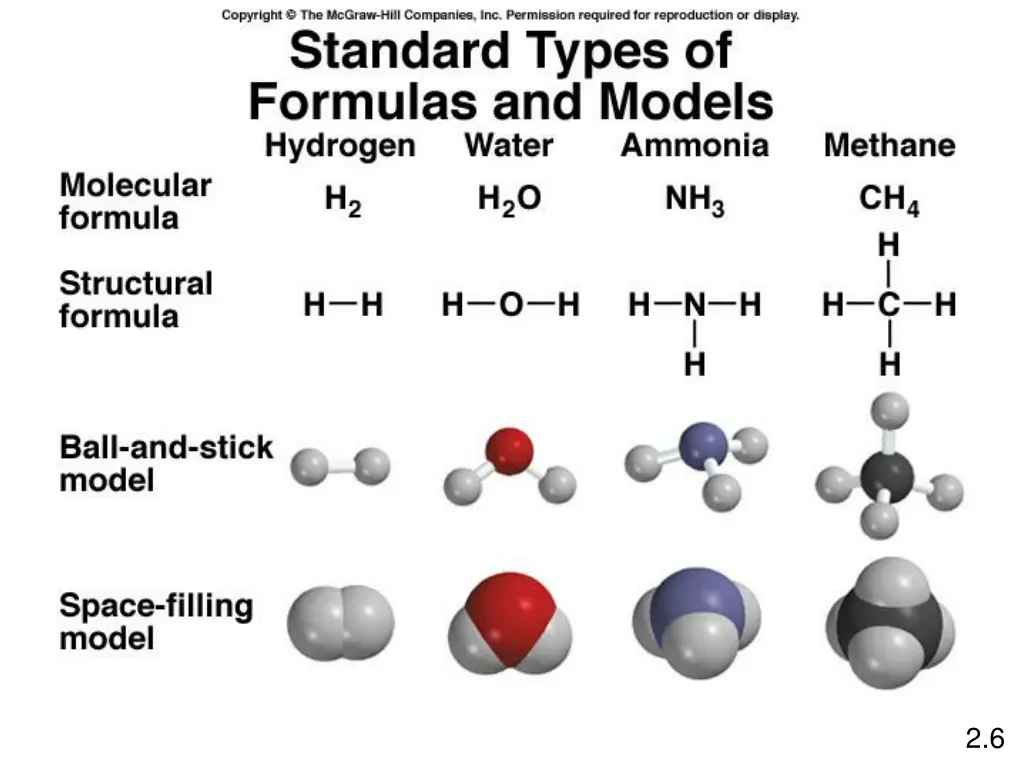
A molecule is an aggregate of two or more atoms in a definite arrangement held together by chemical bonds H2 H2O NH3 CH4 A diatomic molecule contains only two atoms H2, N2, O2, Br2, HCl, CO A polyatomic molecule contains more than two atoms O3, H2O, NH3, CH4 2.5
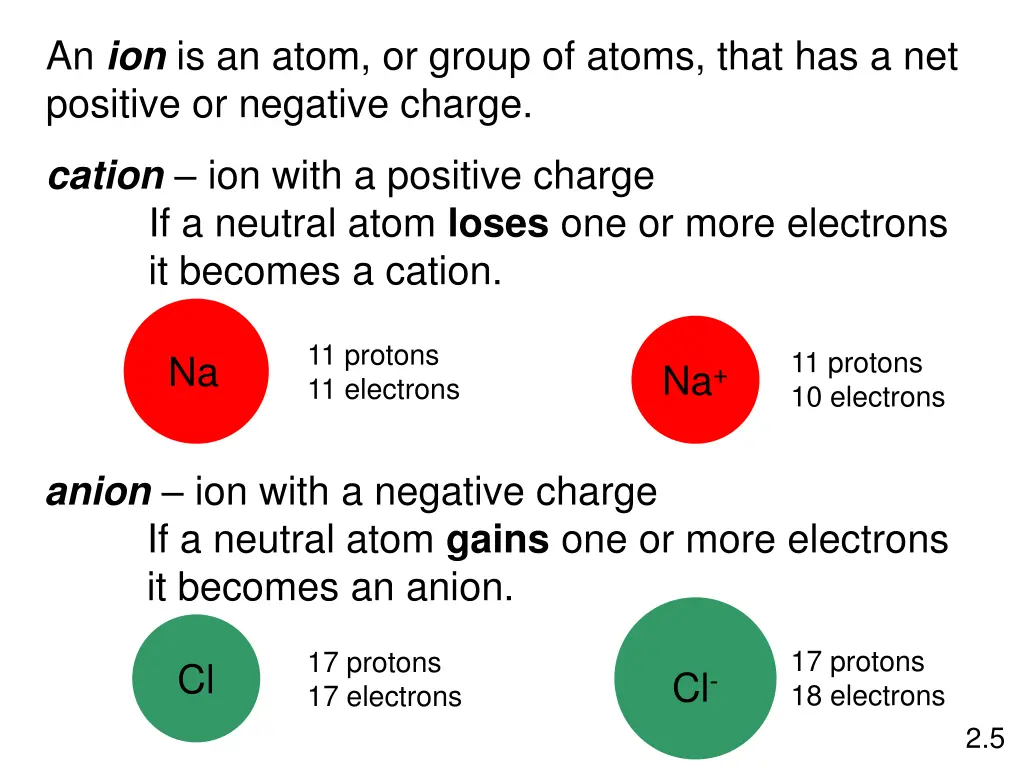
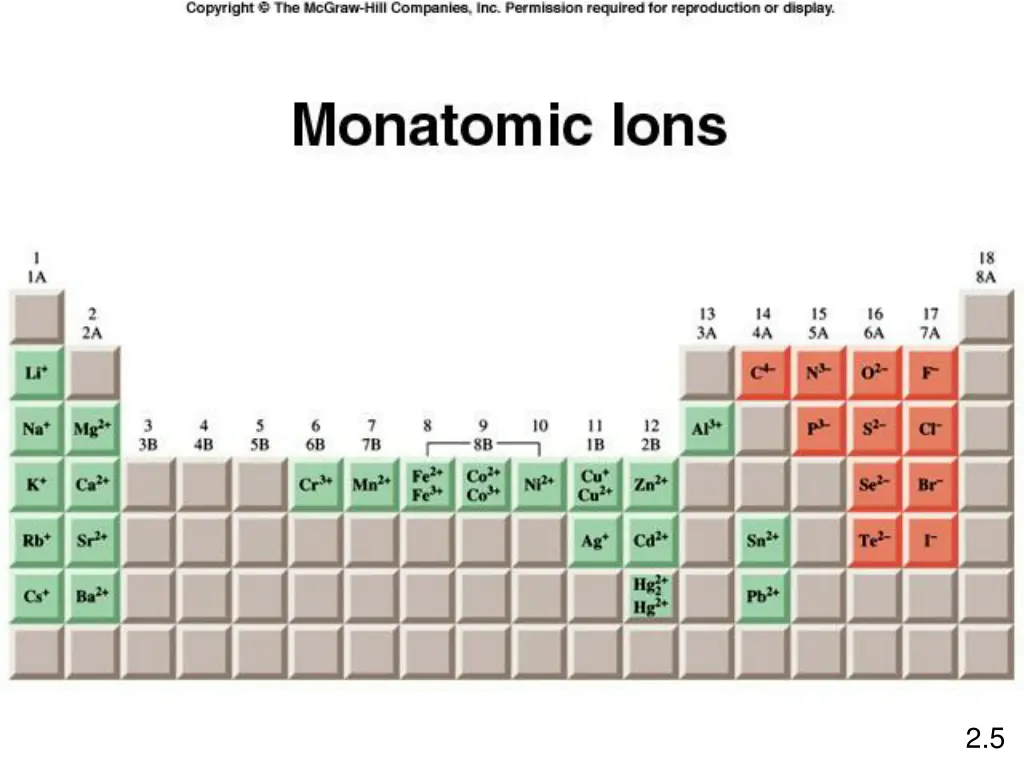
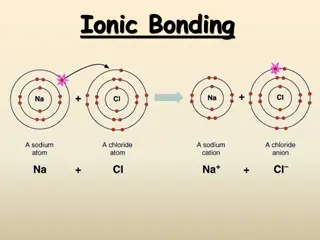
An ion is an atom, or group of atoms, that has a net positive or negative charge. cation ion with a positive charge If a neutral atom loses one or more electrons it becomes a cation. 11 protons 11 electrons 11 protons 10 electrons Na Na+ anion ion with a negative charge If a neutral atom gains one or more electrons it becomes an anion. 17 protons 18 electrons 17 protons 17 electrons Cl Cl- 2.5
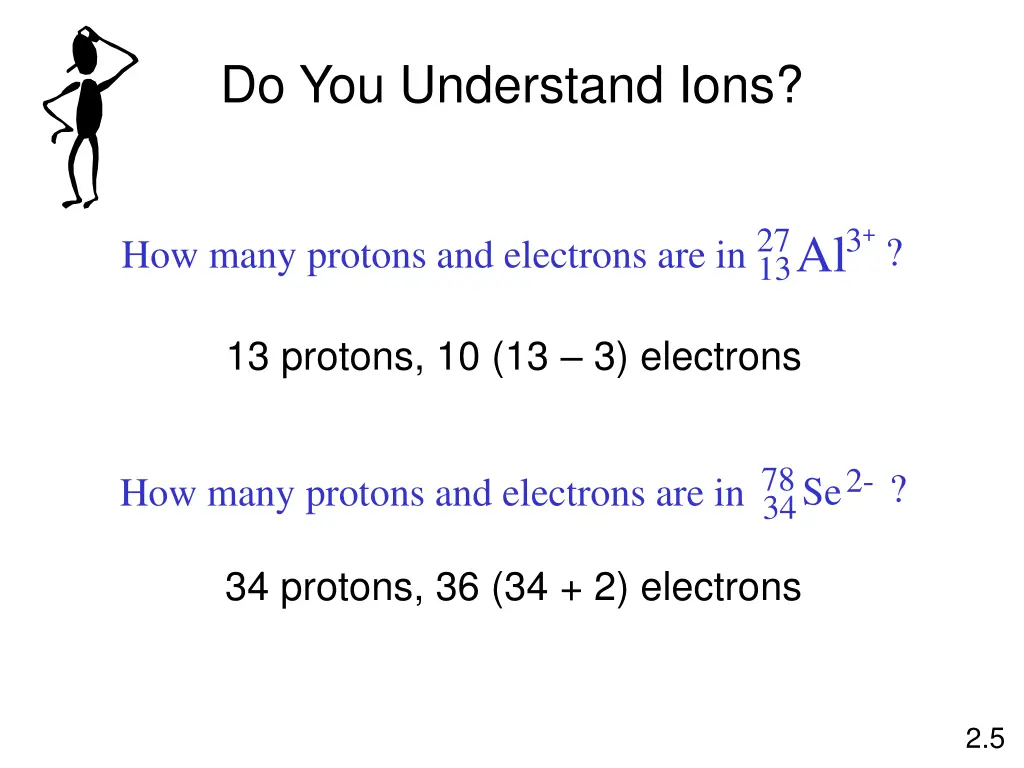
Do You Understand Ions? 27 13 3+ Al ? How many protons and electrons are in 13 protons, 10 (13 3) electrons 78 34 2-? Se How many protons and electrons are in 34 protons, 36 (34 + 2) electrons 2.5
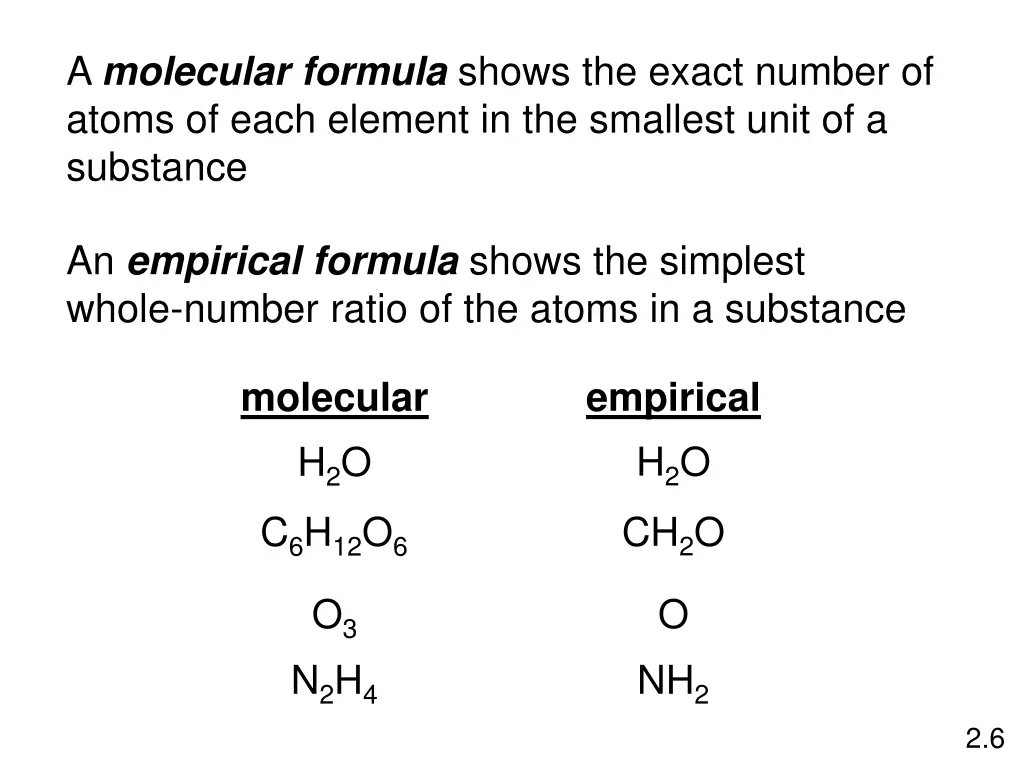
A molecular formula shows the exact number of atoms of each element in the smallest unit of a substance An empirical formula shows the simplest whole-number ratio of the atoms in a substance molecular empirical H2O CH2O H2O C6H12O6 O3 N2H4 O NH2 2.6
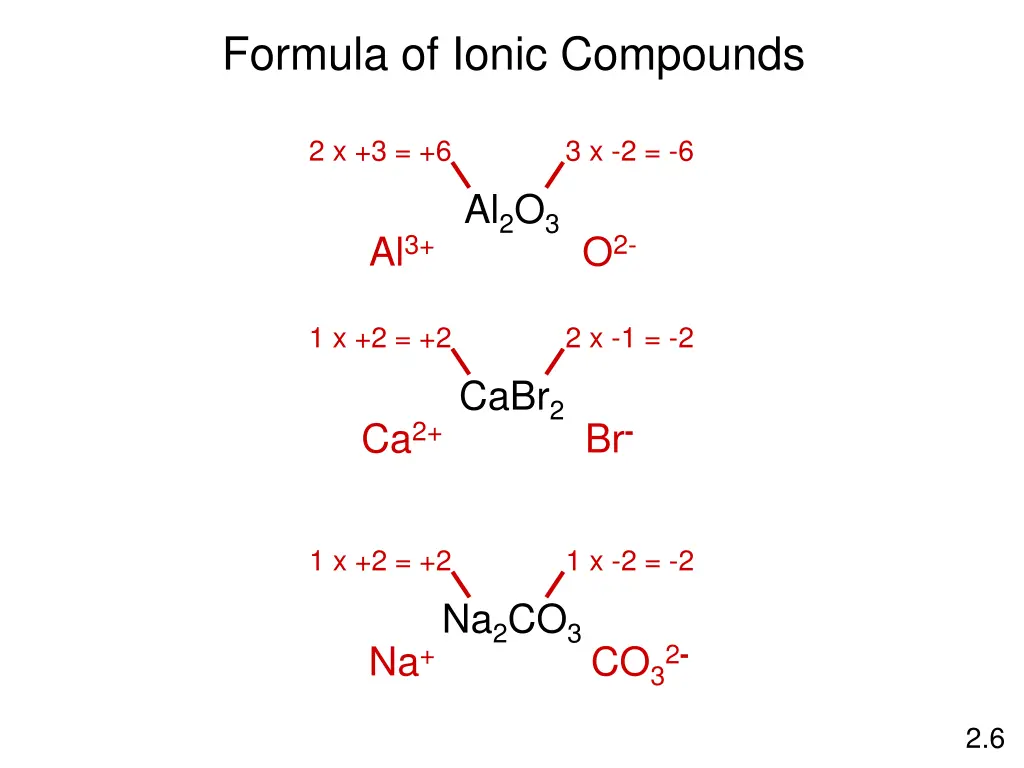
ionic compounds consist of a cation and an anion the formula is always the same as the empirical formula the sum of the charges on the cation and anion in each formula unit must equal zero The ionic compound NaCl 2.6
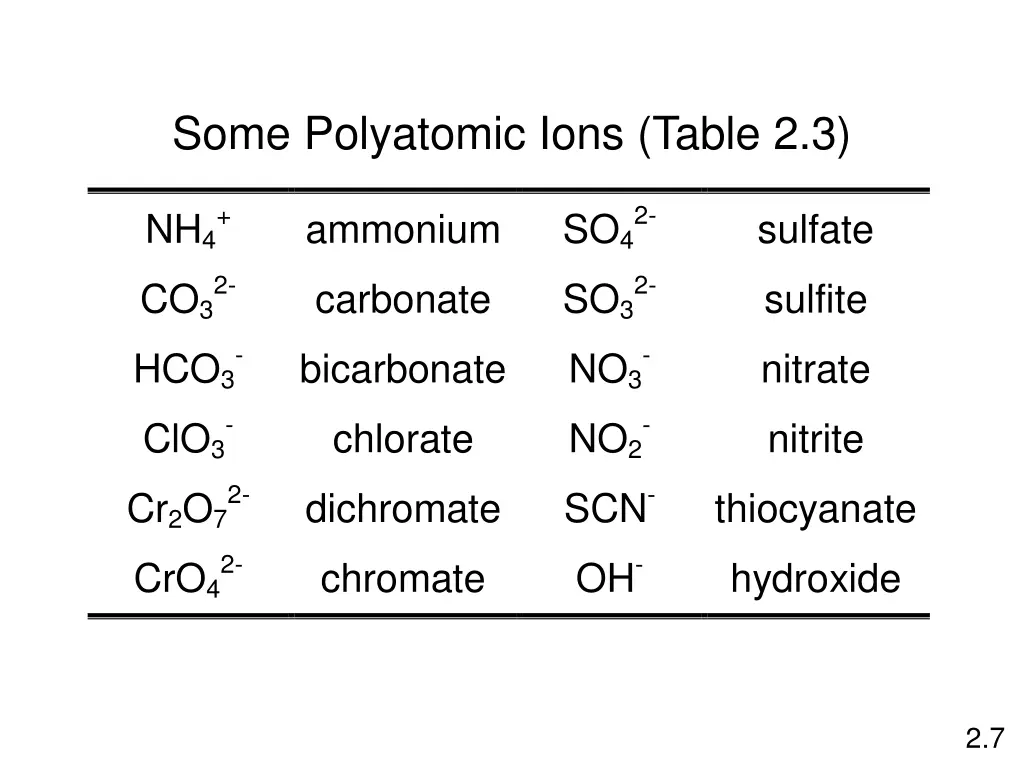
Formula of Ionic Compounds 2 x +3 = +6 3 x -2 = -6 Al2O3 Al3+ O2- 1 x +2 = +2 2 x -1 = -2 CaBr2 Ca2+ Br- 1 x +2 = +2 1 x -2 = -2 Na2CO3 Na+ CO32- 2.6
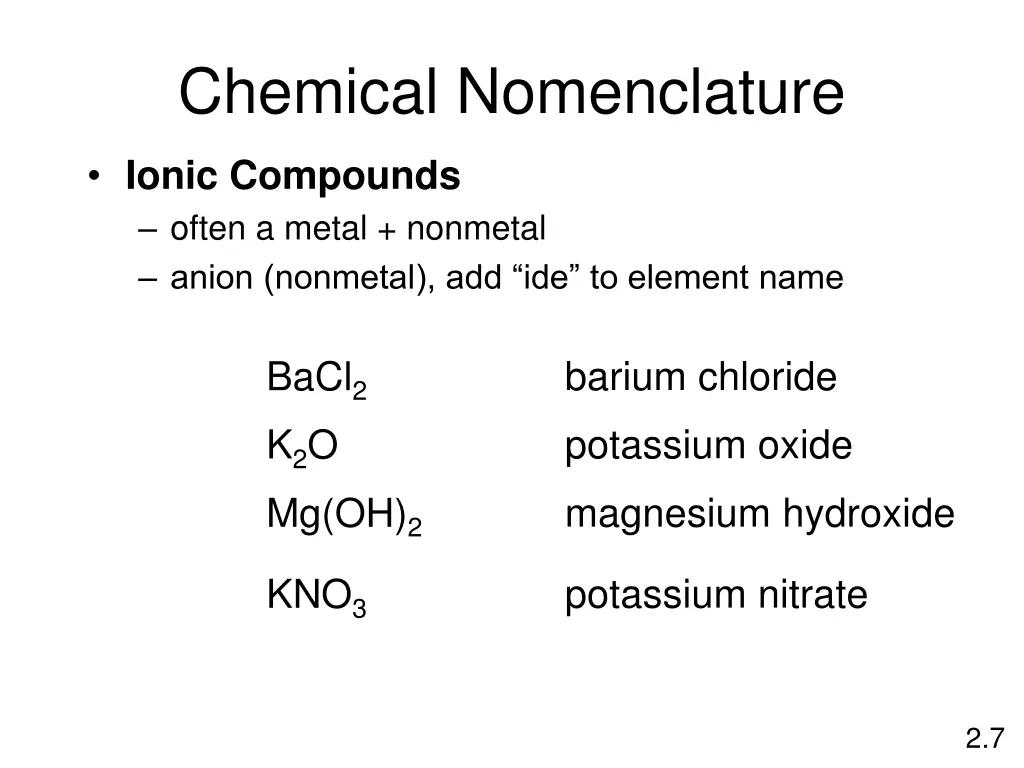
Chemical Nomenclature Ionic Compounds often a metal + nonmetal anion (nonmetal), add ide to element name barium chloride BaCl2 K2O Mg(OH)2 potassium oxide magnesium hydroxide potassium nitrate KNO3 2.7
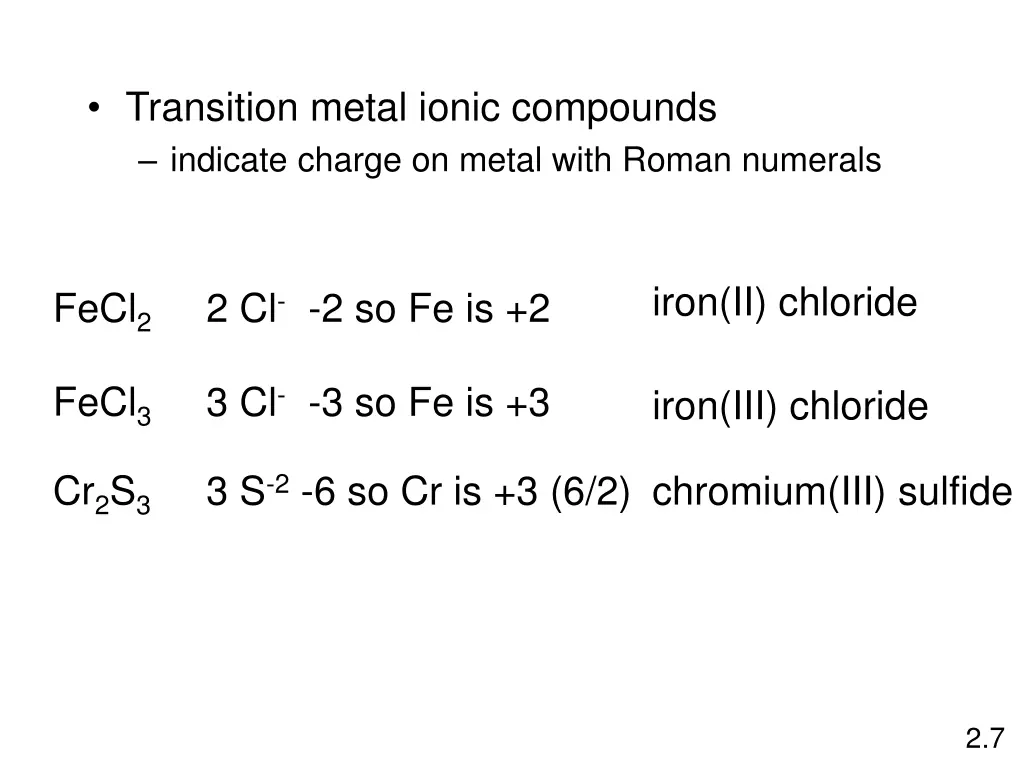
Transition metal ionic compounds indicate charge on metal with Roman numerals iron(II) chloride FeCl2 2 Cl- -2 so Fe is +2 FeCl3 3 Cl- -3 so Fe is +3 iron(III) chloride Cr2S3 3 S-2 -6 so Cr is +3 (6/2) chromium(III) sulfide 2.7
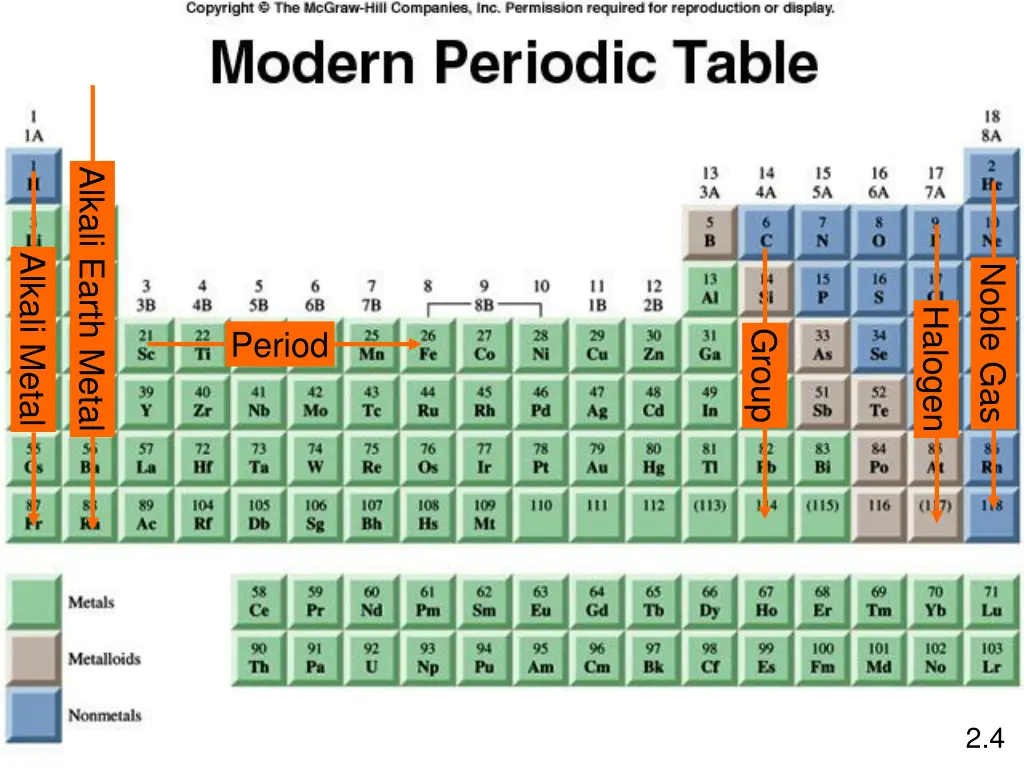
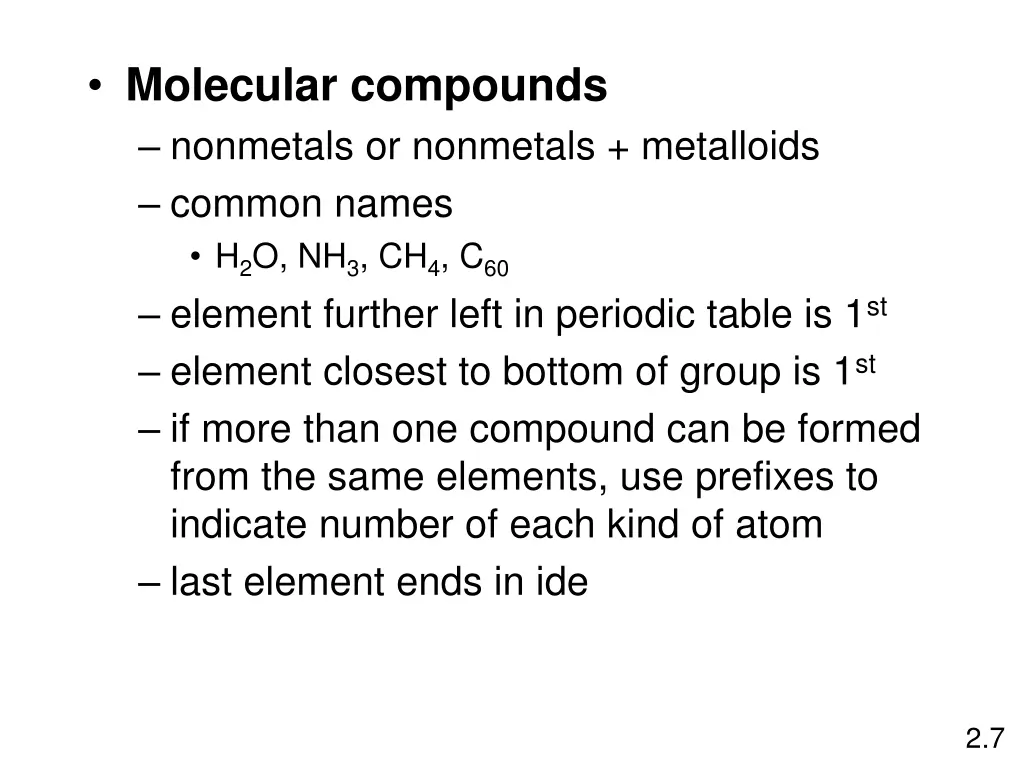
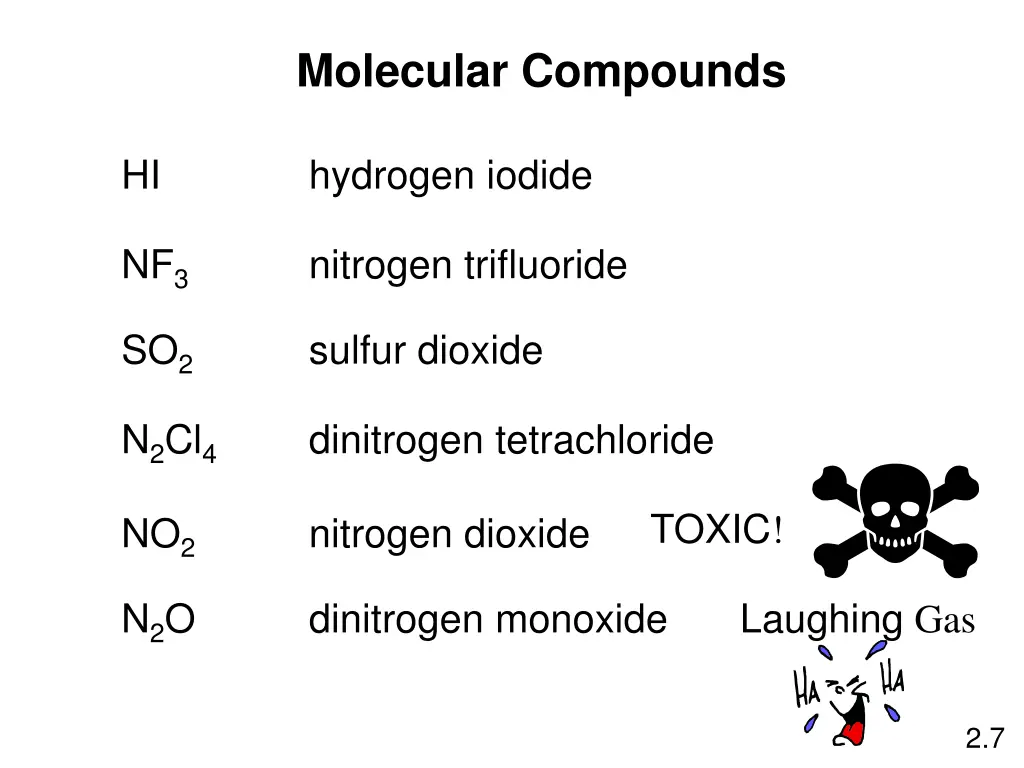
Molecular compounds nonmetals or nonmetals + metalloids common names H2O, NH3, CH4, C60 element further left in periodic table is 1st element closest to bottom of group is 1st if more than one compound can be formed from the same elements, use prefixes to indicate number of each kind of atom last element ends in ide 2.7
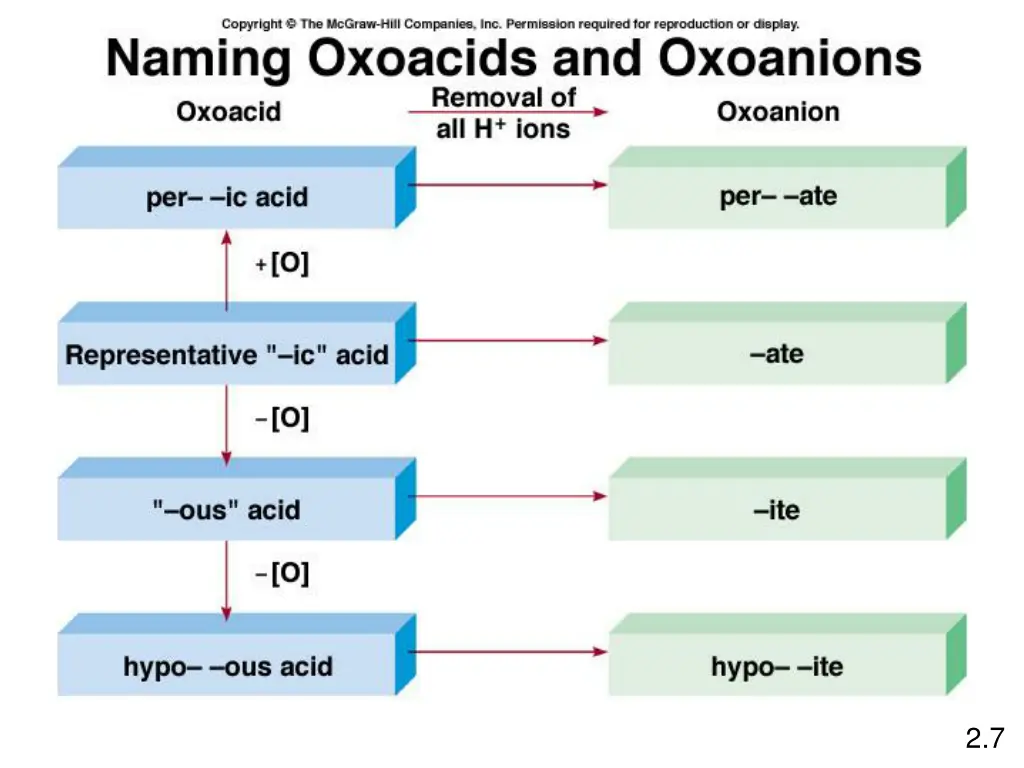
An acid can be defined as a substance that yields hydrogen ions (H+) when dissolved in water. HCl Pure substance, hydrogen chloride Dissolved in water (H+ Cl-), hydrochloric acid An oxoacid is an acid that contains hydrogen, oxygen, and another element. nitric acid HNO3 carbonic acid H2CO3 H2SO4 sulfuric acid 2.7