Explore the research on utilizing silicon nanowires for all-optical signal processing and gain enhancement through four-wave-mixing. Discover the potential applications in ultra-fast digital systems, wavelength provisioned networks, on-chip light sources, and quantum computation. Learn about the effective nonlinearity in silicon waveguides and the challenges posed by two-photon absorption. Comparison with other materials and the potential for high-speed signal processing using silicon-organic hybrid waveguides are also discussed.
Please find below an Image/Link to download the presentation.
The content on the website is provided AS IS for your information and personal use only. It may not be sold, licensed, or shared on other websites without obtaining consent from the author. If you encounter any issues during the download, it is possible that the publisher has removed the file from their server.
You are allowed to download the files provided on this website for personal or commercial use, subject to the condition that they are used lawfully. All files are the property of their respective owners.
The content on the website is provided AS IS for your information and personal use only. It may not be sold, licensed, or shared on other websites without obtaining consent from the author.
E N D
Presentation Transcript
PHOTONICS RESEARCH GROUP FOUR-WAVE-MIXING GAIN AND ALL-OPTICAL SIGNAL PROCESSING IN SILICON NANOWIRES B. Kuyken 1,2, X. Liu3, S. Clemmen4, S. Selvaraja1,2, W. Bogaerts1,2, D. Van Thourhout1,2, R. M. Osgood, Jr. 3, P. Emplit4 , S. Massar4, Y. A. Vlasov5, W. M. Green5, G. Roelkens1,2, R. Baets1,2 1Photonics Research Group, Ghent University, Ghent, Belgium 2Center for Nano- and Biophotonics, Ghent, Belgium 3Electrical Engineering Group, Columbia University, NY 4Laboratoire d Information Quantique (LIQ), Universit Libre de Bruxelles ,Belgium 5IBM Thomas J. Watson Research Center, Yorktown Heights, NY 1 PHOTONICS RESEARCH GROUP
Silicon as a nonlinear material pump Chip-scale nonlinear optical applications using four-wave-mixing (FWM): Ultra-fast digital systems: Tbps all-optical signal processing Wavelength-provisioned networks: Wavelength conversion On-chip light sources: OPOs, supercontinuum generation idler signal Quantum computation: Entangled photon-pair generation High confinement in Si nanophotonic waveguides enhances effective nonlinearity by : ~ 105 compared to single-mode fiber (SMF) ~ 104 compared to highly nonlinear fiber (HNLF) ~10 m HNLF fiber ~1 mm silicon waveguide 2 PHOTONICS RESEARCH GROUP
Effective nonlinearity in waveguide Nonlinear index n2 (Optical Kerr Effect) n = n0 +n2I Nonlinear absorption in material = 0 + I Refractive index change causes phase change in a waveguide n P = = + = + = + ( ) k n n I k n k P 0 2 0 2 0 c c cA n FOM = 2 Nonlinear material needs a good figure of merit (FOM) 3 PHOTONICS RESEARCH GROUP
Downside of silicon: Two photon absorption Fundamental two-photon absorption (TPA): Limits effective pump power Nonlinear efficiency is low in telecom band Intrinsic Two telecom band photons Silicon bandgap p Eg = 1.12 eV p 4 PHOTONICS RESEARCH GROUP
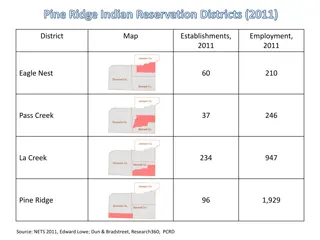
n2 FOM (n2/ ) 0.6 Typical Nonlinear Parameter of waveguide (1/Wm) n 2 Comparison with other materials (@ 1550 nm) (10-20 m2/W) = Ac Crystalline Silicon 650 450 Amorphous Silicon 1300 Nonlinear parameter of a typical waveguide 2.1 770 n2 (10^-20) m2/W FOM Silicon Organic Hybrids: DDMEBT 1700 Crystalline Silicon Amorphous Silicon Silicon Organic Hybrid:DDMEBT slotted strip Chaclogenide As2S3 As2Se3 Ge11.5As24Se54.5 Silica Nitride Ge11.5As24Se64.5(5) Silicon Nitride (6) 650 1300 1700 - 0.6 2.1 450 770 Slotted (1) 2.2 100 2.2 1.2 100 108 Strip (TM) (2) 1.2 108 Chalcogenide 290 >10 1200 860 2.2 - 25 - 10 160 (tapered fiber) 150 As2S3 (3) As2Se3 (4) 290 >10 10 2 60 1200 2 160 <<1 1.5 860 60 150 24 - 1.5 Silica 2.7 - <<1 1)C. Koos, et al. All-optical high-speed signal processing with silicon-organic hybrid slot waveguides , Nature Photonics 3 (2009) 2)T. Vallaitis et al, Optical properties of highly nonlinear silicon-organic hybrid (SOH) waveguide geometries ,Opt. Express 17(2009) 3) M. Lamont et al, "Supercontinuum generation in dispersion engineered highly nonlinear As2S3 chalcogenide planar waveguide, Opt. Express 16(2008) 4) V. Ta'eed et al, "Ultrafast all-optical chalcogenide glass photonic circuits," Opt. Express 15 (2007) 5) X. Gai, Chalcogenide nanowire waveguides with a nonlinear parameter 150,000 /Wm , CLEO (2010) 6) D. T. H. Tan, Group velocity dispersion and self phase modulation in silicon nitride waveguides , Appl. Phys. Lett. 96,(2010) 5 PHOTONICS RESEARCH GROUP
Results for a 1.1 cm waveguide 1 T = + exp( ) 2 exp( ) L L P I L eff R I =770/Wm =-28/Wm FOM>2 (c-Si<~0.5) B. Kuyken, S. Clemmen, S. Selvaraja, W. Bogaerts, S. Massar, R. Baets, G. Roelkens, Self phase modulation in highly nonlinear hydrogenated amorphous silicon,Photonics Society Annual Meeting, United States, (2010) 11 PHOTONICS RESEARCH GROUP
n2 FOM (n2/ ) 0.6 Typical Nonlinear Parameter of waveguide (1/Wm) n 2 Comparison with other materials (@ 1550 nm) (10-20 m2/W) = Ac Crystalline Silicon 650 450 Amorphous Silicon 1300 Nonlinear parameter of a typical waveguide 2.1 770 n2 (10^-20) m2/W FOM Silicon Organic Hybrids: DDMEBT 1700 Crystalline Silicon Amorphous Silicon Silicon Organic Hybrid:DDMEBT slotted strip Chaclogenide As2S3 As2Se3 Ge11.5As24Se54.5 Silica Nitride Ge11.5As24Se64.5(5) Silicon Nitride (6) 650 1300 1700 - 0.6 2.1 450 770 Slotted (1) 2.2 100 2.2 1.2 100 108 Strip (TM) (2) 1.2 108 Chalcogenide 290 >10 1200 860 2.2 - 25 - 10 160 (tapered fiber) 150 As2S3 (3) As2Se3 (4) 290 >10 10 2 60 1200 2 160 <<1 1.5 860 60 150 24 - 1.5 Silica 2.7 - <<1 1)C. Koos, et al. All-optical high-speed signal processing with silicon-organic hybrid slot waveguides , Nature Photonics 3 (2009) 2)T. Vallaitis et al, Optical properties of highly nonlinear silicon-organic hybrid (SOH) waveguide geometries ,Opt. Express 17(2009) 3) M. Lamont et al, "Supercontinuum generation in dispersion engineered highly nonlinear As2S3 chalcogenide planar waveguide, Opt. Express 16(2008) 4) V. Ta'eed et al, "Ultrafast all-optical chalcogenide glass photonic circuits," Opt. Express 15 (2007) 5) X. Gai, Chalcogenide nanowire waveguides with a nonlinear parameter 150,000 /Wm , CLEO (2010) 6) D. T. H. Tan, Group velocity dispersion and self phase modulation in silicon nitride waveguides , Appl. Phys. Lett. 96,(2010) 12 PHOTONICS RESEARCH GROUP
Phasematching in high index contrast waveguides + 2 2 = + + 2 = + i s P P p s i p Small correction for SPM/XPM Figure: MA Foster et al., Broad-band optical parametric gain on a silicon photonic chip , Nature, 2006 14 PHOTONICS RESEARCH GROUP
Dispersion engineering + 2 2 = + i s P 0 p 2 P 1 1 -2,0 -2,4 2/m) Dispersion 2 (ps -2,8 500 nm -3,2 Air a-Si 220 nm -3,6 SiO2 -4,0 1400 1450 1500 Wavelength (nm) 1550 1600 1650 15 PHOTONICS RESEARCH GROUP
Broadband amplification in 1.1 cm a-Si:H waveguide Pump probe Experiment: Pump n~3.6 220 nm a-Si:H Probe 500 nm Looking at synchronized and not synchronized pulses reveals on/off gain 16 PHOTONICS RESEARCH GROUP
Broadband amplification in 1.1 cm a-Si:H waveguide Gain/conversion as a function of wavelength at peak power of 5.2W 30 Max On/off gain 26.5 dB Max On chip gain 23.0 dB Gain Conversion On/off Gain and conversion (dB) 25 c-Si: on/off gain on chip gain 1.8 dB 4.2 dB 20 15 10 5 0 1460 1480 1500 1520 1540 1560 1580 1600 Wavelength (nm) B. Kuyken, et al., On-chip parametric amplification with 26.5dB gain at telecommunication wavelengths using CMOS-compatible hydrogenated amorphous silicon waveguides ,Optics Letters (2011) 17 PHOTONICS RESEARCH GROUP
320 Gbit/s sampling of data in 4 mm a-Si:H waveguide Succesfull sampling with conversion efficiency of +12 dB! (c-Si -7.5dB) H. Ji et al., Optical Waveform Sampling of a 320 Gbit/s Serial Data Signal using a Hydrogenated Amorphous Silicon Waveguide ECOC (2011) 18 PHOTONICS RESEARCH GROUP
Staebler-Wronski effect in amorphous silicon solar cells Amorphous silicon solar cells 1976: first cells developed 1977: Staebler-Wronski effect: dark conductivity decreases after illumination Staebler, Wronski, Appl. Phys. Lett. 31 (1977) 22 PHOTONICS RESEARCH GROUP
Degradation is caused by recombination of electron-hole pairs in amorphous silicon solar cells Recombination energy is enough to break weak Si-Si bonds Leads to the creation of dangling bonds Efficiency a-Si solar cells decreases over time Heating can bring efficiency to its initial level 23 PHOTONICS RESEARCH GROUP
Staebler-Wronski in a-Si:H waveguides? Electron-Hole pairs created by residual TPA a-Si:H Heating chip for 30 min at 200 C resets the material without penalty Original Annealed: 200 C/30min 24 PHOTONICS RESEARCH GROUP
Reducing the TPA by using longer wavelengths Amplification of mid infrared and telecom signals Silicon as broadband gain medium for long wavelength sources 26 PHOTONICS RESEARCH GROUP
Long wavelength to overcome TPA Simple idea: Use a pump at long wavelengths where TPA is absent Puts a lot of stress on the dispersion engineering of waveguides Dispersion engineering ? + 2 2 = + + 2 = + i s P P p s i p Small correction for SPM/XPM 27 PHOTONICS RESEARCH GROUP
Phasematching close to pump in 2 cm waveguide Interesting for mid infrared applications -Sensing/spectroscopy -Free space communication.. -nonlinear processing in mid IR?? How to connect this with telecom? -Use higher order dispersion terms X. Liu, et al., Mid-infrared broadband modulation instability and 50dB Raman assisted parametric gain in silicon photonic wires,CLEO (2011) Pump: 2ps, Rep 78 MHz, Probe: low power CW 29 PHOTONICS RESEARCH GROUP
Phase-Matching Between Mid-IR and Telecom Band Waveguide: 2 cm long Low loss: 2.5 dB/cm Pumped at 1946 nm: 2 ps pulse train, 76 MHz rep rate, Pp = 37 W 2 < 0 and 4 > 0 B. Kuyken, et al., Frequency conversion of mid-infrared optical signals into the telecom band using nonlinear silicon nanophotonic wires ,OFC (2011) 31 31 PHOTONICS RESEARCH GROUP
Up-Conversion of Mid-IR Signals to Telecom Band Up-conversion across > 800 nm Parametric gain probed at 2440 nm 18.8 dB on-chip parametric signal gain Transparency bandwidth ~ 150 nm Mid-IR conversion to telecom L/U band Simultaneous 19.5 dB gain Transparency bandwidth ~ 45 nm 32 32 PHOTONICS RESEARCH GROUP
Down-Conversion of Telecom Signals to Mid-IR Band Down-conversion across > 800 nm Parametric gain probed at 1620 nm 8.4 dB on-chip parametric signal gain Transparency bandwidth ~ 20 nm First demonstration of telecom-band gain with mid-IR pump Telecom conversion to mid-IR band Simultaneous 8.0 dB gain Transparency bandwidth ~ 40 nm Efficient generation of high-speed optical data with telecom components S. Zlatanovic et al., Nature Photonics 4, 561 (2010). A. C. Turner-Foster et al., Opt. Express 18, 1904 (2010). 33 PHOTONICS RESEARCH GROUP 33
Reducing the TPA by using longer wavelengths Amplification of mid infrared and telecom signals Silicon as broadband gain medium for long wavelength sources 34 PHOTONICS RESEARCH GROUP
Telecom to Mid IR Supercontinuum Power in 2cm silicon waveguide >1000 nm -20 OutputSpectrum (dB) Output Input -30 -40 -50 -60 -70 -80 1600 1800 2000 2200 2400 Wavelength (nm) Pump pulses: 12.7 W, 2 ps, 78 MHz Rep B. Kuyken et al., Generation of a telecom-to-mid-infrared spanning supercontinuum using silicon-on-insulator wire waveguides CLEO (2011) 35 PHOTONICS RESEARCH GROUP
The OPO is a widely tunable source Output spectra for different delays Pulse Energy (pJ) at output of the chip 0 2 4 6 8 10 Power linear scale (a.u) 1 0,1 >70 nm 0,01 2040 2060 Wavelength (nm) 2080 2100 2020 2040 2060 2080 2100 2120 2140 Wavelength (nm) B. Kuyken, et al., Widely Tunable Silicon Mid-Infrared Optical Parametric Oscillator , in Group IV Photonics (2011) 40 PHOTONICS RESEARCH GROUP
Conclusion Hydrogenated amorphous silicon waveguides have excellent linear/nonlinear properties Understanding degradation effect is ongoing work Using long wavelength pumps to process telecom signals is achieved by extreme dispersion engineering Nonlinear optics in c-si waveguides can be used to make new sources at long wavelengths. 41 PHOTONICS RESEARCH GROUP