Introduction to Stream Computing and Reservoir Sampling
Explore the concepts of stream computing and reservoir sampling, essential for handling infinite data streams efficiently. Learn about applications in mining query streams, sensor networks, and the challenges of one-pass models and sampling methods.

Download Presentation

Please find below an Image/Link to download the presentation.
The content on the website is provided AS IS for your information and personal use only. It may not be sold, licensed, or shared on other websites without obtaining consent from the author. If you encounter any issues during the download, it is possible that the publisher has removed the file from their server.
You are allowed to download the files provided on this website for personal or commercial use, subject to the condition that they are used lawfully. All files are the property of their respective owners.
The content on the website is provided AS IS for your information and personal use only. It may not be sold, licensed, or shared on other websites without obtaining consent from the author.
E N D
Presentation Transcript
Introduction to Stream Computing and Reservoir Sampling
Data Streams We do not know the entire data set in advance Google queries Twitter feeds Internet traffic Convenient to think of the data as infinite.
Contd.. Input data element enter one after another (i.e., in a stream). Cannot store the entire stream accessibly How do you make critical calculations about the stream using a limited amount of memory?
Applications Mining query streams Google wants to know what queries are more frequent today than yesterday Mining click streams Yahoo wants to know which of its pages are getting an unusual number of hits in the past hour Mining social network news feeds E.g., look for trending topics on Twitter, Facebook From http://www.mmds.org
Applications Sensor Networks Many sensors feeding into a central controller Telephone call records Data feeds into customer bills as well as settlements between telephone companies IP packets monitored at a switch Gather information for optimal routing Detect denial-of-service attacks From http://www.mmds.org
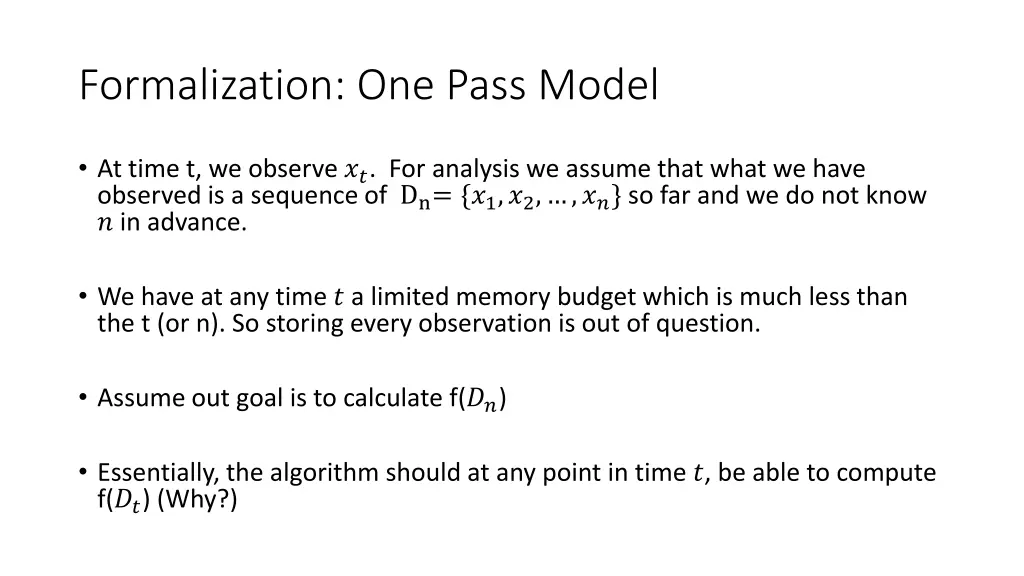
Formalization: One Pass Model At time t, we observe ??. For analysis we assume that what we have observed is a sequence of Dn= {?1,?2, ,??} so far and we do not know ? in advance. We have at any time ? a limited memory budget which is much less than the t (or n). So storing every observation is out of question. Assume out goal is to calculate f(??) Essentially, the algorithm should at any point in time ?, be able to compute f(??) (Why?)
Basic Question: Sampling If we get a representative sample of stream then we can do analysis on it. Example: Find trending tweets from a large enough random sample of streams. How to do sampling on a stream?
Sampling a Fraction Sample a random sample of say 1/10 the total size? How? Generate a random number between [1-10] and if that number is 1, then use the sample. Issues? Size is unknown, so this can go unbounded. How about sampling bias?
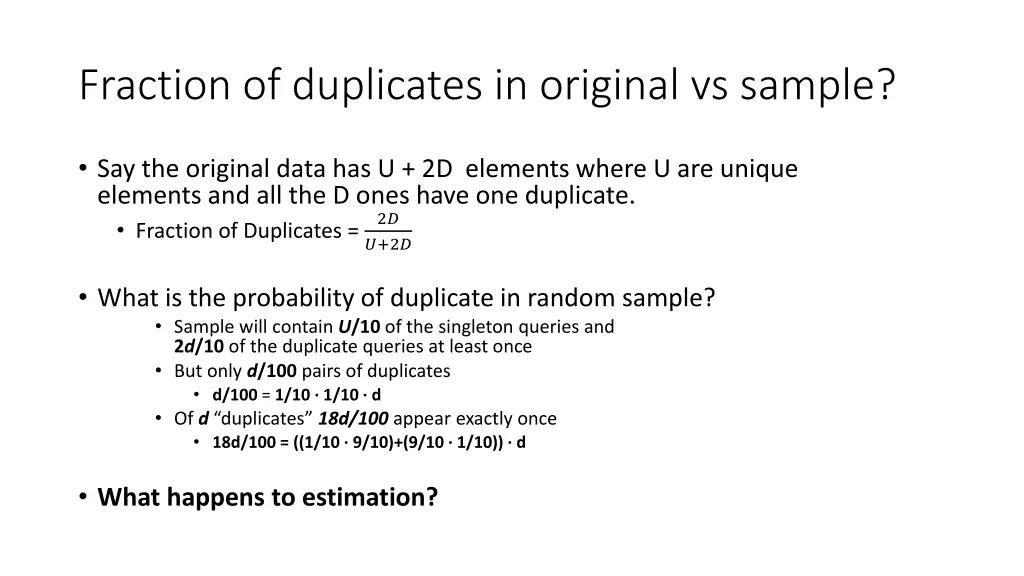
Fraction of duplicates in original vs sample? Say the original data has U + 2D elements where U are unique elements and all the D ones have one duplicate. Fraction of Duplicates = ?+2? 2? What is the probability of duplicate in random sample? Sample will contain U/10 of the singleton queries and 2d/10 of the duplicate queries at least once But only d/100 pairs of duplicates d/100 = 1/10 1/10 d Of d duplicates 18d/100 appear exactly once 18d/100 = ((1/10 9/10)+(9/10 1/10)) d What happens to estimation?
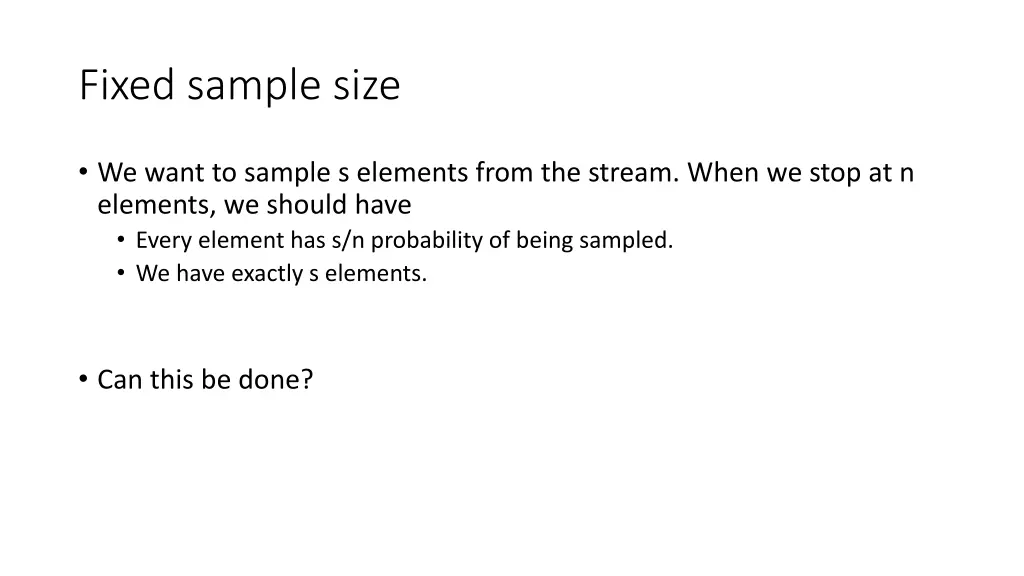
Fixed sample size We want to sample s elements from the stream. When we stop at n elements, we should have Every element has s/n probability of being sampled. We have exactly s elements. Can this be done?
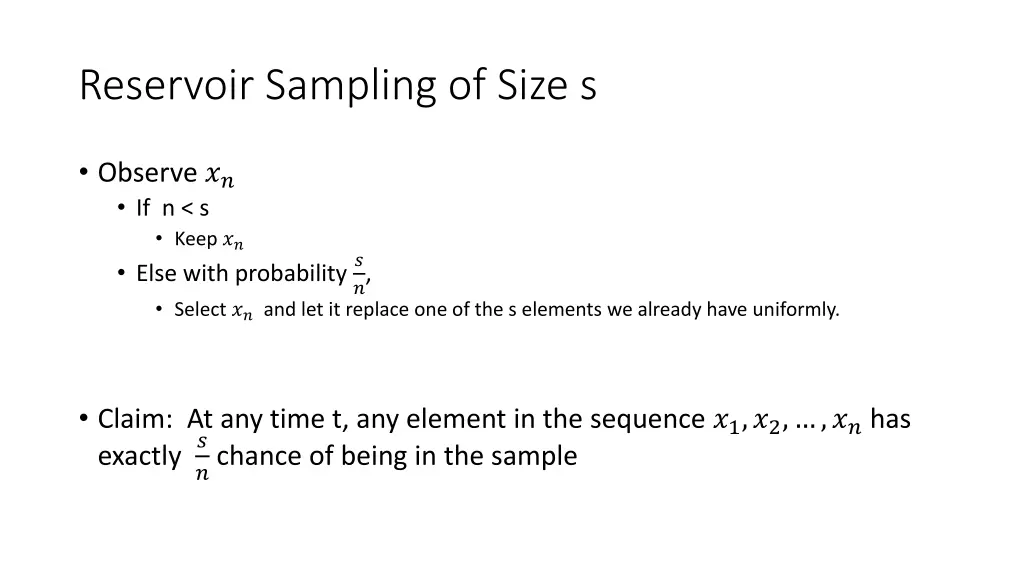
Reservoir Sampling of Size s Observe ?? If n < s Keep ?? Else with probability ? Select ?? and let it replace one of the s elements we already have uniformly. ?, Claim: At any time t, any element in the sequence ?1,?2, ,??has exactly ? ? chance of being in the sample
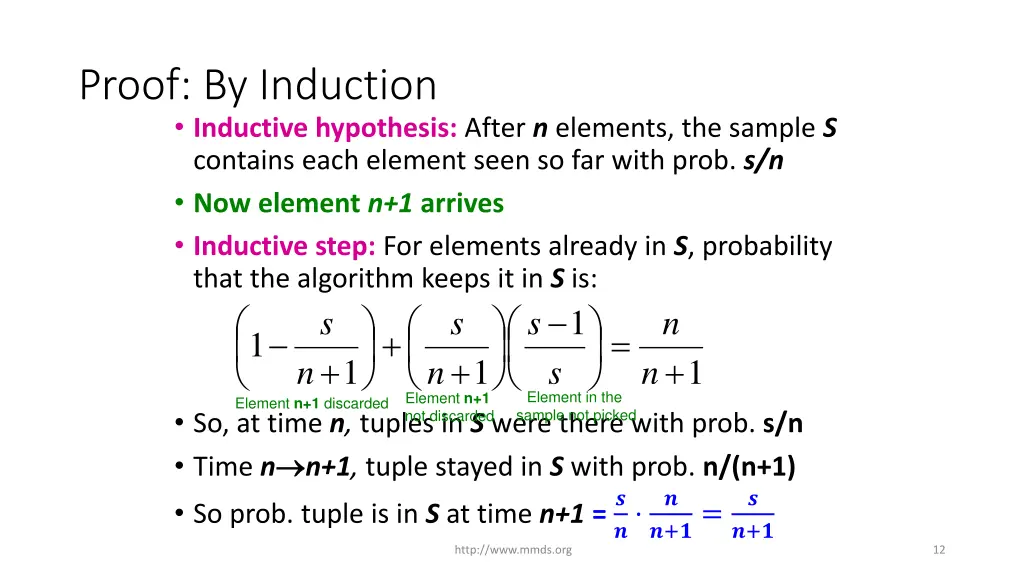
Proof: By Induction Inductive hypothesis: After n elements, the sample S contains each element seen so far with prob. s/n Now element n+1 arrives Inductive step: For elements already in S, probability that the algorithm keeps it in S is: + + n n Element n+1 discarded not discarded Element in the sample not picked 1 s s s n + = Element n+1 1 + 1 1 1 s n So, at time n, tuples in S were there with prob. s/n Time n n+1, tuple stayed in S with prob. n/(n+1) So prob. tuple is in S at time n+1= ? ? ? ? ?+?= ?+? http://www.mmds.org 12
Weighted Reservoir sampling Every element ?? has weight ?? We want to sample s elements from the stream. When we stop at n elements, we should have Every element ?? in the sample has We have exactly s elements. ?? ???probability of being sampled.
Attempt 1 Assume there are ?? copies of ?? anytime you observe ?? Make sure ??? is big enough integer and every ?? is an integer. Issues?
Solution: (Pavlos S Efraimidis and Paul G Spirakis in 2006) Observe ?? Generate ?? uniformly in [0-1] 1 ?? Set ?????? = ?? Report s elements with top-s values of ?????? Question: Can this be done on a stream?
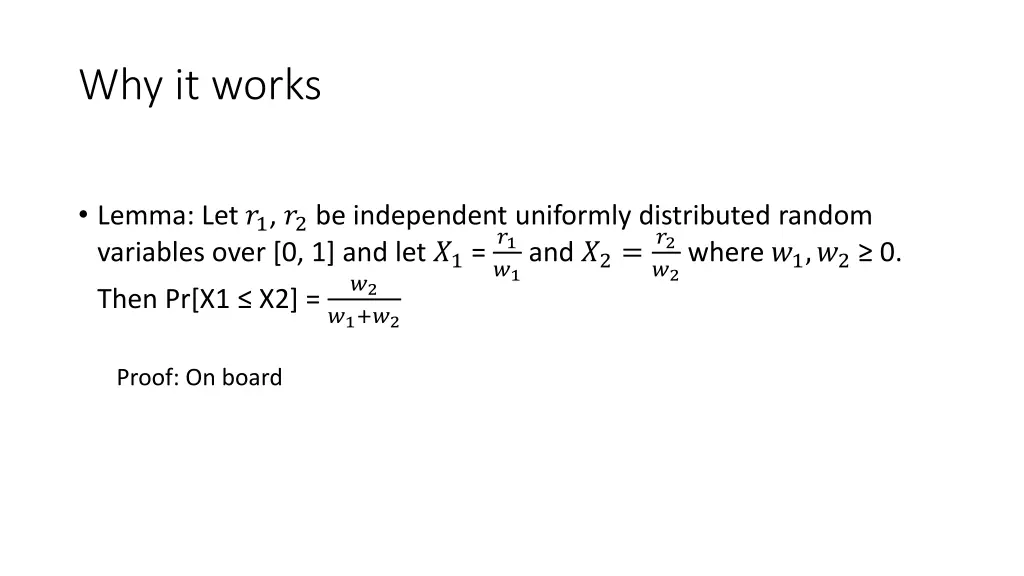
Why it works Lemma: Let ?1, ?2 be independent uniformly distributed random variables over [0, 1] and let ?1 = ?1 Then Pr[X1 X2] = ?1+?2 ?2 ?2 where ?1,?2 0. ?1 and ?2= ?2 Proof: On board