Explore the impacts of invasive species on Florida's ecosystems, addressing challenges in limiting new introductions and managing established species. Learn about the risks to biodiversity, ecosystem services, and vulnerabilities such as climate change and trade. Discover the importance of foresight in preventing further harm from invasive species in Florida.
Please find below an Image/Link to download the presentation.
The content on the website is provided AS IS for your information and personal use only. It may not be sold, licensed, or shared on other websites without obtaining consent from the author. If you encounter any issues during the download, it is possible that the publisher has removed the file from their server.
You are allowed to download the files provided on this website for personal or commercial use, subject to the condition that they are used lawfully. All files are the property of their respective owners.
The content on the website is provided AS IS for your information and personal use only. It may not be sold, licensed, or shared on other websites without obtaining consent from the author.
E N D
Presentation Transcript
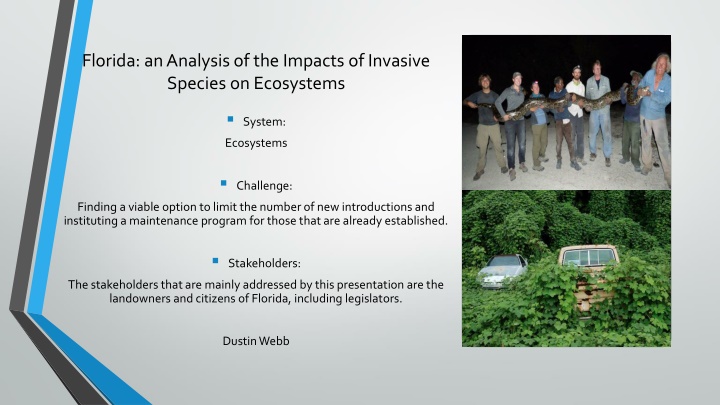
Florida: an Analysis of the Impacts of Invasive Species on Ecosystems System: Ecosystems Challenge: Finding a viable option to limit the number of new introductions and instituting a maintenance program for those that are already established. Stakeholders: The stakeholders that are mainly addressed by this presentation are the landowners and citizens of Florida, including legislators. Dustin Webb
Details Essential to Understanding What Makes for a successful invasive species? High fecundity Large dispersal Adaptability An absence of predators, competition, and other biotic controls. Ranging environmental preferences. It is important to note that: Not all nonnative species are considered invasive. Invasive species are nonnatives that cause ecological, economic, or human harm (Dodds et al., 2014). Established invasive species are those that have reproduced for five or more years (Hardin, 2007). While it may be less of a challenge to identify traits of a successful invasive species, it is rather difficult to identify which will succeed. Rule of 10 s: 10 percent of nonnative species become established and 10 percent of those species become invasive (Hardin, 2007). Can be purposeful or accidental.
Biodiversity Loss: biodiversity loss. Biodiversity is essential to the well-being of ecosystems and humanity (Chapin et al., 2000). Loss of ecosystem services Second only to habitat destruction, invasive species are a major factor in human function (Chapin et al.,2000) Biodiversity allows for free services that are invaluable to ecological and Some of these services include: - Food Hazards - Pharmaceuticals - Environmental stability - Soil production and nutrient storage - Pollination Introduction of nonnative pathogens Agricultural losses Estimated agricultural loss of 179 million dollars annually (Dodds et al., 2014)
Vulnerabilities Climate: easily acclimated and established (Simberloff et al., 1997). Tourism and Trade: Florida hosts the ideal climate for species to become financial growth in Florida, which leads to a greater potential of invasive species. World globalization is the leading factor of the issue (Pimental et al., 2005). Range Expansion: Tourism and trade are among the top industries of their way across the Southern United States (Rodda et al., 2008). Climate Change: Florida could be the pathway for invasive species making Because of rising temperatures, more habitats are becoming suitable for species like that of the Burmese python (Rodda et al., 2008) Land Disturbance: Climate change is also adding to range expansion. greater when it becomes disturbed. Invasive species adapt to unfulfilled niches and become established in these ecosystems far more often than those that are intact (Lozon et al., 1997). The delicacy of an ecosystem becomes exponentially
Foresight: A lack of foresight has been evident as far back as the 1500 s with the introduction of feral pigs by European explorers and even in the early 20th century with the introduction of Kudzu (Pueraria montana). With evolving research and identification the tables can still be turned toward a better future. Scenario 1: A no action plan. In this scenario no human interference occurs and we let the system run it s course. Potentially seeing irreversible effects on biodiversity and far greater extinction rates than what are already being witnessed. This would impede on human well- being both, economically and physically. Leaving the outcomes to following generations. Scenario 2: Prevention and control. This scenario would lead to a better understanding of which species become invasive. It would be of some economic and ecologic cost, but this would give ample time to investigate realistic methods of prevention. Scenario 3: Eradication. Jumping in and eliminating the problem all together is infeasible. This would require a great deal of cooperation amongst all stakeholders and would be detrimental to the economy of Florida. There would be no time to learn about the issue, which could lead to a reoccurrence in the future.
Decision making The Florida Fish and Wildlife Conservation Commission: including the maintenance and repair of invasive species and their effects. Contains a legislative branch that consists of lobbyists, analysts, and legislative planners. Governor and legislators: Goal of the FWC is to provide regulatory plans pertaining to the conservation of Florida, usage and regulatory plans and outcomes. Provides the funding and grants authority to the FWC. The FWC is required to meet with the Governor several times a year to discuss revenue
Options Option 1: eradication of known invasive species. This option would be near to impossible because the financial stability of Florida is dependent on these two economic factors. The presence of invasive species is hard to determine and even more difficult to eliminate entirely, especially considering plant and microbe organisms. A stop of trade and tourism in an attempt to get this problem under control and Option 2: around prevention rather than elimination. Prevention is far less costly than the latter and is an easier attained goal. An educated population would be ideal with this option as to further the efforts. A scientific focus on prevention would lead to better understanding and could contribute to efforts of other states and countries that are struggling with the same problem. A better understanding could eliminate future occurrences. A more established control and management plan. This option would be centered
My recommendation for this issue is to continue the management track that has already been implemented by the FWC. I feel that the public needs to have a better grasp of the issue, which would lead to more involvement. The option of doing nothing is infeasible. A combination of eradication and control is the ideal scenario at this point. This could give ample time for more extensive research and provide a potentially better approach. A stricter set of laws for the exotic pet trade in an attempt to deter the establishment of unwanted species and a focus on prevention is key. Recommendations
References: Chapin III, S., Zavaleta, E., Eviner, V., Naylor, R., Vitousek, P., Reynolds, H., Hooper, D., Lavorel, S., Sala, O., Hobbie, S., Mack, M., Diaz, S., 2000. Consequences of changing biodiversity. Nature. Vol: 405. Pp. 234-242. DOI: 10.1038/35012241. Dodds, N., Miller, M., Lamm, A., 2014. Floridians Perceptions of Invasive Species. AEC524 Agricultural Education and Communication Department, UF/IFAS Extension. Hardin, S., 2007. Managing Non-Native Wildlife in Florida: State Perspective, Policy and Practice. Managing vertebrate invasive species: proceedings of an international symposium. Lozon, J., MacIsaac, H., 1997. Biological invasions: are they dependent on disturbance? Environmental Review. Vol: 5. Pp. 131-144. Accessed on April 4th, 2018. www.reabic.net/publ/Lozon_MacIsaac_1997.pdf. Pimental, D., Zunigo, R., Morrison, D., 2005. Update on the environmental and economic costs associated with alien-invasive species in the United States. Ecological Economics. Vol: 52. Pp: 273-288. https://doi.org/10.1016/j.ecolecon.2004.10.002. Rodda, G., Jarnevich, C., Reed, R., 2008. What Parts of the U.S. Mainland Are Climatically Suitable for Invasive Alien Pythons Spreading from Everglades National Park? Biological Invasions. http://dx.doi.org/10.1007/s10530-008-9228-z.