Hyperdimensional Computing for EEG Error-Related Potentials
This study explores Hyperdimensional Computing for noninvasive Brain-Computer Interfaces, specifically focusing on blind and one-shot classification of EEG Error-Related Potentials. The research delves into the architecture, basics, and experimental results of applying Hyperdimensional Computing to understand brain signals, aiming for faster learning and efficient operation with raw EEG data.

Download Presentation

Please find below an Image/Link to download the presentation.
The content on the website is provided AS IS for your information and personal use only. It may not be sold, licensed, or shared on other websites without obtaining consent from the author.If you encounter any issues during the download, it is possible that the publisher has removed the file from their server.
You are allowed to download the files provided on this website for personal or commercial use, subject to the condition that they are used lawfully. All files are the property of their respective owners.
The content on the website is provided AS IS for your information and personal use only. It may not be sold, licensed, or shared on other websites without obtaining consent from the author.
E N D
Presentation Transcript
Hyperdimensional Computing for Noninvasive Brain Computer Interfaces: Blind and One-Shot Classification of EEG Error-Related Potentials Abbas Rahimi, Pentti Kanerva, Jos del R. Mill n, Jan M. Rabaey EECS Department, UC Berkeley IBI-STI, EPFL
Outline Architecture for Brain-Computer Interface (BCI) Electroencephalogram (EEG) error-related potentials Hyperdimensional Computing Basics Mapping to hypervectors and arithmetic Hyperdimensional computing examples Mapping EEG Electrodes to Hypervectors Temporal-Spatial Hyperdimensional Encoder Experimental Results Summary
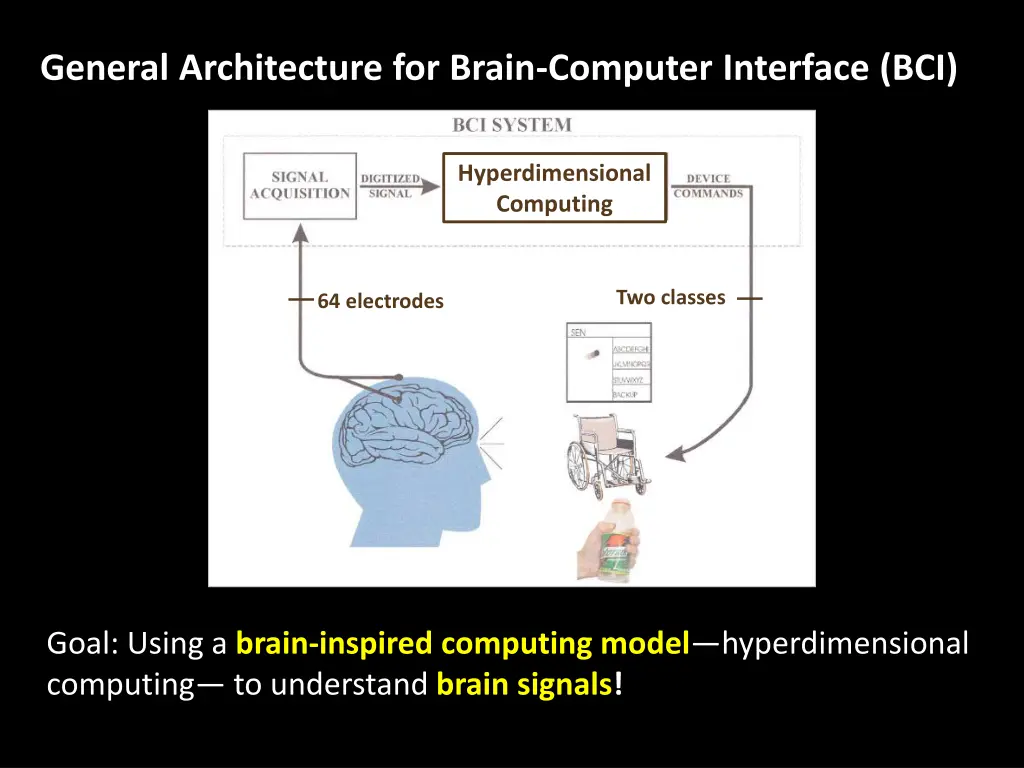
General Architecture for Brain-Computer Interface (BCI) Hyperdimensional Computing Two classes 64 electrodes Goal: Using a brain-inspired computing model hyperdimensional computing to understand brain signals!
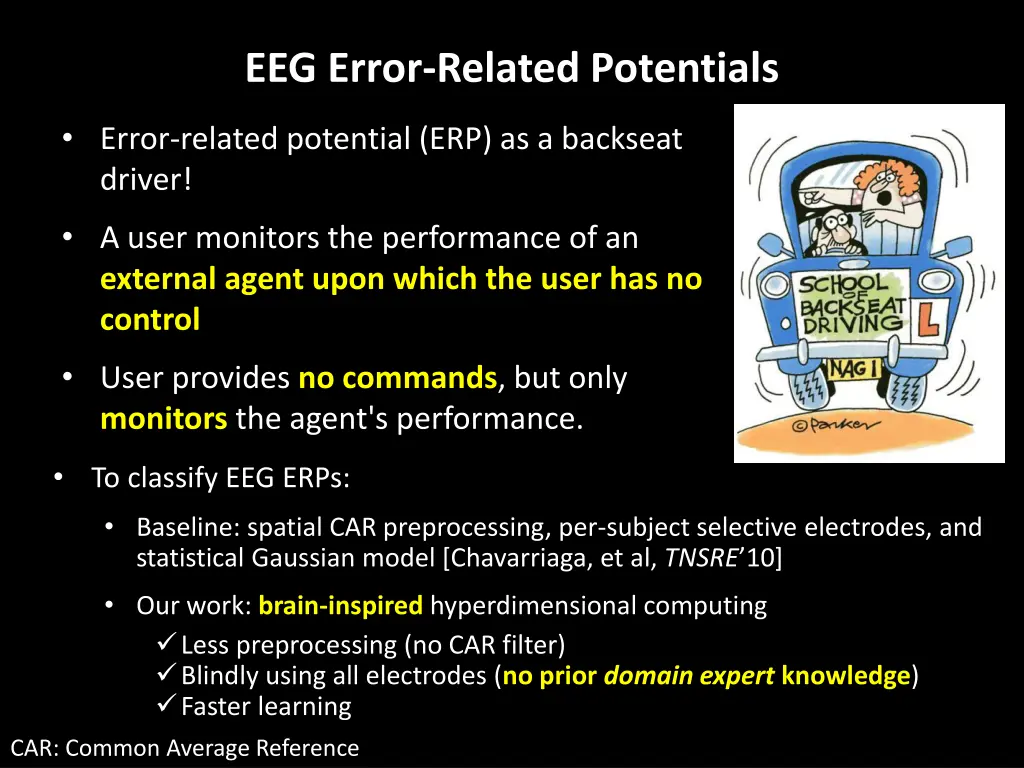
EEG Error-Related Potentials Error-related potential (ERP) as a backseat driver! A user monitors the performance of an external agent upon which the user has no control User provides no commands, but only monitors the agent's performance. To classify EEG ERPs: Baseline: spatial CAR preprocessing, per-subject selective electrodes, and statistical Gaussian model [Chavarriaga, et al, TNSRE 10] Our work: brain-inspired hyperdimensional computing Less preprocessing (no CAR filter) Blindly using all electrodes (no prior domain expert knowledge) Faster learning CAR: Common Average Reference
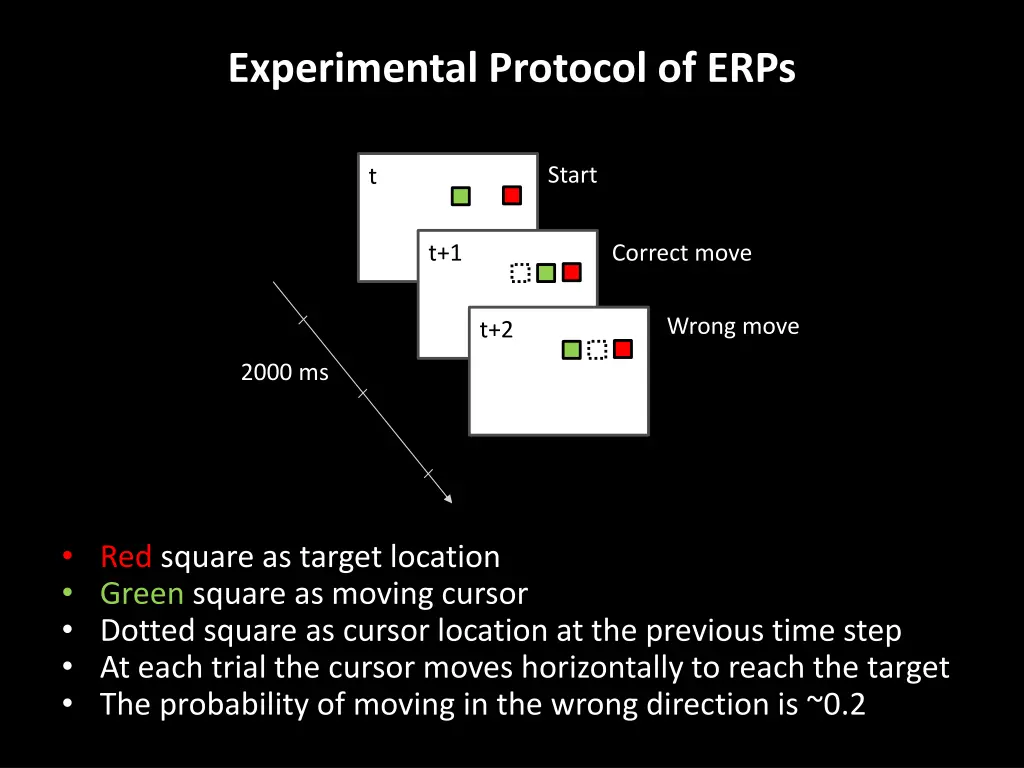
Experimental Protocol of ERPs Start t Correct move t+1 Wrong move t+2 2000 ms Red square as target location Green square as moving cursor Dotted square as cursor location at the previous time step At each trial the cursor moves horizontally to reach the target The probability of moving in the wrong direction is ~0.2
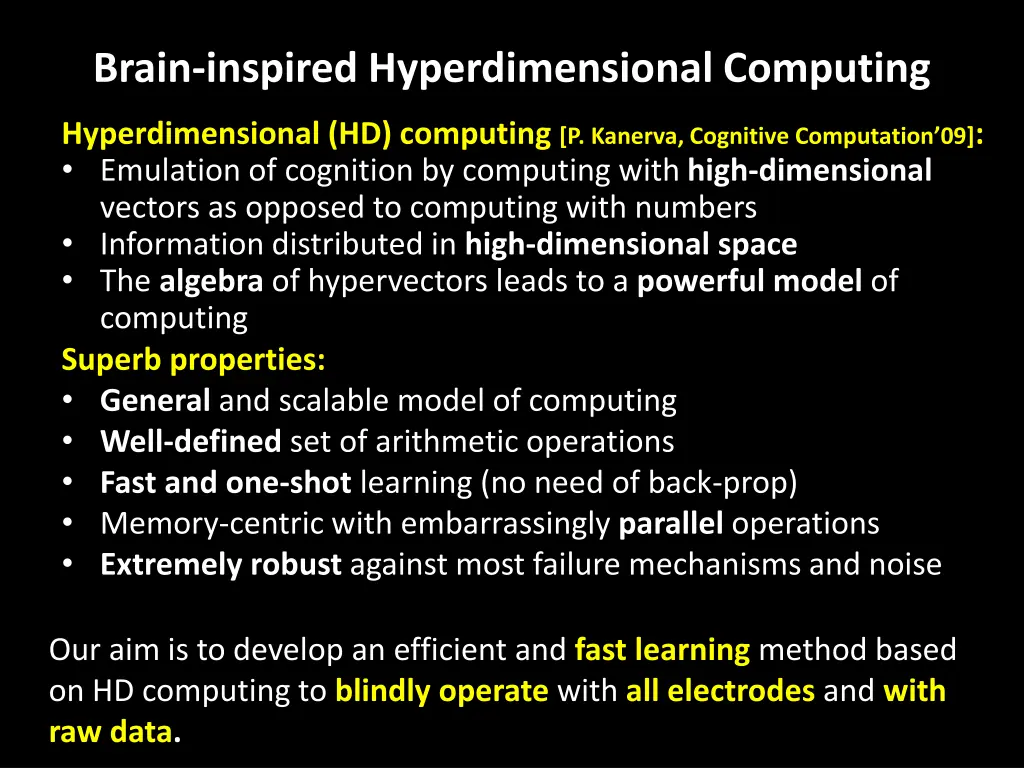
Brain-inspired Hyperdimensional Computing Hyperdimensional (HD) computing [P. Kanerva, Cognitive Computation 09]: Emulation of cognition by computing with high-dimensional vectors as opposed to computing with numbers Information distributed in high-dimensional space The algebra of hypervectors leads to a powerful model of computing Superb properties: General and scalable model of computing Well-defined set of arithmetic operations Fast and one-shot learning (no need of back-prop) Memory-centric with embarrassingly parallel operations Extremely robust against most failure mechanisms and noise Our aim is to develop an efficient and fast learning method based on HD computing to blindly operate with all electrodes and with raw data.
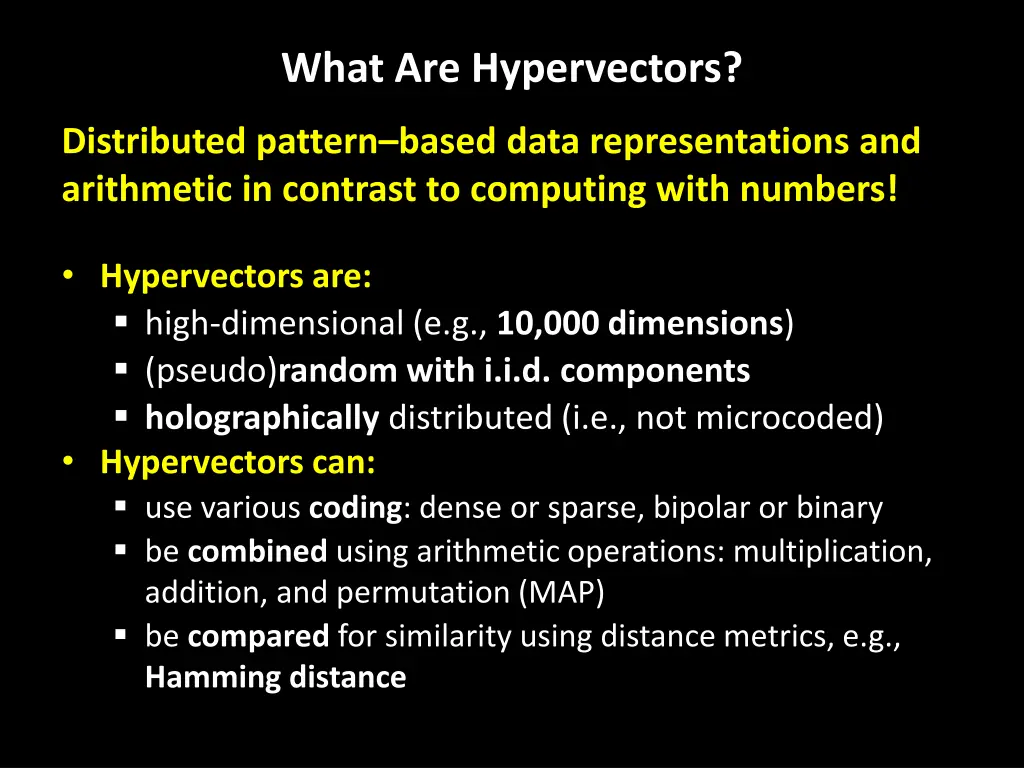
What Are Hypervectors? Distributed pattern based data representations and arithmetic in contrast to computing with numbers! Hypervectors are: high-dimensional (e.g., 10,000 dimensions) (pseudo)random with i.i.d. components holographically distributed (i.e., not microcoded) Hypervectors can: use various coding: dense or sparse, bipolar or binary be combined using arithmetic operations: multiplication, addition, and permutation (MAP) be compared for similarity using distance metrics, e.g., Hamming distance
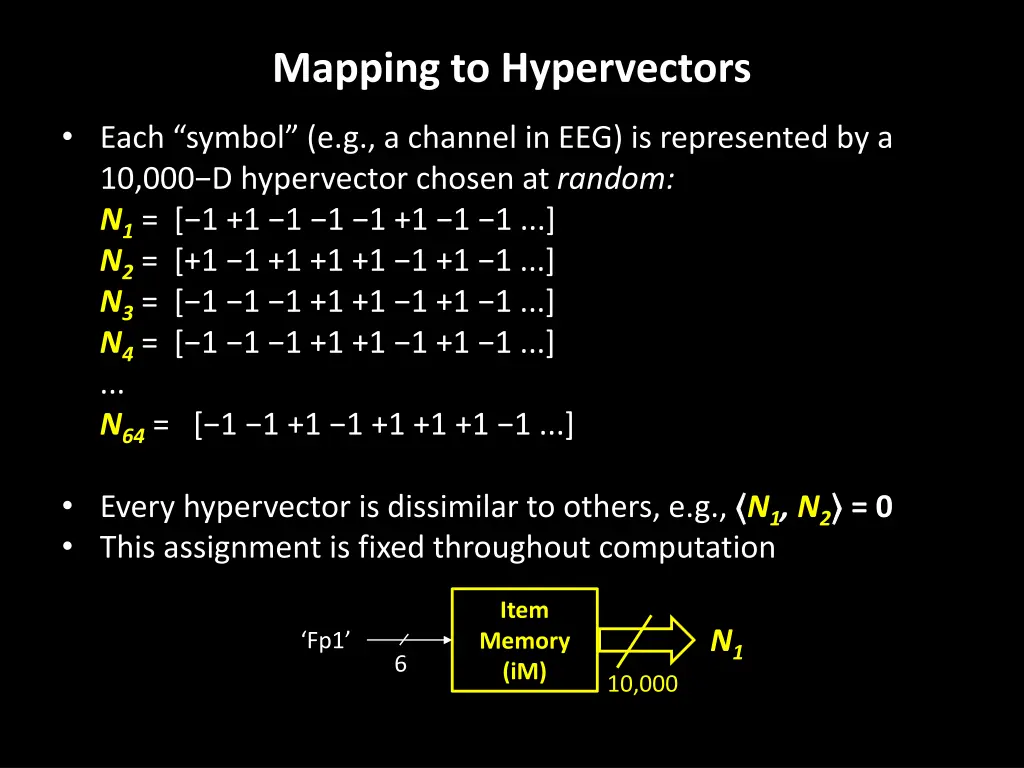
Mapping to Hypervectors Each symbol (e.g., a channel in EEG) is represented by a 10,000 D hypervector chosen at random: N1= [ 1 +1 1 1 1 +1 1 1 ...] N2= [+1 1 +1 +1 +1 1 +1 1 ...] N3= [ 1 1 1 +1 +1 1 +1 1 ...] N4= [ 1 1 1 +1 +1 1 +1 1 ...] ... N64= [ 1 1 +1 1 +1 +1 +1 1 ...] Every hypervector is dissimilar to others, e.g., N1, N2 = 0 This assignment is fixed throughout computation Item Memory (iM) N1 Fp1 6 10,000
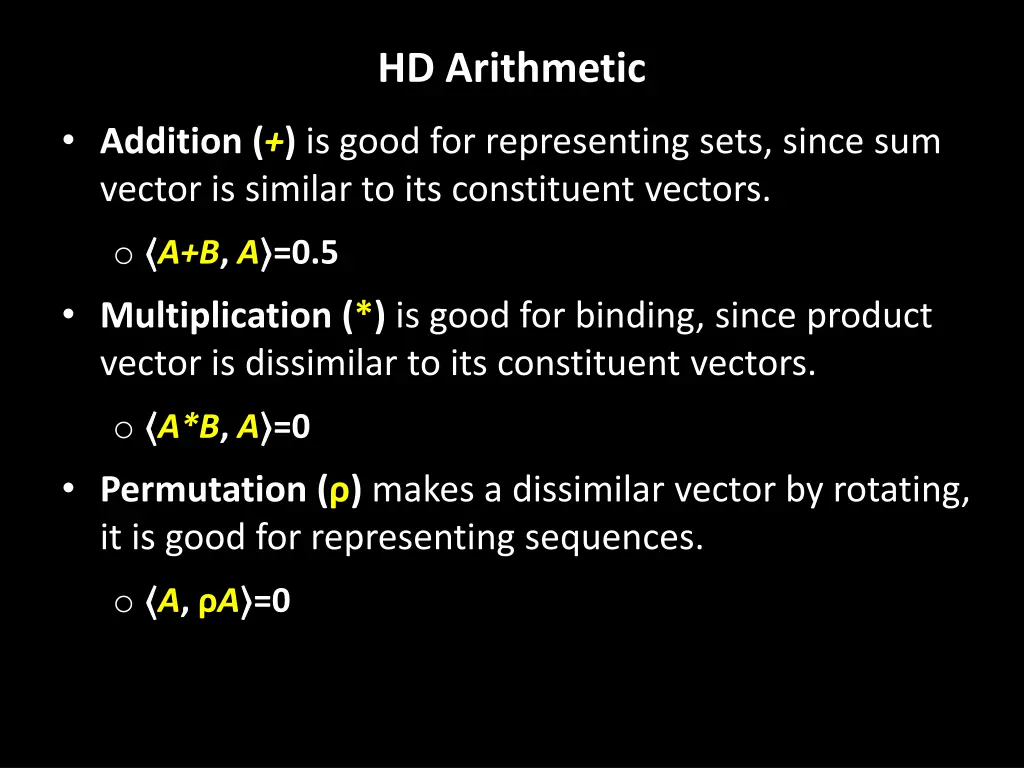
HD Arithmetic Addition (+) is good for representing sets, since sum vector is similar to its constituent vectors. o A+B, A =0.5 Multiplication (*) is good for binding, since product vector is dissimilar to its constituent vectors. o A*B, A =0 Permutation ( ) makes a dissimilar vector by rotating, it is good for representing sequences. o A, A =0
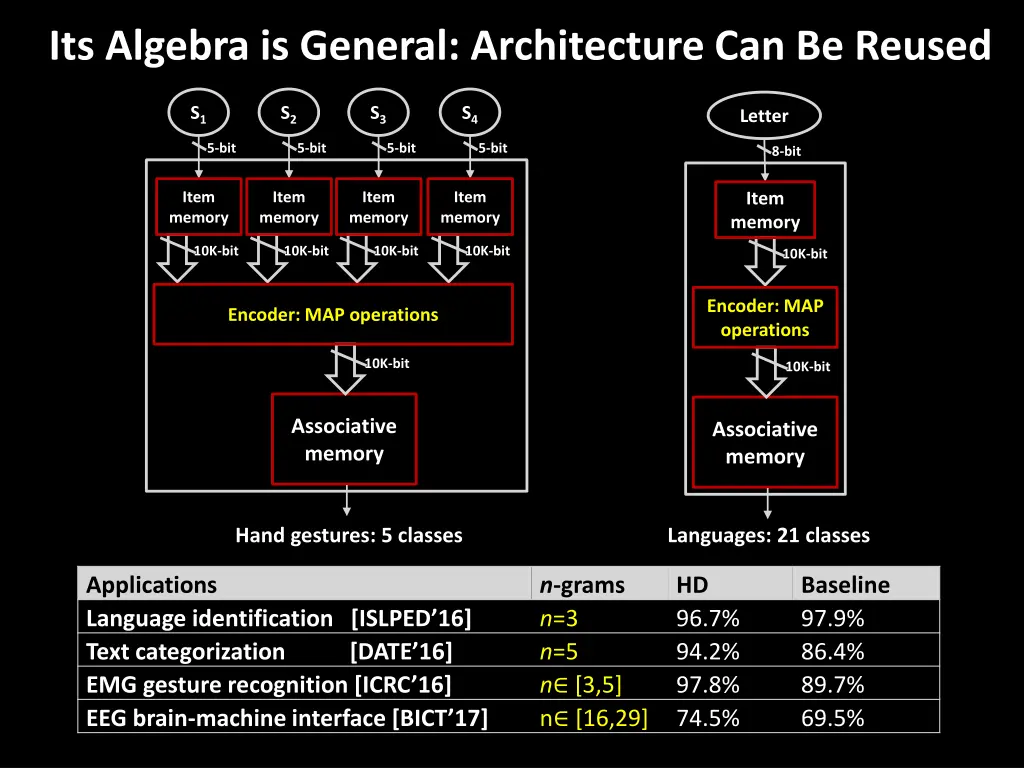
Its Algebra is General: Architecture Can Be Reused S1 S2 S3 S4 Letter 5-bit 5-bit 5-bit 5-bit 8-bit Item memory Item memory Item memory Item memory Item memory 10K-bit 10K-bit 10K-bit 10K-bit 10K-bit Encoder: MAP operations Encoder: MAP operations 10K-bit 10K-bit Associative memory Associative memory Hand gestures: 5 classes Languages: 21 classes Applications Language identification [ISLPED 16] Text categorization [DATE 16] EMG gesture recognition [ICRC 16] EEG brain-machine interface [BICT 17] n-grams n=3 n=5 n [3,5] n [16,29] HD 96.7% 94.2% 97.8% 74.5% Baseline 97.9% 86.4% 89.7% 69.5%
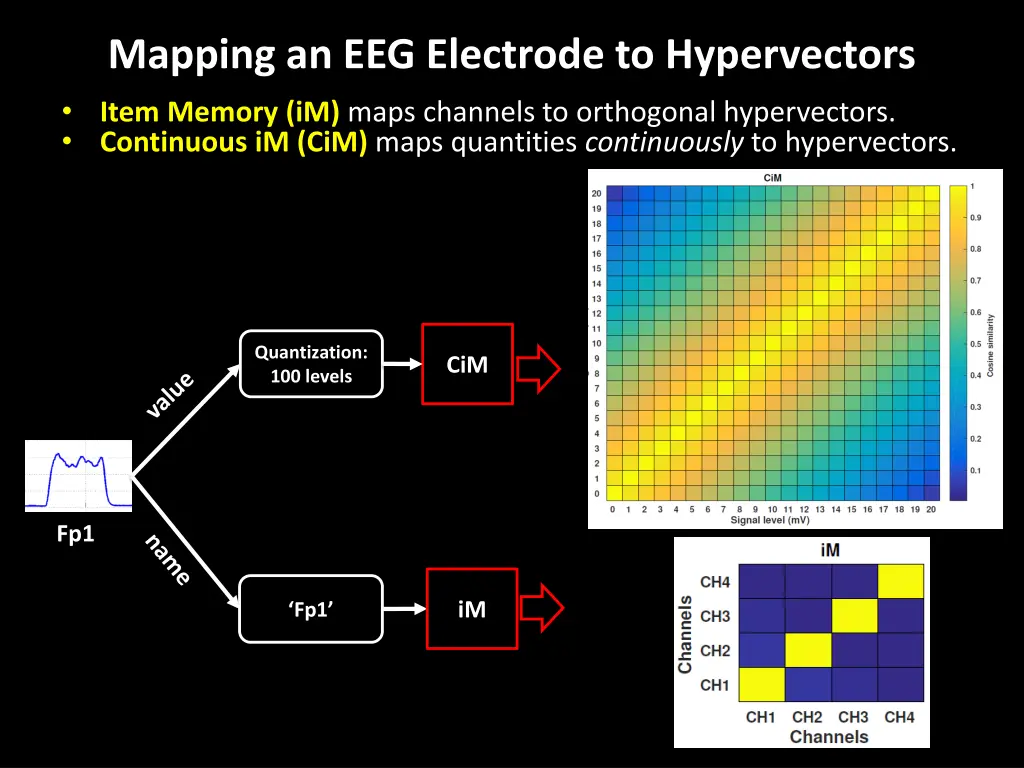
Mapping an EEG Electrode to Hypervectors Item Memory (iM) maps channels to orthogonal hypervectors. Continuous iM (CiM) maps quantities continuously to hypervectors. Quantization: 100 levels CiM Fp1 iM Fp1
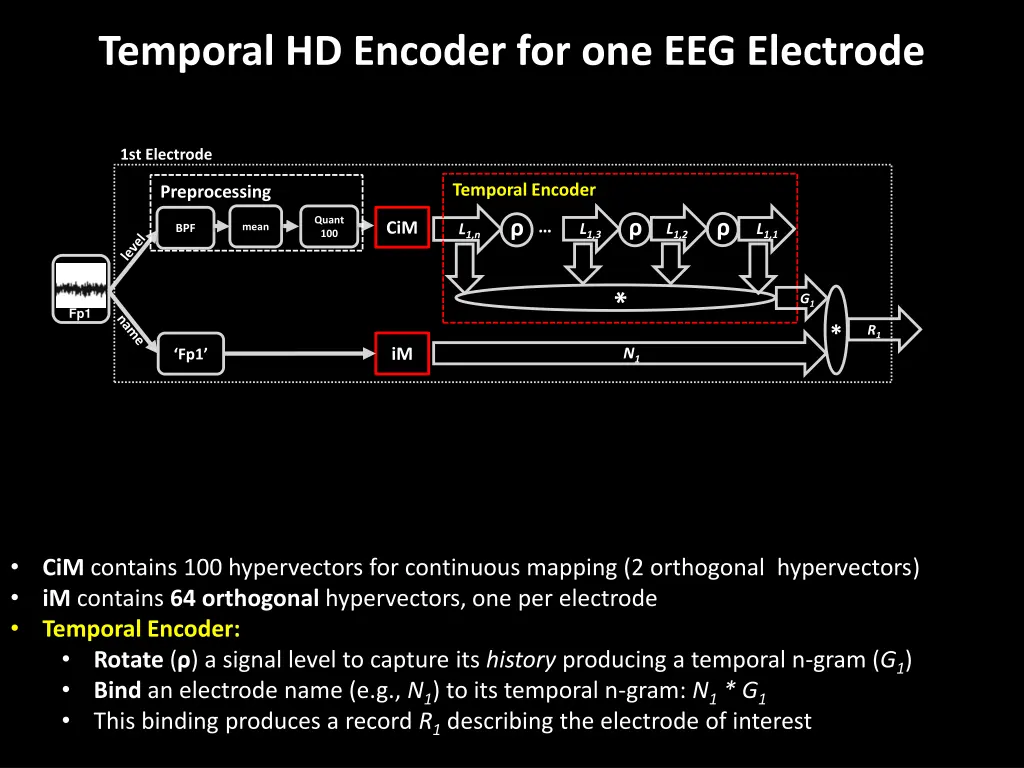
Temporal HD Encoder for one EEG Electrode 1st Electrode Temporal Encoder Preprocessing Quant 100 CiM L1,2 L1,3 L1,1 L1,n mean BPF * G1 Fp1 * R1 iM N1 Fp1 CiM contains 100 hypervectors for continuous mapping (2 orthogonal hypervectors) iM contains 64orthogonal hypervectors, one per electrode Temporal Encoder: Rotate ( ) a signal level to capture its history producing a temporal n-gram (G1) Bind an electrode name (e.g., N1) to its temporal n-gram: N1 * G1 This binding produces a record R1 describing the electrode of interest
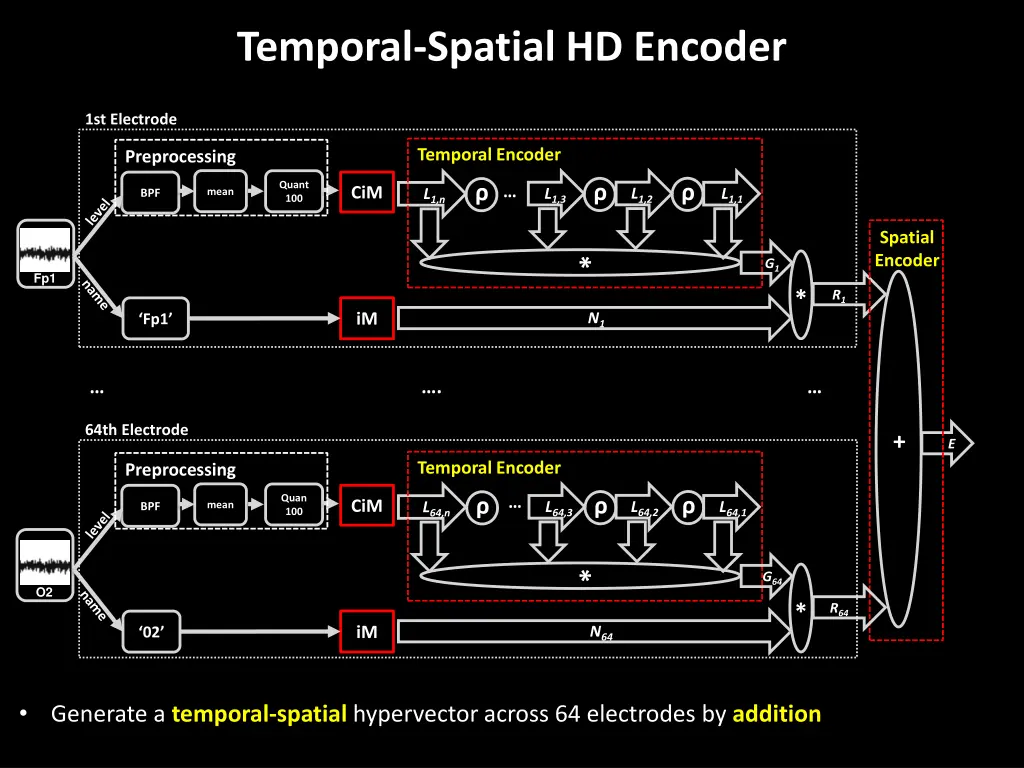
Temporal-Spatial HD Encoder 1st Electrode Temporal Encoder Preprocessing Quant 100 CiM L1,2 L1,3 L1,1 L1,n mean BPF Spatial Encoder * G1 Fp1 * R1 iM N1 Fp1 . 64th Electrode + E Temporal Encoder Preprocessing Quan 100 CiM L64,2 L64,3 L64,1 L64,n mean BPF * G64 O2 * R64 iM N64 02 Generate a temporal-spatial hypervector across 64 electrodes by addition
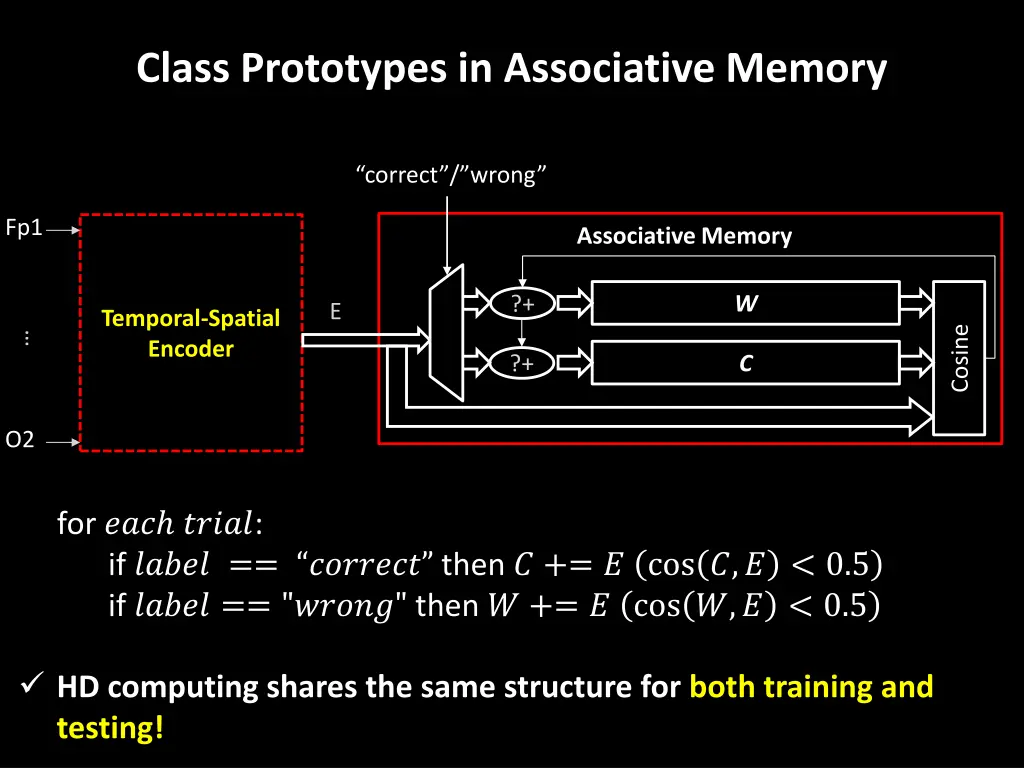
Class Prototypes in Associative Memory correct / wrong Fp1 Associative Memory W ?+ E Temporal-Spatial Encoder Cosine C ?+ O2 for ??? ?????: if ????? == ??????? then ? += ? cos ?,? < 0.5 if ????? == "?????" then ? += ? cos ?,? < 0.5 HD computing shares the same structure for both training and testing!
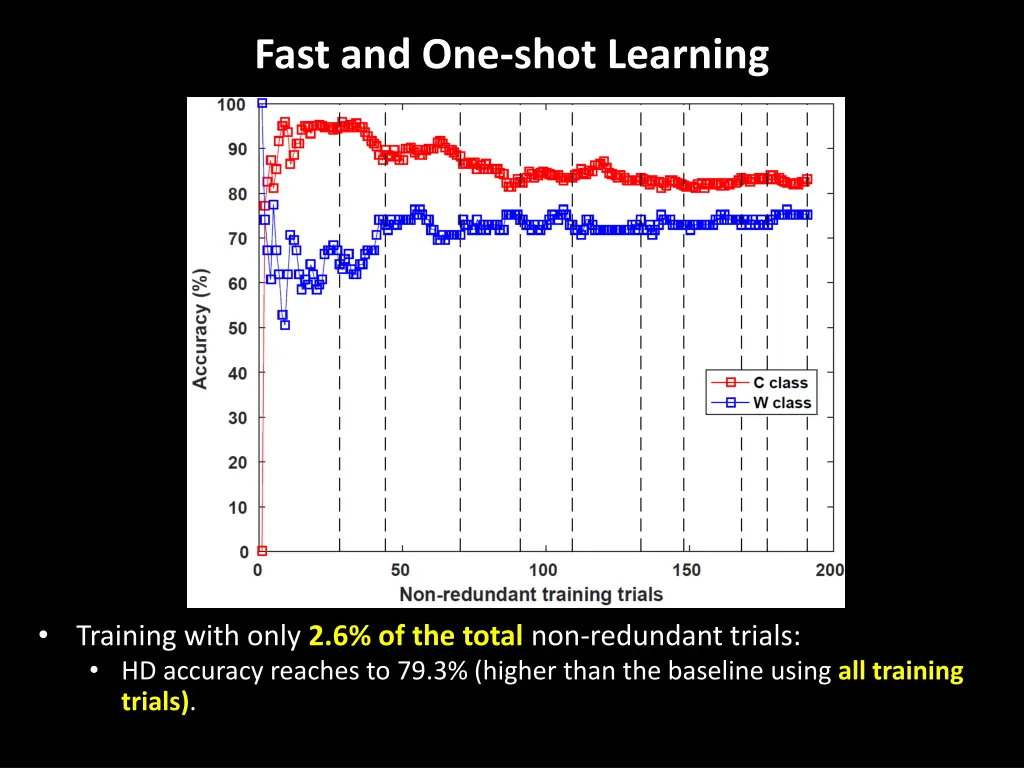
Fast and One-shot Learning Training with only 2.6% of the total non-redundant trials: HD accuracy reaches to 79.3% (higher than the baseline using all training trials).
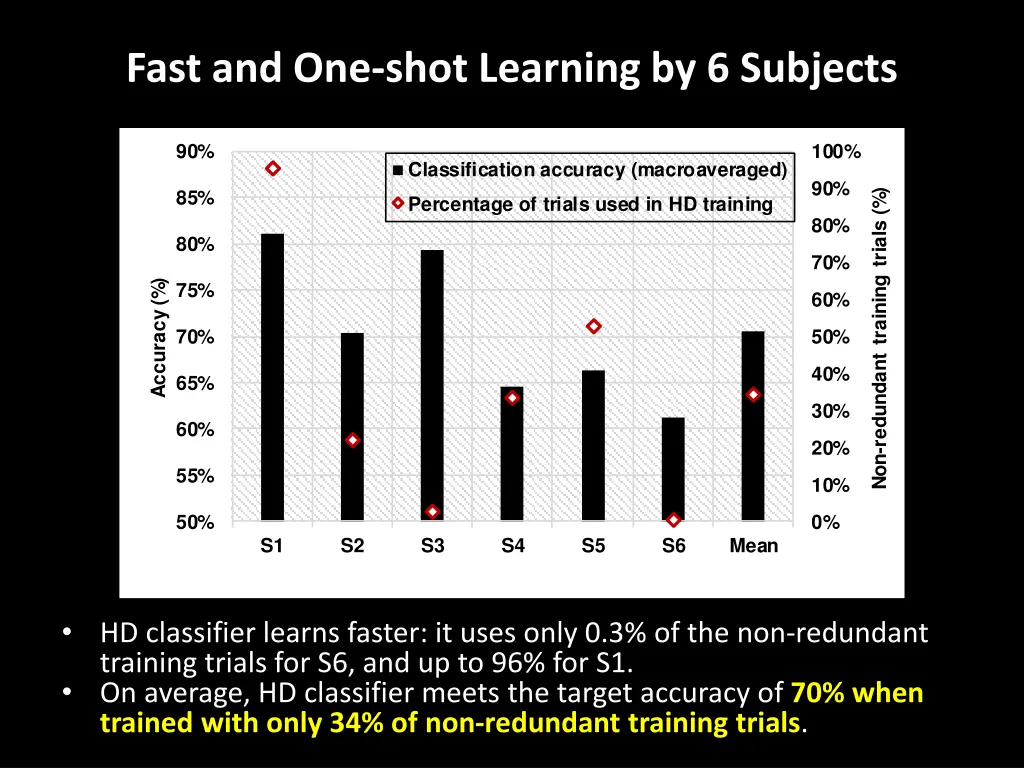
Fast and One-shot Learning by 6 Subjects 90% 100% Classification accuracy (macroaveraged) 90% 85% Non-redundant training trials (%) Percentage of trials used in HD training 80% 80% 70% Accuracy (%) 75% 60% 70% 50% 40% 65% 30% 60% 20% 55% 10% 50% 0% S1 S2 S3 S4 S5 S6 Mean HD classifier learns faster: it uses only 0.3% of the non-redundant training trials for S6, and up to 96% for S1. On average, HD classifier meets the target accuracy of 70% when trained with only 34% of non-redundant training trials.
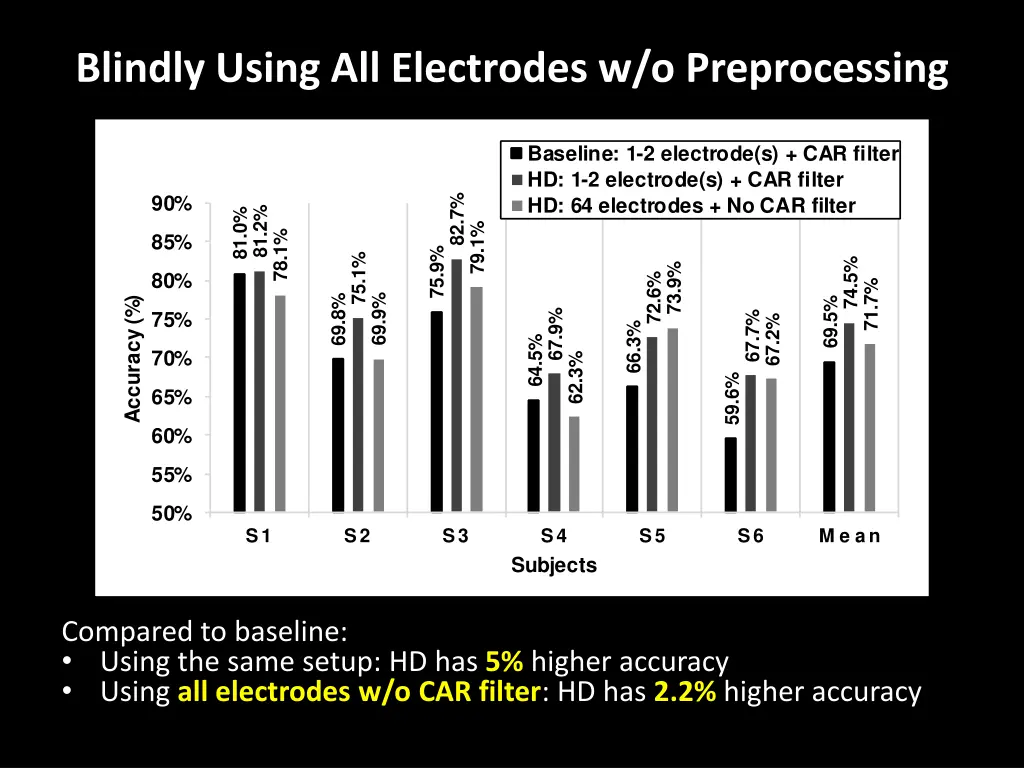
Blindly Using All Electrodes w/o Preprocessing Baseline: 1-2 electrode(s) + CAR filter HD: 1-2 electrode(s) + CAR filter HD: 64 electrodes + No CAR filter 90% 82.7% 81.2% 81.0% 79.1% 78.1% 85% 75.9% 75.1% 74.5% 73.9% 80% 72.6% 71.7% 69.9% 69.8% Accuracy (%) 69.5% 75% 67.9% 67.7% 67.2% 66.3% 64.5% 70% 62.3% 59.6% 65% 60% 55% 50% S1 S2 S3 S4 S5 S6 M e an Subjects Compared to baseline: Using the same setup: HD has 5% higher accuracy Using all electrodes w/o CAR filter: HD has 2.2% higher accuracy
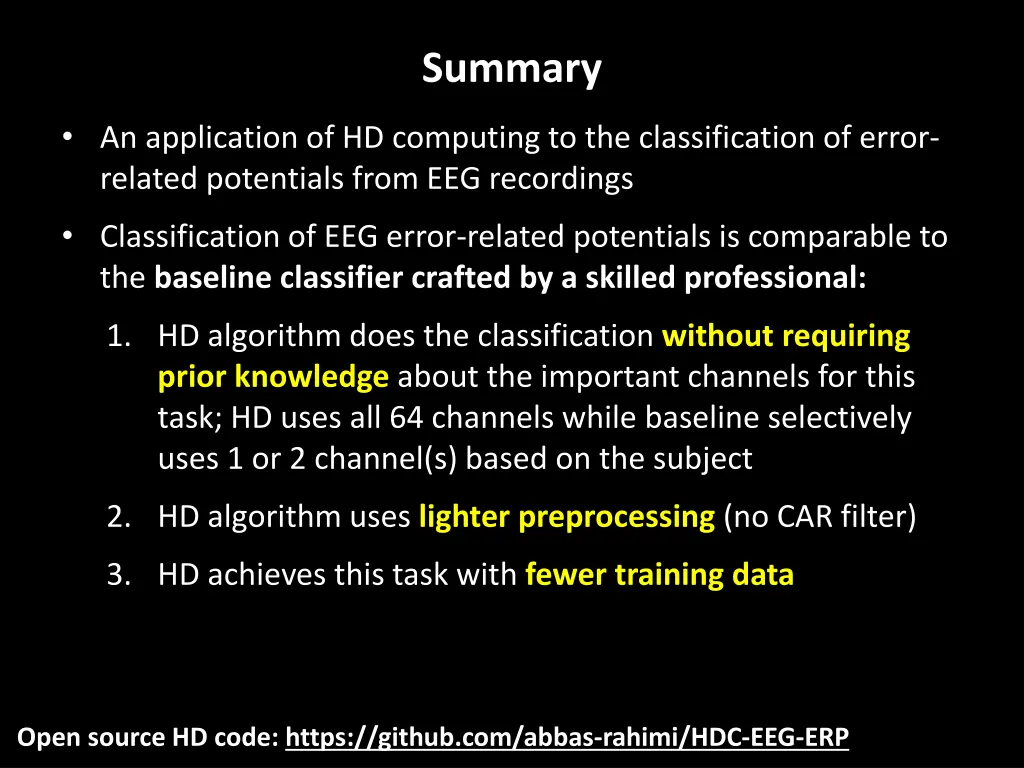
Summary An application of HD computing to the classification of error- related potentials from EEG recordings Classification of EEG error-related potentials is comparable to the baseline classifier crafted by a skilled professional: 1. HD algorithm does the classification without requiring prior knowledge about the important channels for this task; HD uses all 64 channels while baseline selectively uses 1 or 2 channel(s) based on the subject 2. HD algorithm uses lighter preprocessing (no CAR filter) 3. HD achieves this task with fewer training data Open source HD code: https://github.com/abbas-rahimi/HDC-EEG-ERP
Acknowledgment This work was supported in part by Systems on Nanoscale Information fabriCs (SONIC), one of the six SRC STARnet Centers, sponsored by MARCO and DARPA Intel Strategic Research Alliance (ISRA) program on Neuromorphic Architectures for Mainstream Computing