Explore the coupling of UrQMD 3.4 and SMM models for simulating neutron and nuclear fragment productions in nucleus-nucleus interactions. Discover the main assumptions, experimental data analysis, neutron production studies, and more in this comprehensive scientific research.
Please find below an Image/Link to download the presentation.
The content on the website is provided AS IS for your information and personal use only. It may not be sold, licensed, or shared on other websites without obtaining consent from the author. If you encounter any issues during the download, it is possible that the publisher has removed the file from their server.
You are allowed to download the files provided on this website for personal or commercial use, subject to the condition that they are used lawfully. All files are the property of their respective owners.
The content on the website is provided AS IS for your information and personal use only. It may not be sold, licensed, or shared on other websites without obtaining consent from the author.
E N D
Presentation Transcript
Coupling of UrQMD 3.4 and SMM Coupling of UrQMD 3.4 and SMM models for simulation of neutron and models for simulation of neutron and nuclear fragment productions in nuclear fragment productions in nucleus nucleus- -nucleus interactions nucleus interactions A. Galoyan1,T.Q.T. Le2, V. Uzhinsky1 1. Joint Institute for Nuclear Research, Dubna, Russia 2. Institute of Research and Development, Duy Tan University, Da Nang, 550000, Vietnam 1
Content 1. Main assumptions of Ultralelativistic Quantum Molecular Dynamic model (UrQMD). 2. Description of experimental data of the NA61/SHINE collaboration on , K , proton, antiproton production in Ar+Sc interactions at 13, 19, 30, 40, 75, 150 GeV/c/N using UrQMD version 3.4. 3. Study of neutron production in p + A interactions in the frame of UrQMD model version 3.4. 4. Coupling of UrQMD 3.4 model with Statistical Multifragmentation model (SMM) by A. Botvina. 5. Analysis of neutron spectra in UrQMD + SMM model for proton-nucleus and nucleus nucleus interactions. 6. Descriptions of fragment productions in nucleus-nucleus interactions by UrQMD+SMM model. 7. Conclusion 2
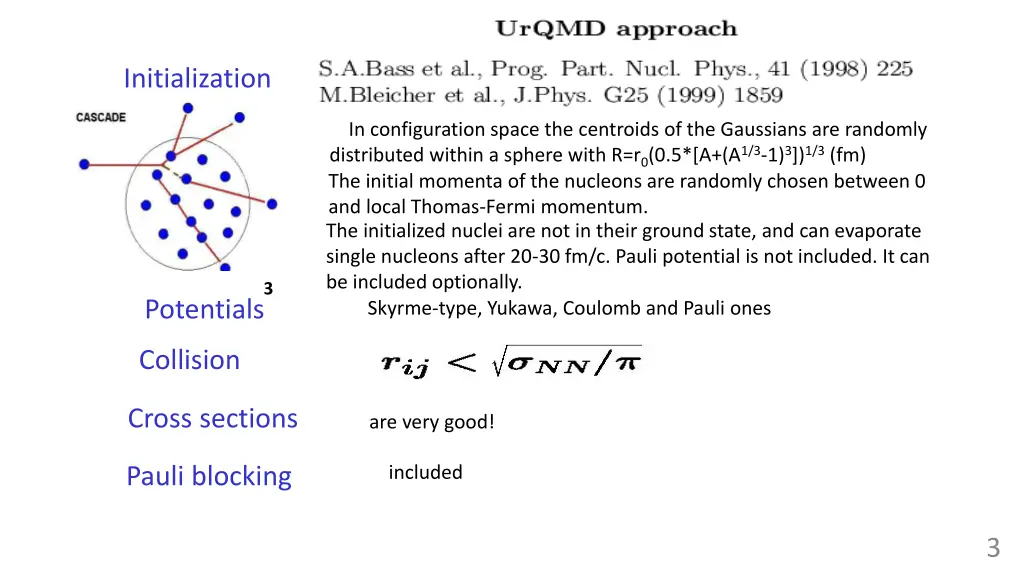
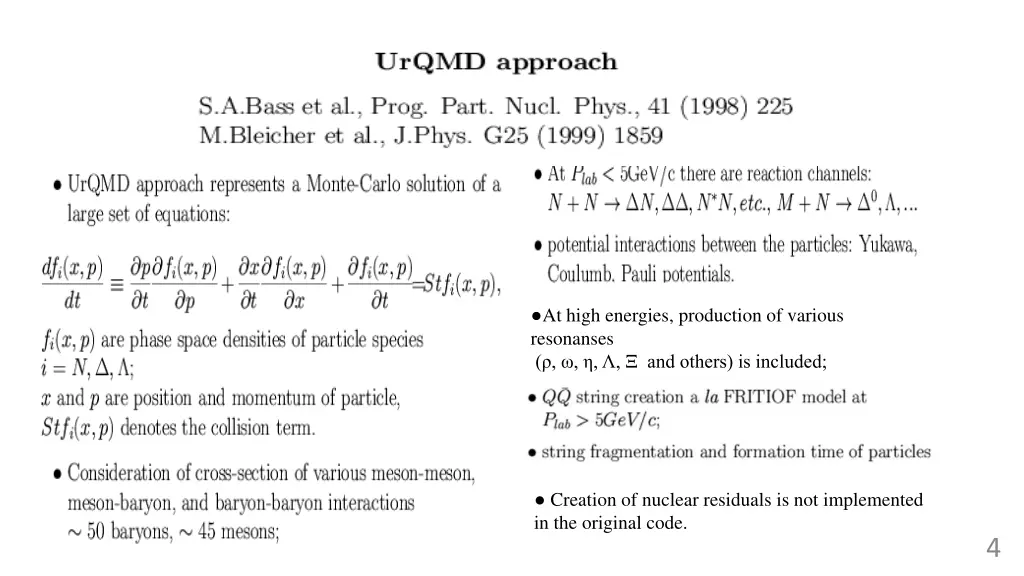
Initialization In configuration space the centroids of the Gaussians are randomly distributed within a sphere with R=r0(0.5*[A+(A1/3-1)3])1/3 (fm) The initial momenta of the nucleons are randomly chosen between 0 and local Thomas-Fermi momentum. The initialized nuclei are not in their ground state, and can evaporate single nucleons after 20-30 fm/c. Pauli potential is not included. It can be included optionally. Skyrme-type, Yukawa, Coulomb and Pauli ones 3 Potentials Collision Cross sections are very good! included Pauli blocking 3
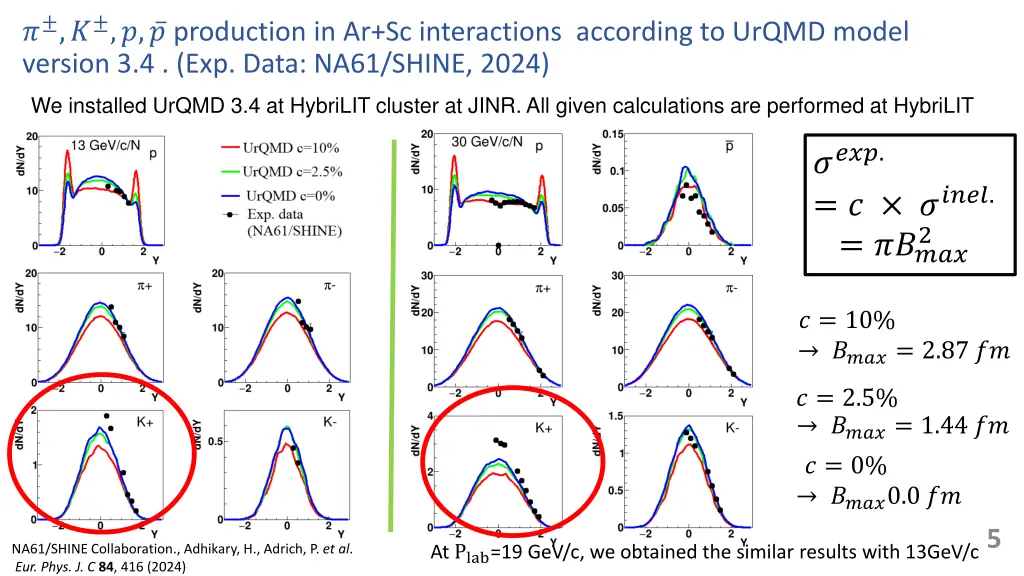
?,?,?, ? production in Ar+Sc interactions according to UrQMD model version 3.4 . (Exp. Data: NA61/SHINE, 2024) We installed UrQMD 3.4 at HybriLIT cluster at JINR. All given calculations are performed at HybriLIT ????. = ? ?????. = ????? 2 ? = 10% ????= 2.87 ?? ? = 2.5% ????= 1.44 ?? ? = 0% ????0.0 ?? 5 At Plab=19 GeV/c, we obtained the similar results with 13GeV/c NA61/SHINE Collaboration., Adhikary, H., Adrich, P. et al. Eur. Phys. J. C 84, 416 (2024)
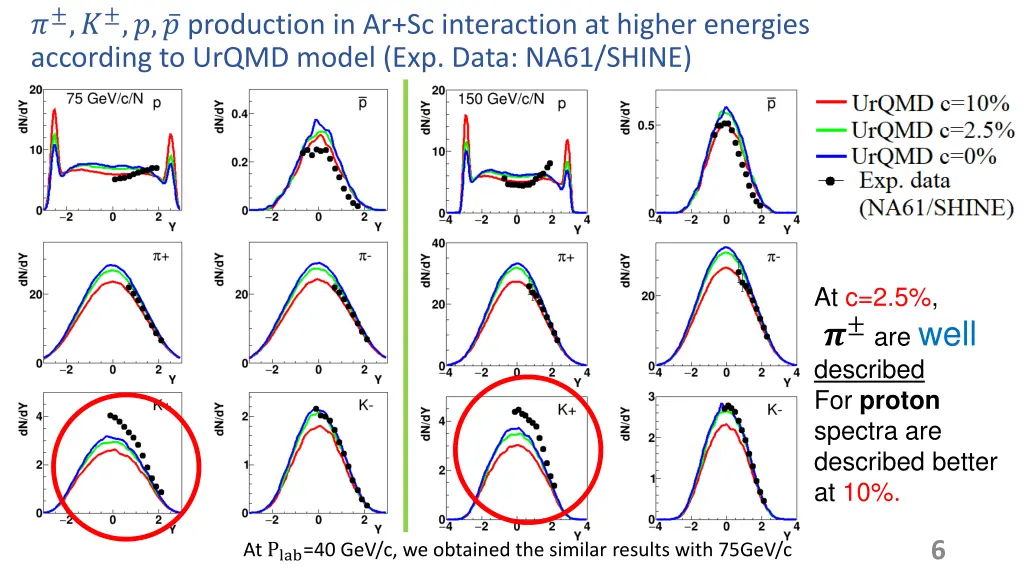
?,?,?, ? production in Ar+Sc interaction at higher energies according to UrQMD model (Exp. Data: NA61/SHINE) At c=2.5%, ? are well described For proton spectra are described better at 10%. 6 At Plab=40 GeV/c, we obtained the similar results with 75GeV/c
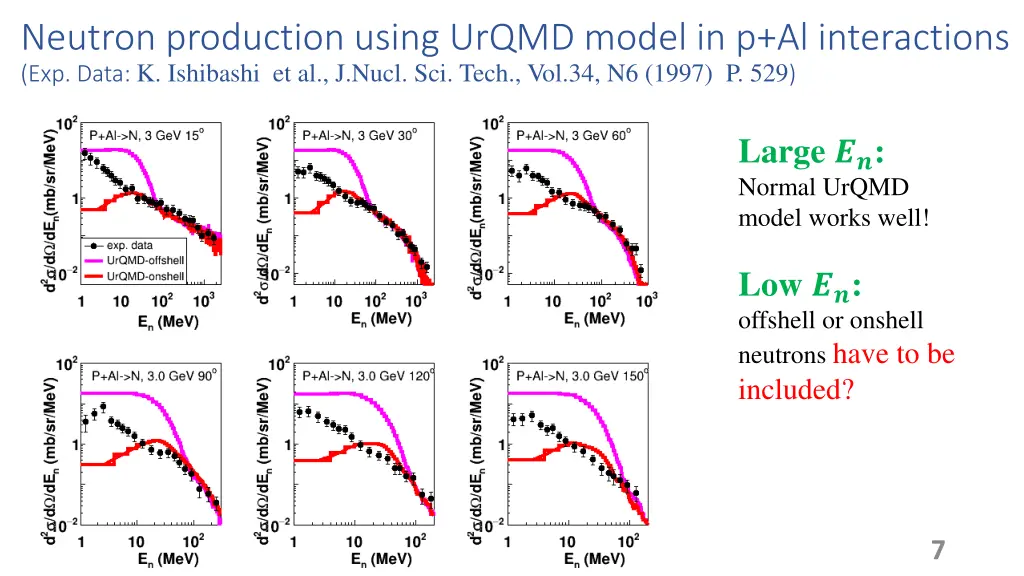
Neutron production using UrQMD model in p+Al interactions (Exp. Data: K. Ishibashi et al., J.Nucl. Sci. Tech., Vol.34, N6 (1997) P. 529) Large ??: Normal UrQMD model works well! Low ??: offshell or onshell neutrons have to be included? 7
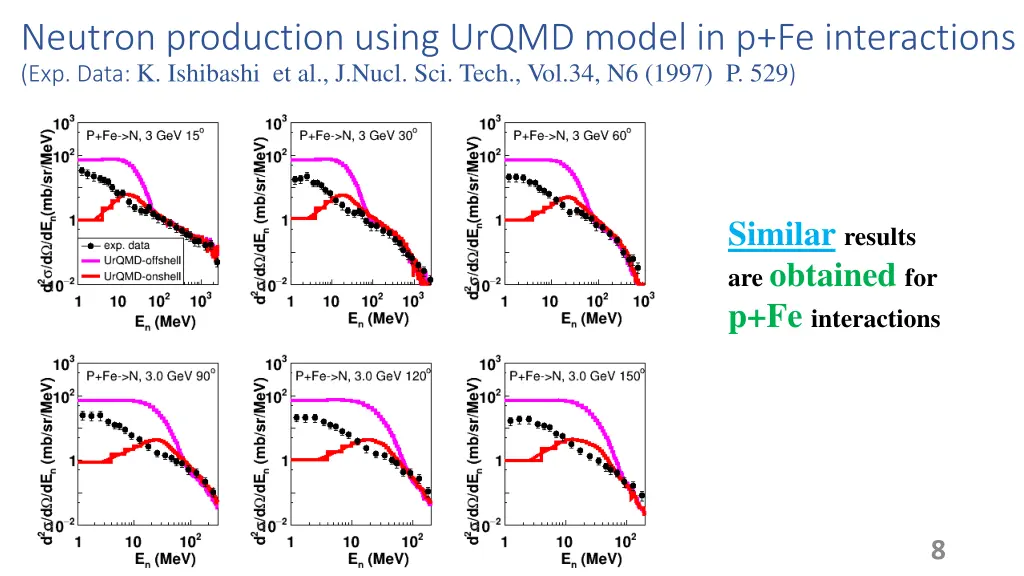
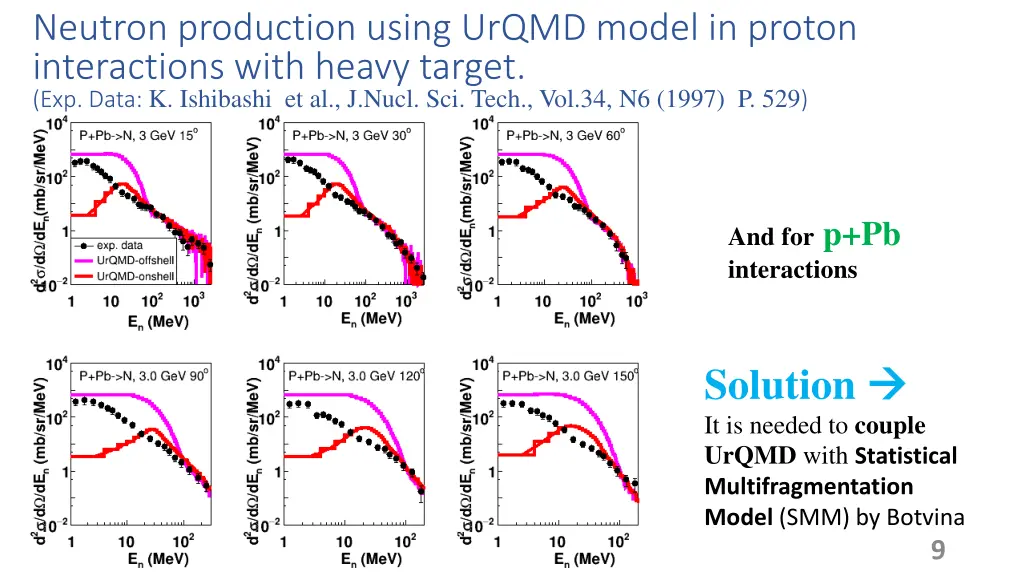
Neutron production using UrQMD model in proton interactions with heavy target. (Exp. Data: K. Ishibashi et al., J.Nucl. Sci. Tech., Vol.34, N6 (1997) P. 529) And for p+Pb interactions Solution It is needed to couple UrQMD withStatistical Multifragmentation Model (SMM) by Botvina 9
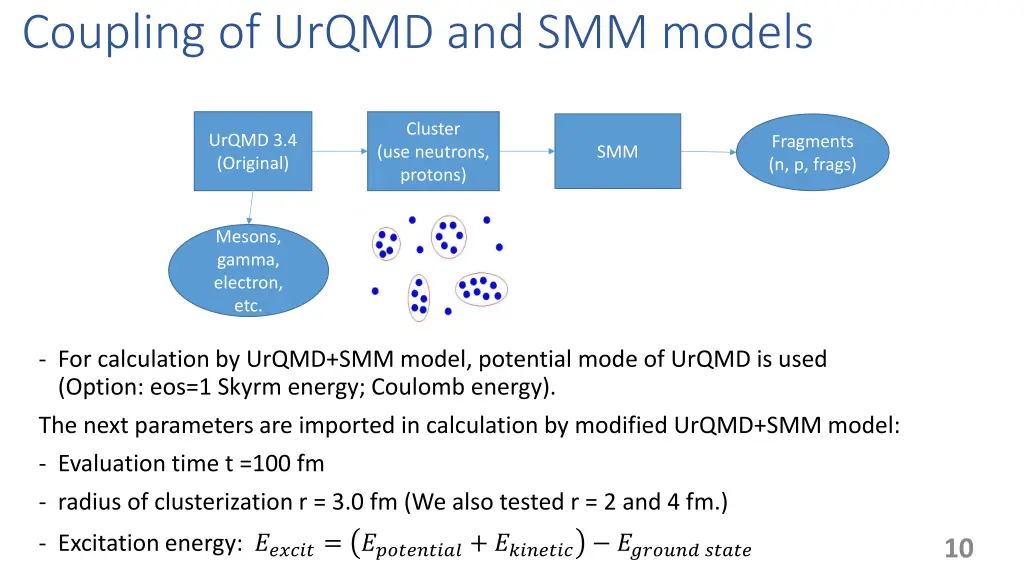
Coupling of UrQMD and SMM models Cluster UrQMD 3.4 (Original) Fragments (n, p, frags) (use neutrons, protons) SMM Mesons, gamma, electron, etc. - For calculation by UrQMD+SMM model, potential mode of UrQMD is used (Option: eos=1 Skyrm energy; Coulomb energy). The next parameters are imported in calculation by modified UrQMD+SMM model: - Evaluation time t =100 fm - radius of clusterization r = 3.0 fm (We also tested r = 2 and 4 fm.) - Excitation energy: ??????= ??????????+ ???????? ??????? ????? 10
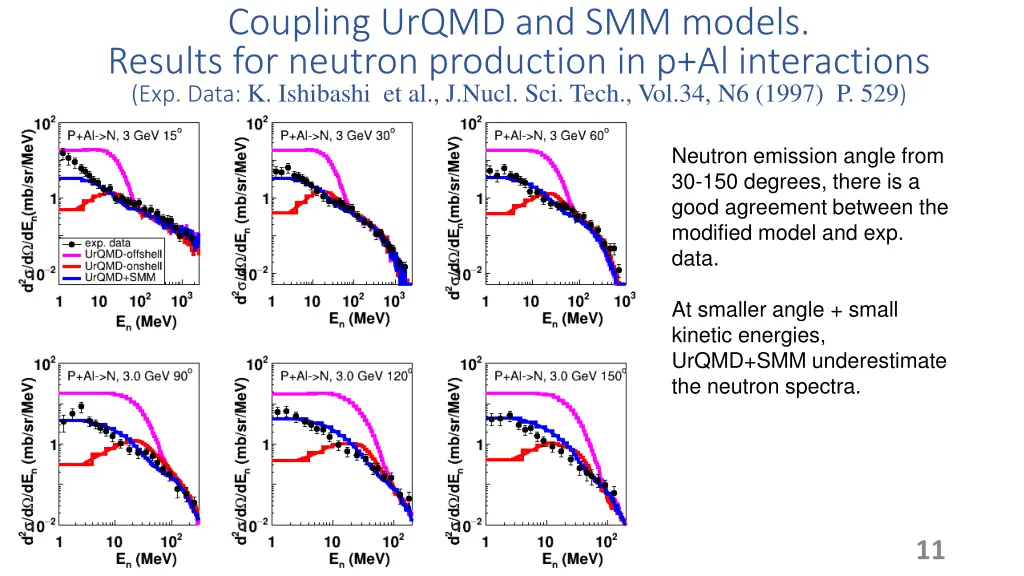
Coupling UrQMD and SMM models. Results for neutron production in p+Al interactions (Exp. Data: K. Ishibashi et al., J.Nucl. Sci. Tech., Vol.34, N6 (1997) P. 529) Neutron emission angle from 30-150 degrees, there is a good agreement between the modified model and exp. data. At smaller angle + small kinetic energies, UrQMD+SMM underestimate the neutron spectra. 11
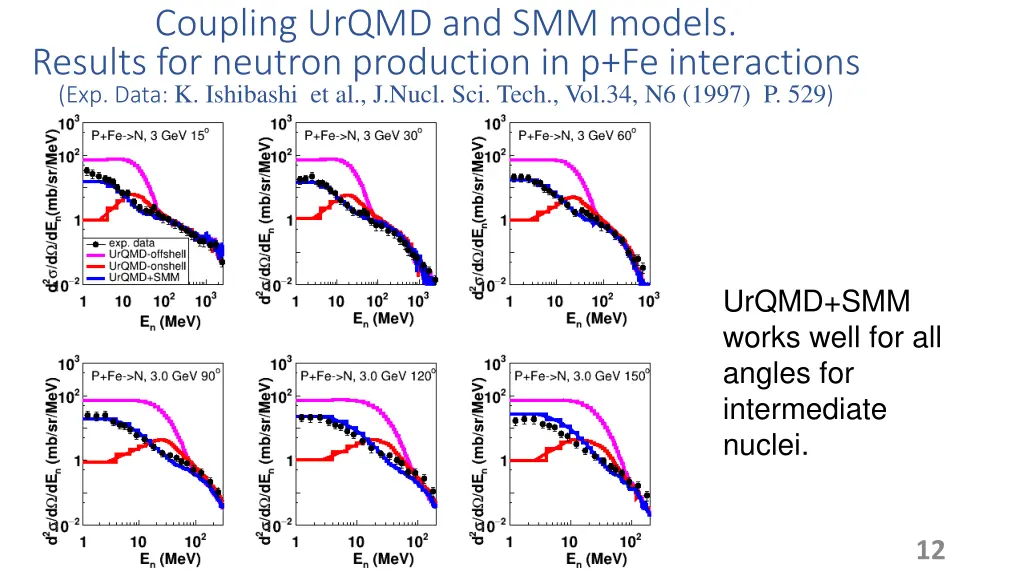
Coupling UrQMD and SMM models. Results for neutron production in p+Fe interactions (Exp. Data: K. Ishibashi et al., J.Nucl. Sci. Tech., Vol.34, N6 (1997) P. 529) UrQMD+SMM works well for all angles for intermediate nuclei. 12
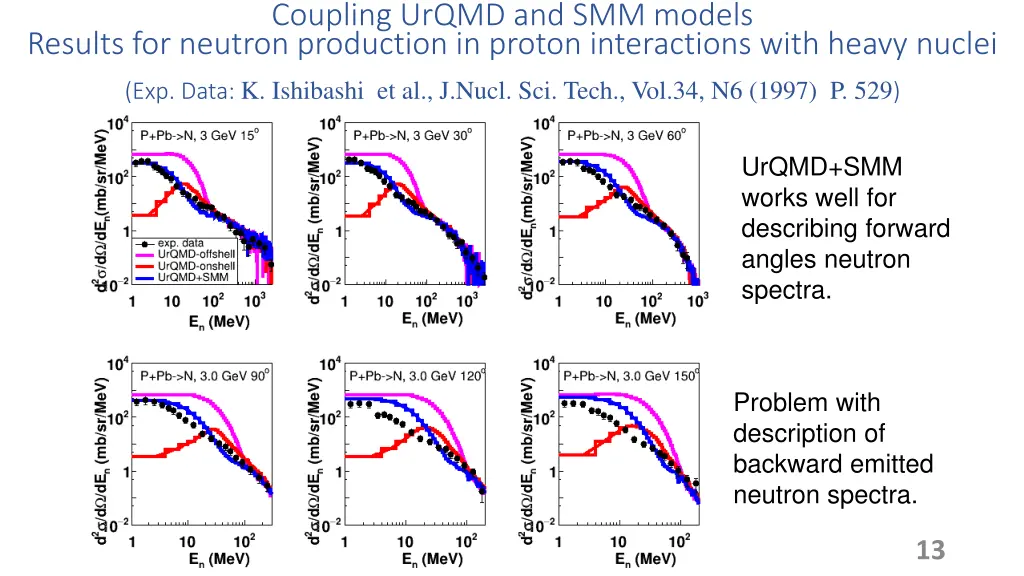
Coupling UrQMD and SMM models Results for neutron production in proton interactions with heavy nuclei (Exp. Data: K. Ishibashi et al., J.Nucl. Sci. Tech., Vol.34, N6 (1997) P. 529) UrQMD+SMM works well for describing forward angles neutron spectra. Problem with description of backward emitted neutron spectra. 13
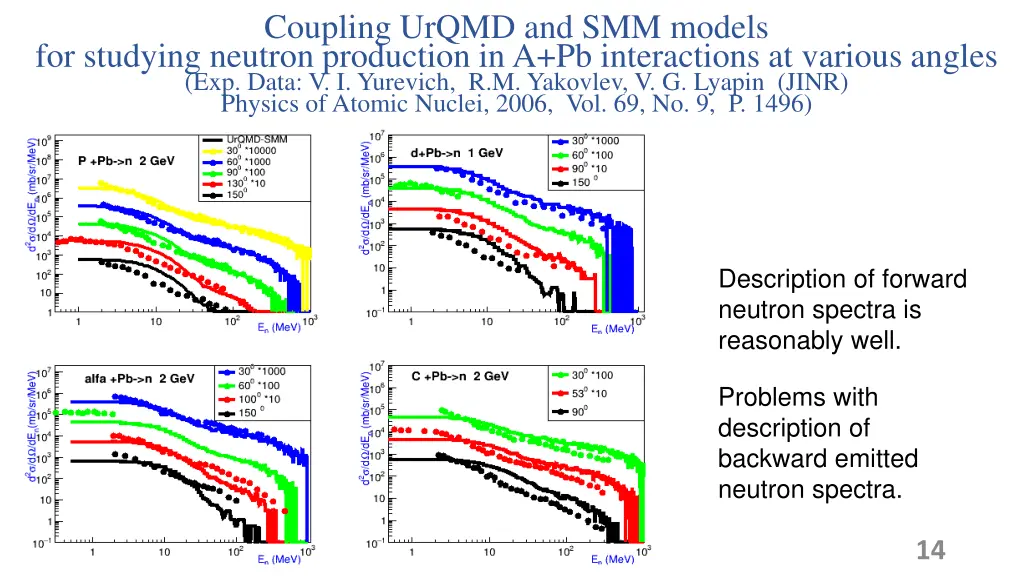
Coupling UrQMD and SMM models for studying neutron production in A+Pb interactions at various angles (Exp. Data: V. I. Yurevich, R.M. Yakovlev, V. G. Lyapin (JINR) Physics of Atomic Nuclei, 2006, Vol. 69, No. 9, P. 1496) Description of forward neutron spectra is reasonably well. Problems with description of backward emitted neutron spectra. 14
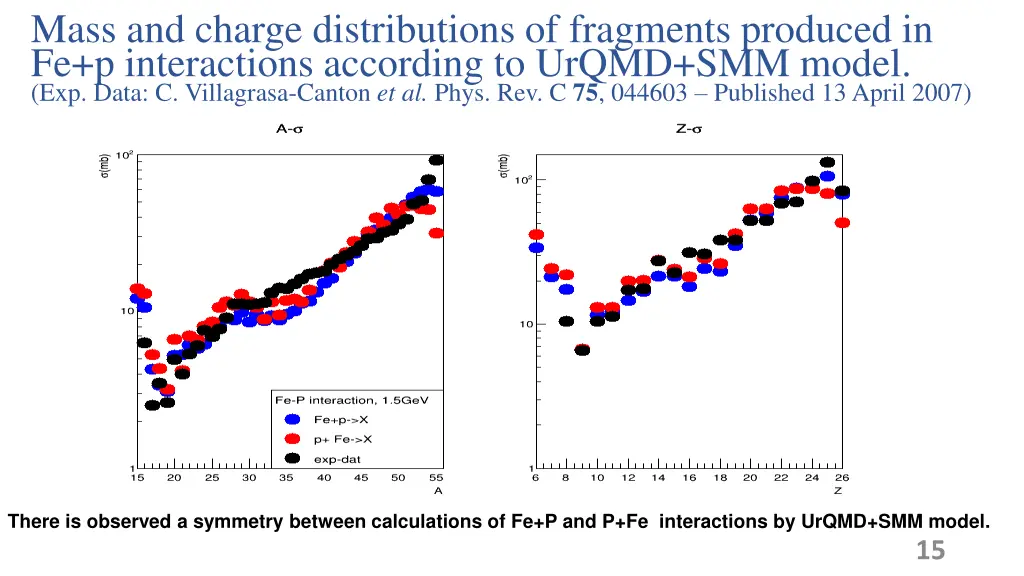
Mass and charge distributions of fragments produced in Fe+p interactions according to UrQMD+SMM model. (Exp. Data: C. Villagrasa-Canton et al. Phys. Rev. C 75, 044603 Published 13 April 2007) There is observed a symmetry between calculations of Fe+P and P+Fe interactions by UrQMD+SMM model. 15
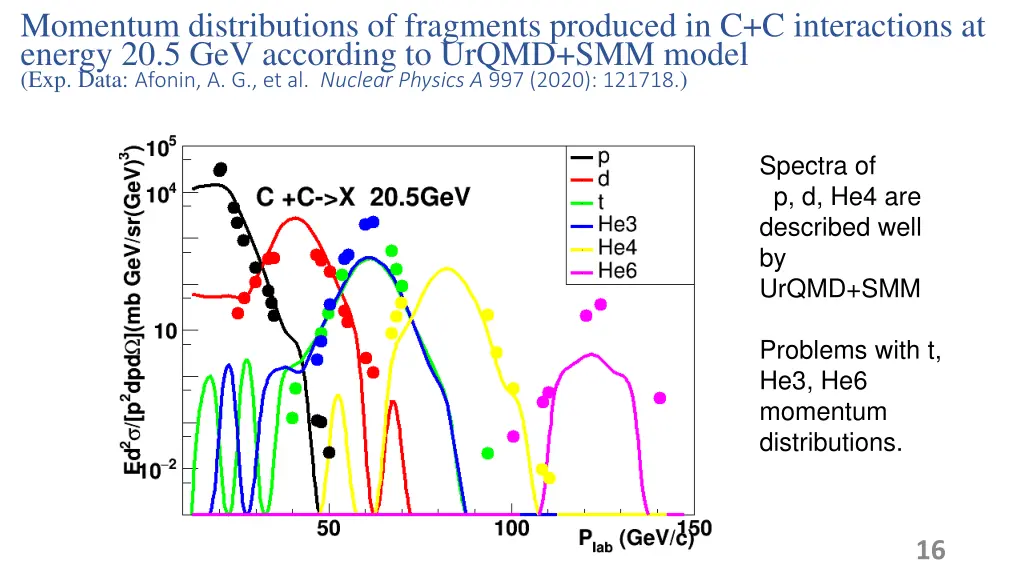
Momentum distributions of fragments produced in C+C interactions at energy 20.5 GeV according to UrQMD+SMM model (Exp. Data: Afonin, A. G., et al. Nuclear Physics A 997 (2020): 121718.) Spectra of p, d, He4 are described well by UrQMD+SMM Problems with t, He3, He6 momentum distributions. 16
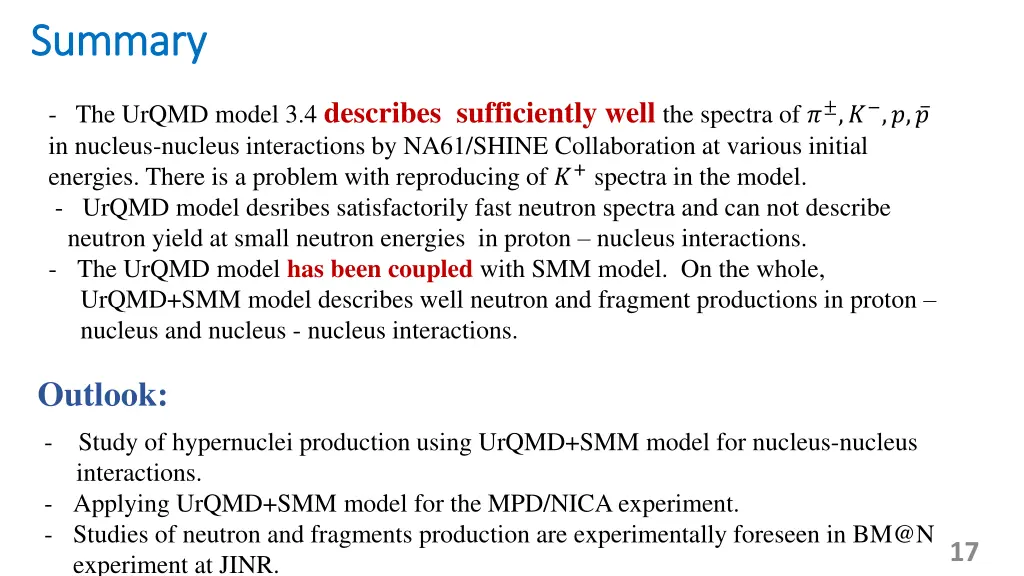
Summary Summary - The UrQMD model 3.4 describes sufficiently wellthe spectra of ? ,? ,?, ? in nucleus-nucleus interactions by NA61/SHINE Collaboration at various initial energies. There is a problem with reproducing of ?+ spectra in the model. - UrQMD model desribes satisfactorily fast neutron spectra and can not describe neutron yield at small neutron energies in proton nucleus interactions. - The UrQMD model has been coupled with SMM model. On the whole, UrQMD+SMM model describes well neutron and fragment productions in proton nucleus and nucleus - nucleus interactions. Outlook: - Study of hypernuclei production using UrQMD+SMM model for nucleus-nucleus interactions. - Applying UrQMD+SMM model for the MPD/NICA experiment. - Studies of neutron and fragments production are experimentally foreseen in BM@N experiment at JINR. 17
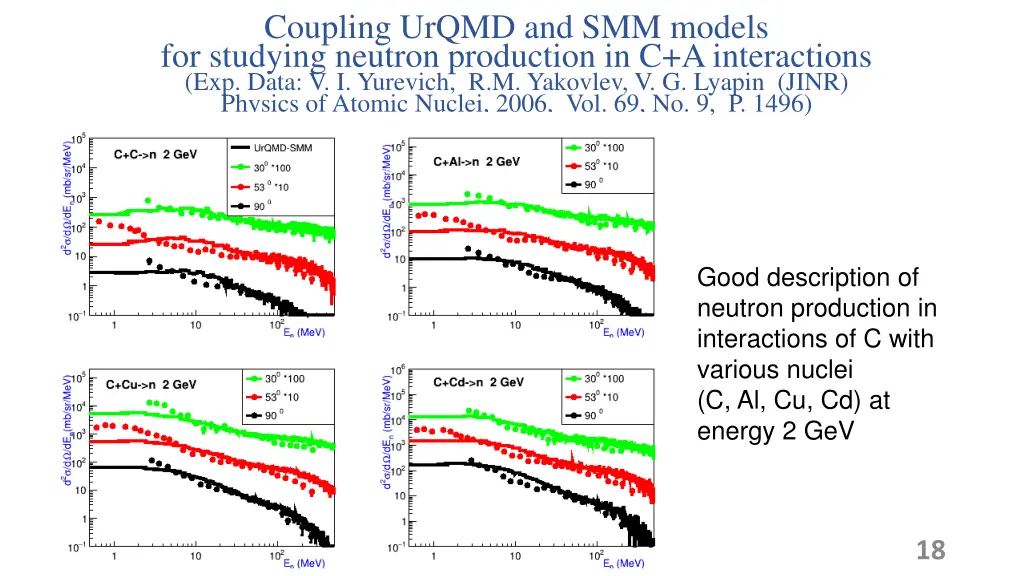
Coupling UrQMD and SMM models for studying neutron production in C+A interactions (Exp. Data: V. I. Yurevich, R.M. Yakovlev, V. G. Lyapin (JINR) Physics of Atomic Nuclei, 2006, Vol. 69, No. 9, P. 1496) Good description of neutron production in interactions of C with various nuclei (C, Al, Cu, Cd) at energy 2 GeV 18
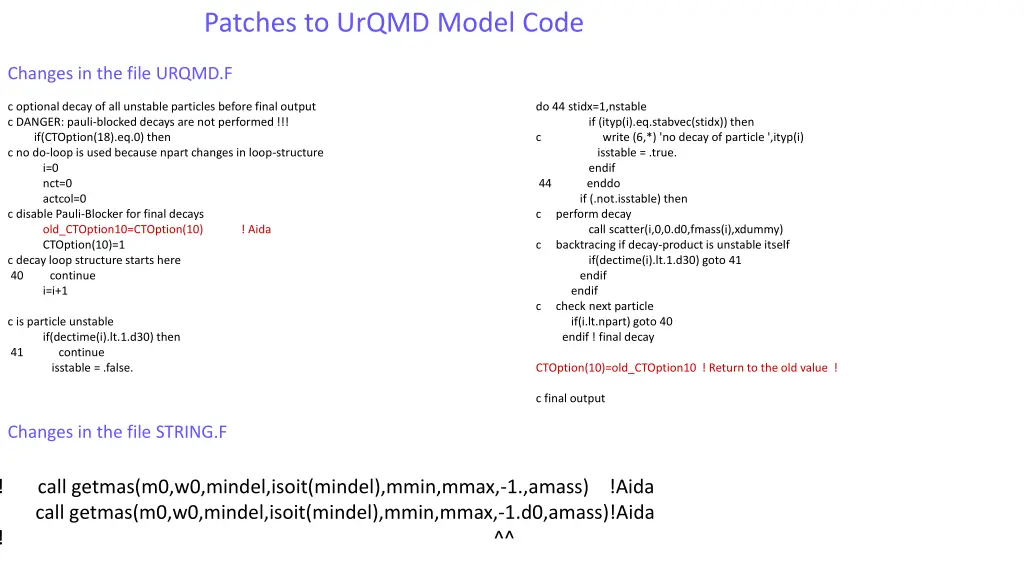
Patches to UrQMD Model Code Changes in the file URQMD.F c optional decay of all unstable particles before final output c DANGER: pauli-blocked decays are not performed !!! if(CTOption(18).eq.0) then c no do-loop is used because npart changes in loop-structure i=0 nct=0 actcol=0 c disable Pauli-Blocker for final decays old_CTOption10=CTOption(10) ! Aida CTOption(10)=1 c decay loop structure starts here 40 continue i=i+1 do 44 stidx=1,nstable if (ityp(i).eq.stabvec(stidx)) then c write (6,*) 'no decay of particle ',ityp(i) isstable = .true. endif 44 enddo if (.not.isstable) then c perform decay call scatter(i,0,0.d0,fmass(i),xdummy) c backtracing if decay-product is unstable itself if(dectime(i).lt.1.d30) goto 41 endif endif c check next particle if(i.lt.npart) goto 40 endif ! final decay c is particle unstable if(dectime(i).lt.1.d30) then 41 continue isstable = .false. CTOption(10)=old_CTOption10 ! Return to the old value ! c final output Changes in the file STRING.F ! call getmas(m0,w0,mindel,isoit(mindel),mmin,mmax,-1.,amass) !Aida call getmas(m0,w0,mindel,isoit(mindel),mmin,mmax,-1.d0,amass)!Aida ! ^^
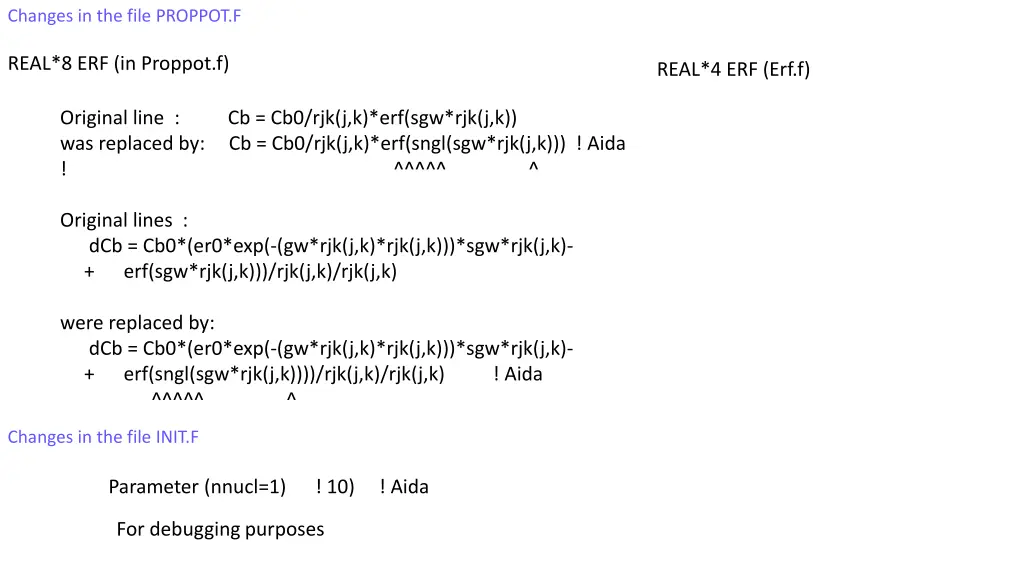
Changes in the file PROPPOT.F REAL*8 ERF (in Proppot.f) REAL*4 ERF (Erf.f) Original line : was replaced by: Cb = Cb0/rjk(j,k)*erf(sngl(sgw*rjk(j,k))) ! Aida ! Cb = Cb0/rjk(j,k)*erf(sgw*rjk(j,k)) ^^^^^ ^ Original lines : dCb = Cb0*(er0*exp(-(gw*rjk(j,k)*rjk(j,k)))*sgw*rjk(j,k)- + erf(sgw*rjk(j,k)))/rjk(j,k)/rjk(j,k) were replaced by: dCb = Cb0*(er0*exp(-(gw*rjk(j,k)*rjk(j,k)))*sgw*rjk(j,k)- + erf(sngl(sgw*rjk(j,k))))/rjk(j,k)/rjk(j,k) ! Aida ^^^^^ ^ Changes in the file INIT.F Parameter (nnucl=1) ! 10) ! Aida For debugging purposes
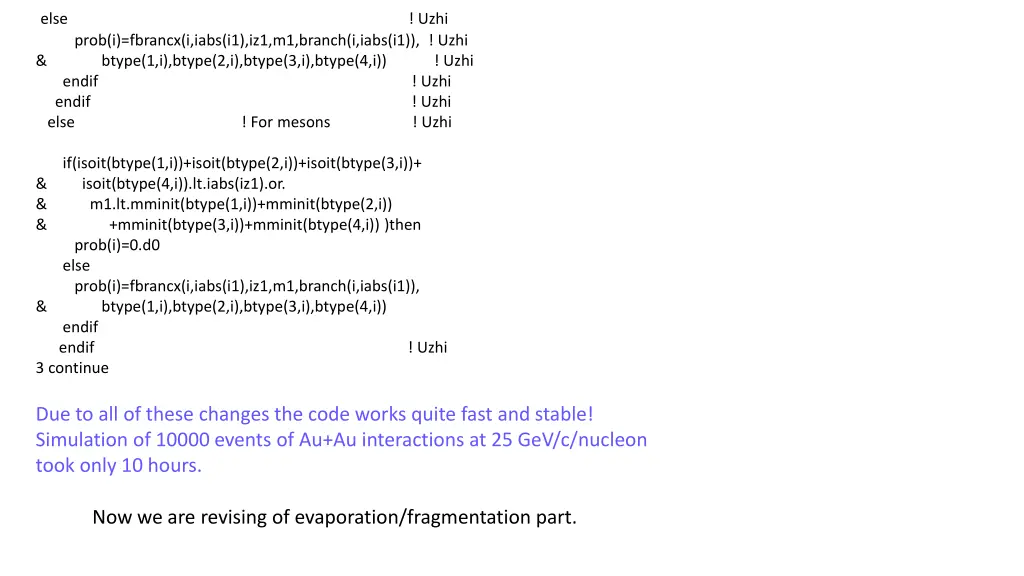
else ! Uzhi prob(i)=fbrancx(i,iabs(i1),iz1,m1,branch(i,iabs(i1)), ! Uzhi & btype(1,i),btype(2,i),btype(3,i),btype(4,i)) endif endif else ! For mesons ! Uzhi ! Uzhi ! Uzhi ! Uzhi if(isoit(btype(1,i))+isoit(btype(2,i))+isoit(btype(3,i))+ & isoit(btype(4,i)).lt.iabs(iz1).or. & m1.lt.mminit(btype(1,i))+mminit(btype(2,i)) & +mminit(btype(3,i))+mminit(btype(4,i)) )then prob(i)=0.d0 else prob(i)=fbrancx(i,iabs(i1),iz1,m1,branch(i,iabs(i1)), & btype(1,i),btype(2,i),btype(3,i),btype(4,i)) endif endif 3 continue ! Uzhi Due to all of these changes the code works quite fast and stable! Simulation of 10000 events of Au+Au interactions at 25 GeV/c/nucleon took only 10 hours. Now we are revising of evaporation/fragmentation part.
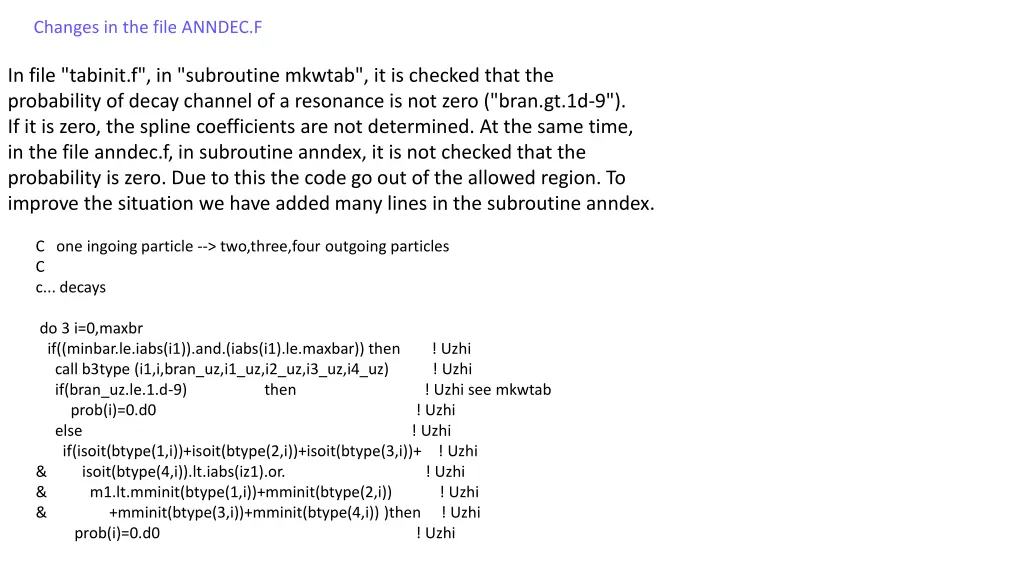
Changes in the file ANNDEC.F In file "tabinit.f", in "subroutine mkwtab", it is checked that the probability of decay channel of a resonance is not zero ("bran.gt.1d-9"). If it is zero, the spline coefficients are not determined. At the same time, in the file anndec.f, in subroutine anndex, it is not checked that the probability is zero. Due to this the code go out of the allowed region. To improve the situation we have added many lines in the subroutine anndex. C one ingoing particle --> two,three,four outgoing particles C c... decays do 3 i=0,maxbr if((minbar.le.iabs(i1)).and.(iabs(i1).le.maxbar)) then ! Uzhi call b3type (i1,i,bran_uz,i1_uz,i2_uz,i3_uz,i4_uz) ! Uzhi if(bran_uz.le.1.d-9) then prob(i)=0.d0 else if(isoit(btype(1,i))+isoit(btype(2,i))+isoit(btype(3,i))+ ! Uzhi & isoit(btype(4,i)).lt.iabs(iz1).or. & m1.lt.mminit(btype(1,i))+mminit(btype(2,i)) ! Uzhi & +mminit(btype(3,i))+mminit(btype(4,i)) )then ! Uzhi prob(i)=0.d0 ! Uzhi see mkwtab ! Uzhi ! Uzhi ! Uzhi ! Uzhi