Explore the future career prospects in experimental high energy physics, understand how future experiments are planned and funded, and find reliable sources of information to work on unfamiliar topics. Get insights on current big questions in the field, ongoing projects, group capacities, and advisory organisms. Attend conferences, seminars, and read review papers to stay informed. Learn about global efforts and advisory panels shaping the future of experimental high energy physics.
Please find below an Image/Link to download the presentation.
The content on the website is provided AS IS for your information and personal use only. It may not be sold, licensed, or shared on other websites without obtaining consent from the author. If you encounter any issues during the download, it is possible that the publisher has removed the file from their server.
You are allowed to download the files provided on this website for personal or commercial use, subject to the condition that they are used lawfully. All files are the property of their respective owners.
The content on the website is provided AS IS for your information and personal use only. It may not be sold, licensed, or shared on other websites without obtaining consent from the author.
E N D
Presentation Transcript
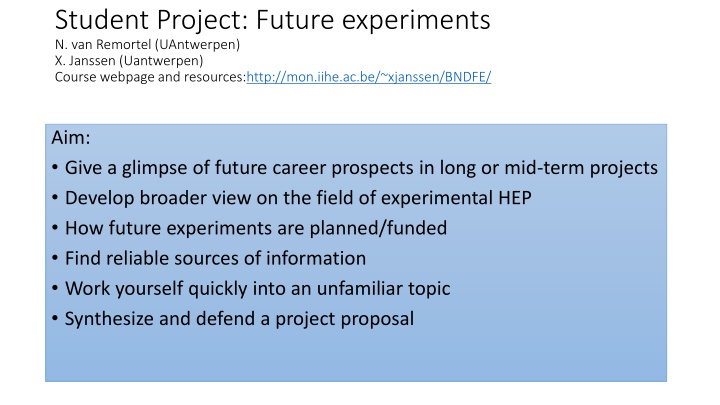
Student Project: Future experiments N. van Remortel (UAntwerpen) X. Janssen (Uantwerpen) Course webpage and resources:http://mon.iihe.ac.be/~xjanssen/BNDFE/ Aim: Give a glimpse of future career prospects in long or mid-term projects Develop broader view on the field of experimental HEP How future experiments are planned/funded Find reliable sources of information Work yourself quickly into an unfamiliar topic Synthesize and defend a project proposal
Motivations What are the current big open questions in the field of High Energy Physics (HEP)? What are current ongoing and planned/proposed HEP experiments/projects to address these questions? What is the capacity of your group: is there manpower and budget to be involved in more than 1 experiment? Do you prefer the comfort but perhaps also the anonymity of a large collaboration? What type of physics do YOU find worth pursuing? Do your (local) funding agencies agree with your opinion? Is there a long standing research tradition of your lab in a given subfield of HEP, which you could use to your advantage? Do you want to build or develop a new experiment? Do you enjoy collaborating with certain people?
Informing yourself Attend large and renown HEP conferences with a broad scope: ICHEP, EPS, Lepton- Photon, Moriond, ... Visit general audience HEP seminars in your own or neighboring institutes (National HEP days, jamborees, APS annual meeting, CERN colloquia, Fermilab wine&cheese, ...) Organize seminars/topical lectures in your own lab Read review papers: Particle data group annual review, see also dedicated journal issues: http://www.slac.stanford.edu/spires/reviews/ http://library.web.cern.ch/particle_physics_information#par Read PhD theses on other topics, they usually offer a concise and up to date state of the art of the field Follow HEP science blogs ...
Advisory organisms & strategy groups Experimental HEP is global effort, predominantly concentrated on 2 continents: United States Future experimental HEP program is largely steered by the Particle Physics Project Prioritization Panel (P5), a subgroup of the High Energy Physics Advisory Panel (HEPAP). Their reports and recommendations can be found here: http://science.energy.gov/hep/hepap/reports/ The latest long term strategy report issued by P5 can be found here: http://science.energy.gov/~/media/hep/hepap/pdf/May-2014/FINAL_P5_Report_Interactive_060214.pdf Europe Has similar advisory panels and strategy groups that report or meet once every few years: http://europeanstrategygroup.web.cern.ch/europeanstrategygroup/ the latest European strategy report: https://www.dropbox.com/s/c7rzncjsxm06ajm/Strategy_Report_LR.pdf Additional large scale projects in Russia (JINR/Dubna, Protvino/Serphukov), JAPAN (KEK, JPARC), China (IHEP/Beijing), India,
Advisory panels International Committee for Future Accelerators (ICFA), (http://www.fnal.gov/directorate/icfa/) European Committee for Future Accelerators (ECFA), (http://ecfa.web.cern.ch/ecfa/en/Welcome.html) AStroParticle European Research Area (ASPERA), (http://www.aspera-eu.org/) Astroparticle Physics European Consortium (ApPEC), (http://193.146.122.114:8888/appec/) European Physical Society, High Energy and Particle Physics Division: http://eps- hepp.web.cern.ch/eps-hepp/ American Physical Society (APS), Division of Particles and Fields (http://dpfnewsletter.org/) SNOWMASS workshops (http://www.snowmass2013.org/tiki-index.php) US National Science Foundation (NSF) and HEPAP advisory panel (http://science.energy.gov/hep/hepap) National science foundation and physical society of your own country, ...
Current active HEP experiments 703 active experiments listed in SPIRES database: http://www.slac.stanford.edu/spires/experiments/online_exp.shtml O(100) Experiments conducted at CERN: http://greybook.cern.ch/ 7 LHC based 8 SPS based >20 PS based 5 in preparation for neutrino >10 R&D projects >5 projects under study, including ILC, FCC Space and non-accelerator: Including AMS, CAST,
Your project in practice Group yourself in groups of 5-6 people, there will be 10 groups in this way Choose with your group one topic out of the list given here: http://mon.iihe.ac.be/~xjanssen/BNDFE/topics/topics.html NOTE: It is forbidden to choose a topic related to your own experiment or field of expertise. Distribute the work among the members of your group: Physics questions and motivation, key measurements, current stakeholders, future prospects, implications, ... Prepare a 10 minute presentation (by an appointed member of your group) The presentation should convince a panel of reviewers to either fund your project/experiment or not Keep it focused, scientifically relevant and correct Dates and times of sessions and presentations: After choosing your topic, perform background research and do some reading in your spare time. You can ask questions to the lecturers (N. van Remortel and X. Janssen during the work sessions. The work sessions are also an opportunity to discuss and prepare the final project presentation within your group. Mon 29/8, 16:15 - 18:00 : Introduction and forming of groups Tues 06/9, 15:30 - 17:15 : work session Wed 07/9, 10:30 - 12:15 : work session Thur 08/9, 15:30 - 18:15 : Final presentation of projects!
Some guidelines for preparation and presentation Introduction to the physics case: Why is this measurement important, in terms of the big open questions in our field? What is currently already experimentally established for this type of physics ? (example: we know for a fact that neutrino's do oscillate and posses mass, we do know there's a scalar particle, ...) What is currently not or badly known for this type of physics ? (example: the neutrino mass hierarchy, the self coupling of the scalar, ...) Are there any controversies that need to be resolved? (conflicting experimental data, interpretational issues?) How can one measure these badly known properties ? What is needed to improve these measurements ? (bigger detectors, more data, higher energy, different beams, ...) The essential experimental techniques: How do you measure the key parameters of your physics problem (specific decay channels, specific kinematic properties, golden signatures, ...) What beams, detectors are typically used? If there are several techniques/facilities, what are the pros and cons ? Are some techniques/facilities complementary? Key features of your proposal: Does it involve an existing beam, lab, or does it require a new accelerator? Does it involve an upgrade of an existing experiment or a totally new design? What are the key features of the experimental setup, and why are they necessary? What is the possible time line of your project ? What is the current status of approval of your project?
Possible topics 16 pre-prepared pages for you, but feel free to choose others, if interested High energy frontier physics BSM searches at Super-LHC (link) BSM searches at ILC (link) Higgs at Super-LHC (link) Higgs at ILC (link) Higgs with FCC (link) High intensity frontier physics (link) Heavy Flavor factories: Belle-II at KEKB Lepton flavor violation: MEGII at PSI Lepton flavor violation: Mu2e at Fermilab Low mass dark sector: CERN SPS SHIP experiment Non-Accelerator based Dark Matter searches (link) Xenon1T COUPP-500 Neutrino Oscillations and mixing (link) Fermilab's Long-Baseline Neutrino Facility (LBNF) + Deep Underground Neutrino Experiment (DUNE) Fermilab's Microboone experiment Jiangmen Underground Neutrino Observatory (JUNO) Dirac vs Majorana neutrinos: neutrinoless double beta (link) SuperNEMO expriment in Frejus/Modane EXO-200 in new Mexico