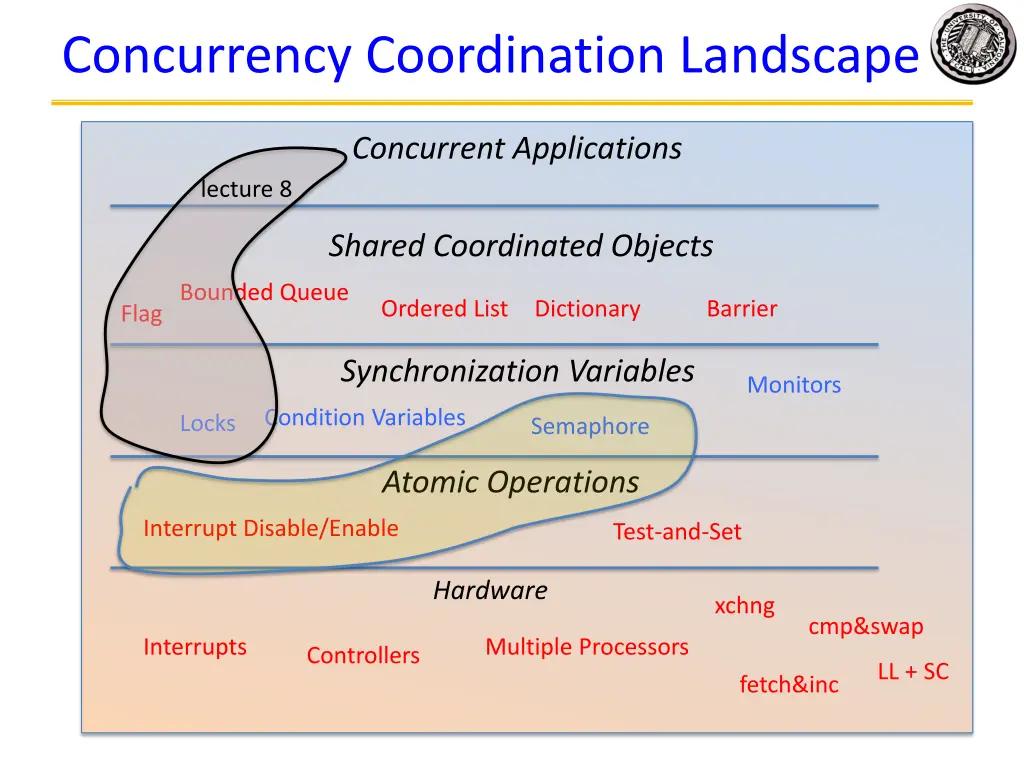
Explore the structured approach to concurrent programming with threads by synchronizing shared objects in C. Learn about the challenges and mechanisms like flags, locks, condition variables, and semaphores. Understand mutual exclusion, critical sections, and atomic operations in coordinating concurrent applications.
Please find below an Image/Link to download the presentation.
The content on the website is provided AS IS for your information and personal use only. It may not be sold, licensed, or shared on other websites without obtaining consent from the author. If you encounter any issues during the download, it is possible that the publisher has removed the file from their server.
You are allowed to download the files provided on this website for personal or commercial use, subject to the condition that they are used lawfully. All files are the property of their respective owners.
The content on the website is provided AS IS for your information and personal use only. It may not be sold, licensed, or shared on other websites without obtaining consent from the author.
E N D
Presentation Transcript
Thread Coordination Concurrent objects & Lock Implementation David E. Culler CS162 Operating Systems and Systems Programming Lecture 9 Sept 19, 2014 Reading: A&D 5.7-5.9 HW 2 out Proj 1 out: CP1
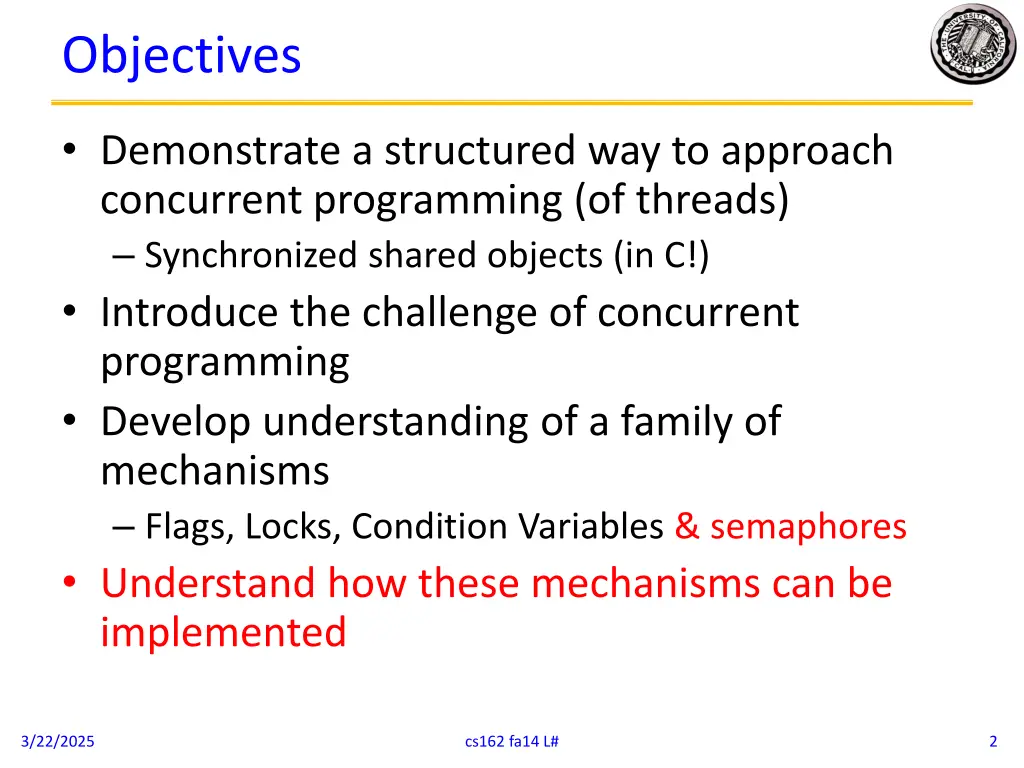
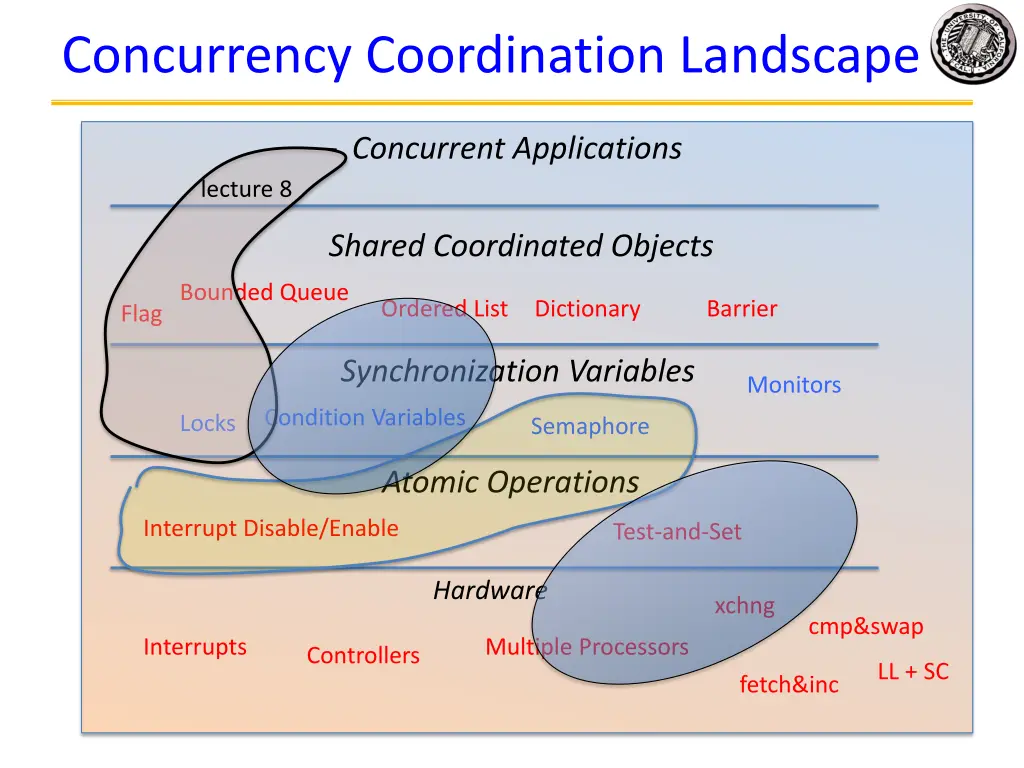
Objectives Demonstrate a structured way to approach concurrent programming (of threads) Synchronized shared objects (in C!) Introduce the challenge of concurrent programming Develop understanding of a family of mechanisms Flags, Locks, Condition Variables & semaphores Understand how these mechanisms can be implemented 3/22/2025 cs162 fa14 L# 2
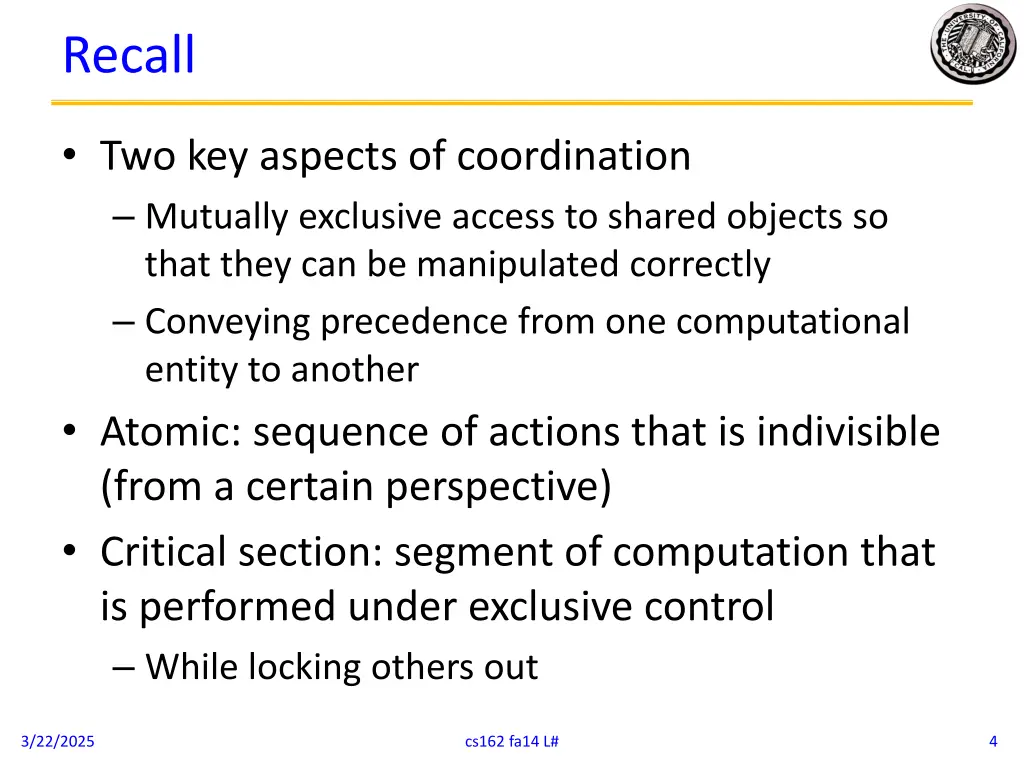
Recall Two key aspects of coordination Mutually exclusive access to shared objects so that they can be manipulated correctly Conveying precedence from one computational entity to another Atomic: sequence of actions that is indivisible (from a certain perspective) Critical section: segment of computation that is performed under exclusive control While locking others out 3/22/2025 cs162 fa14 L# 4
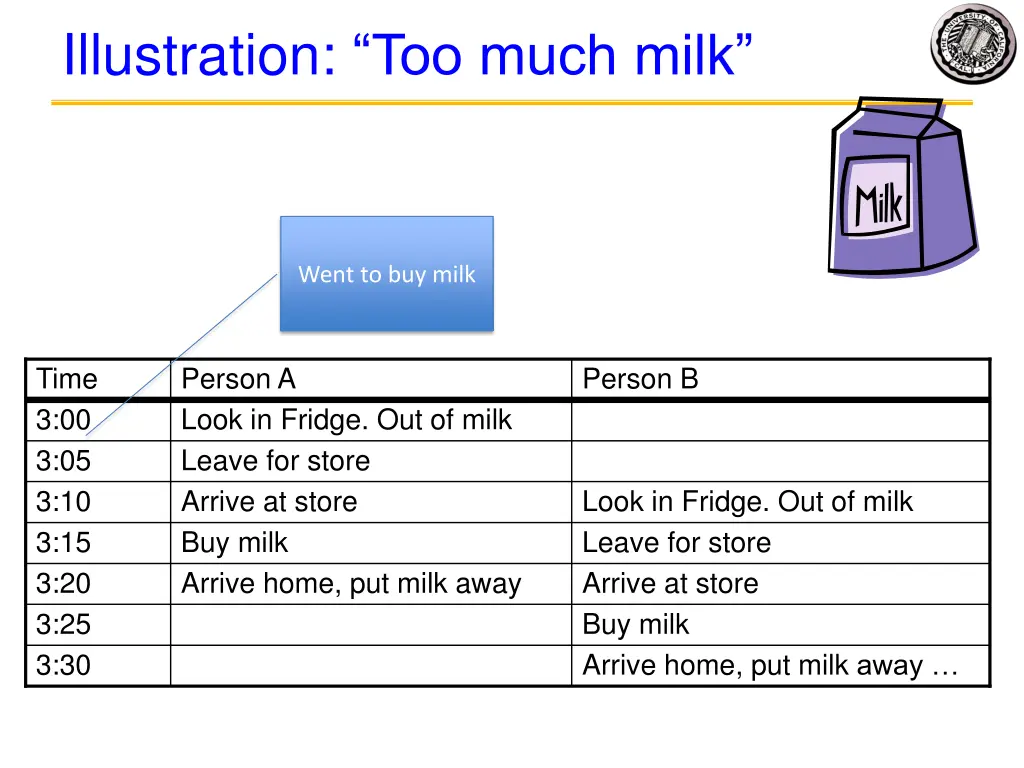
Illustration: Too much milk Went to buy milk Time Person A Person B 3:00 Look in Fridge. Out of milk 3:05 3:10 Leave for store Arrive at store Look in Fridge. Out of milk 3:15 Buy milk Leave for store 3:20 Arrive home, put milk away Arrive at store 3:25 Buy milk 3:30 Arrive home, put milk away
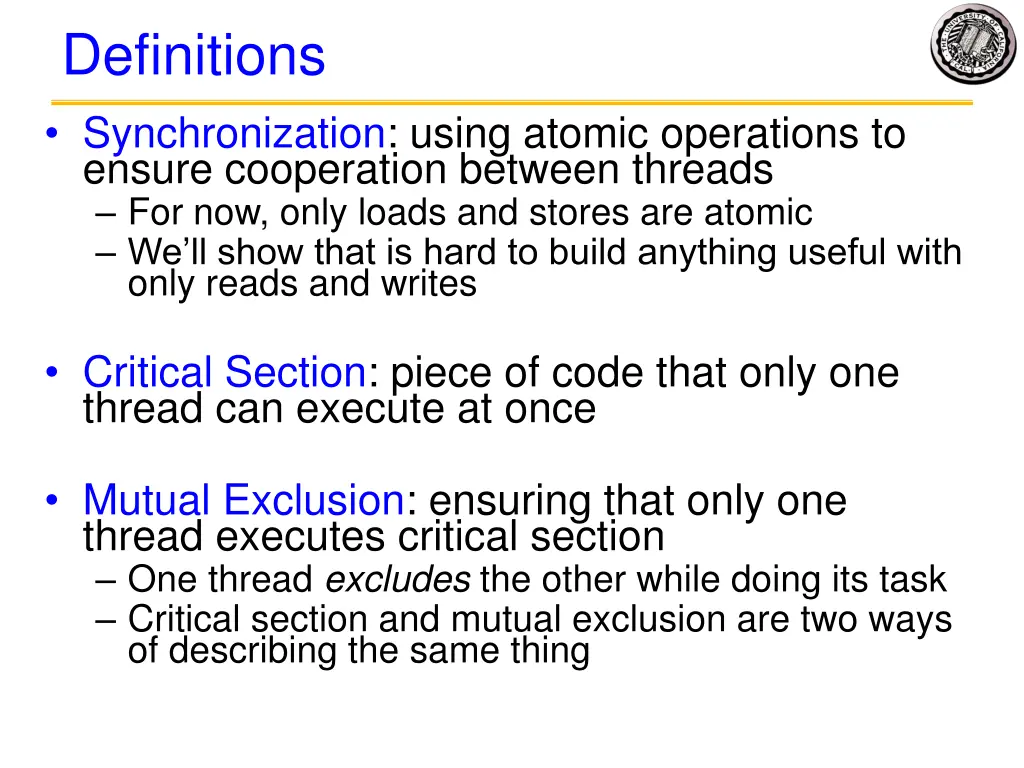
Definitions Synchronization: using atomic operations to ensure cooperation between threads For now, only loads and stores are atomic We ll show that is hard to build anything useful with only reads and writes Critical Section: piece of code that only one thread can execute at once Mutual Exclusion: ensuring that only one thread executes critical section One thread excludes the other while doing its task Critical section and mutual exclusion are two ways of describing the same thing
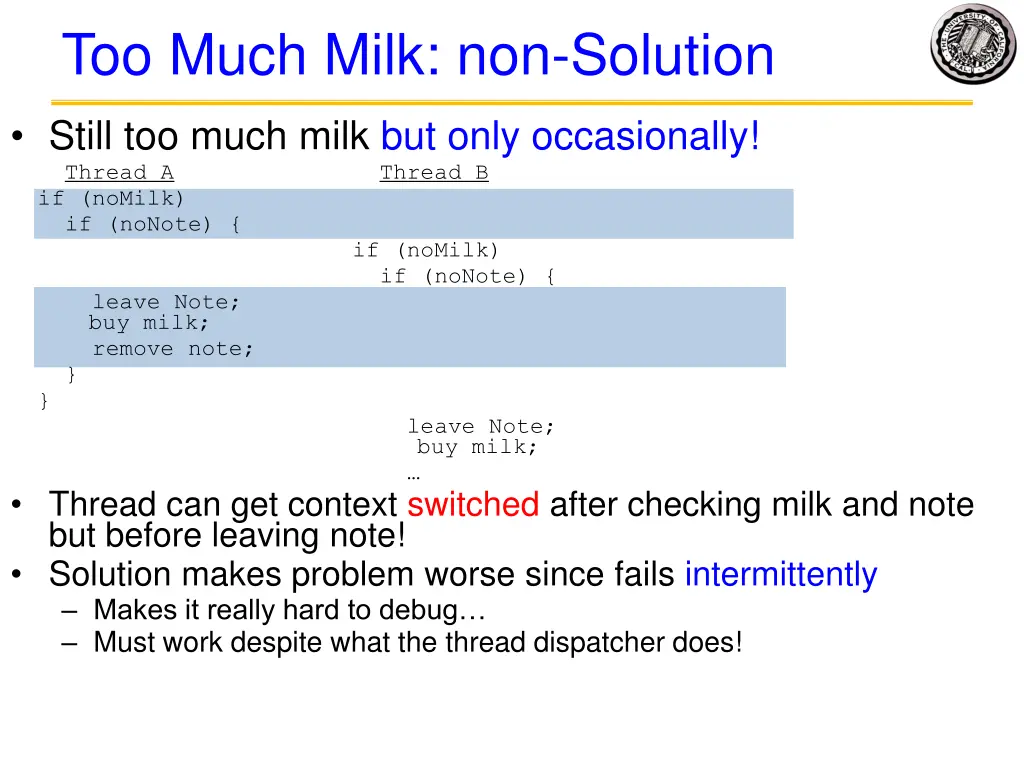
Too Much Milk: non-Solution Still too much milk but only occasionally! Thread A Thread B if (noMilk) if (noNote) { if (noMilk) if (noNote) { leave Note; buy milk; remove note; } } leave Note; Thread can get context switched after checking milk and note but before leaving note! Solution makes problem worse since fails intermittently Makes it really hard to debug Must work despite what the thread dispatcher does! buy milk;
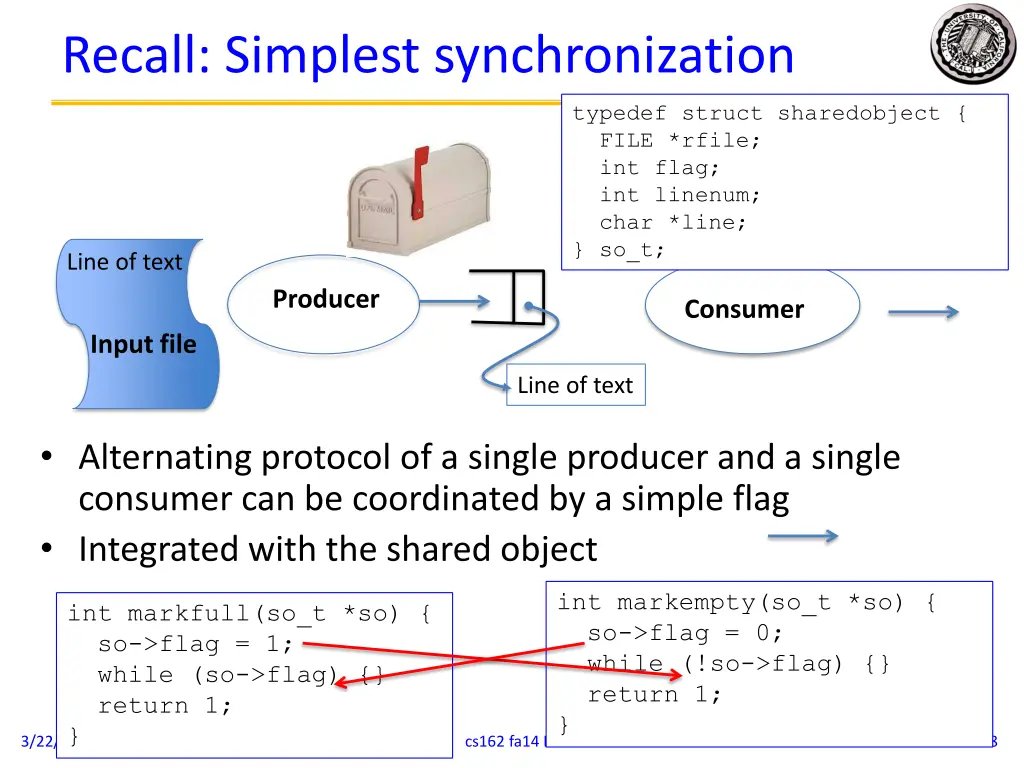
Recall: Simplest synchronization typedef struct sharedobject { FILE *rfile; int flag; int linenum; char *line; } so_t; Line of text Producer Consumer Input file Line of text Alternating protocol of a single producer and a single consumer can be coordinated by a simple flag Integrated with the shared object int markempty(so_t *so) { so->flag = 0; while (!so->flag) {} return 1; } int markfull(so_t *so) { so->flag = 1; while (so->flag) {} return 1; } 3/22/2025 cs162 fa14 L# 8
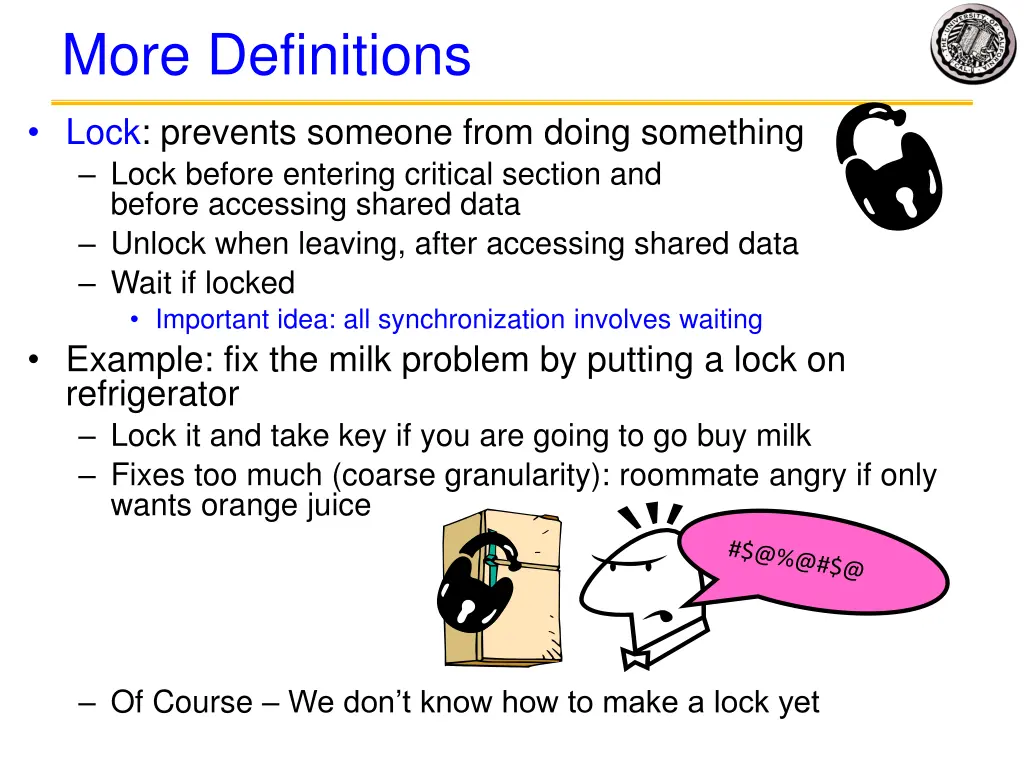
More Definitions Lock: prevents someone from doing something Lock before entering critical section and before accessing shared data Unlock when leaving, after accessing shared data Wait if locked Important idea: all synchronization involves waiting Example: fix the milk problem by putting a lock on refrigerator Lock it and take key if you are going to go buy milk Fixes too much (coarse granularity): roommate angry if only wants orange juice Of Course We don t know how to make a lock yet
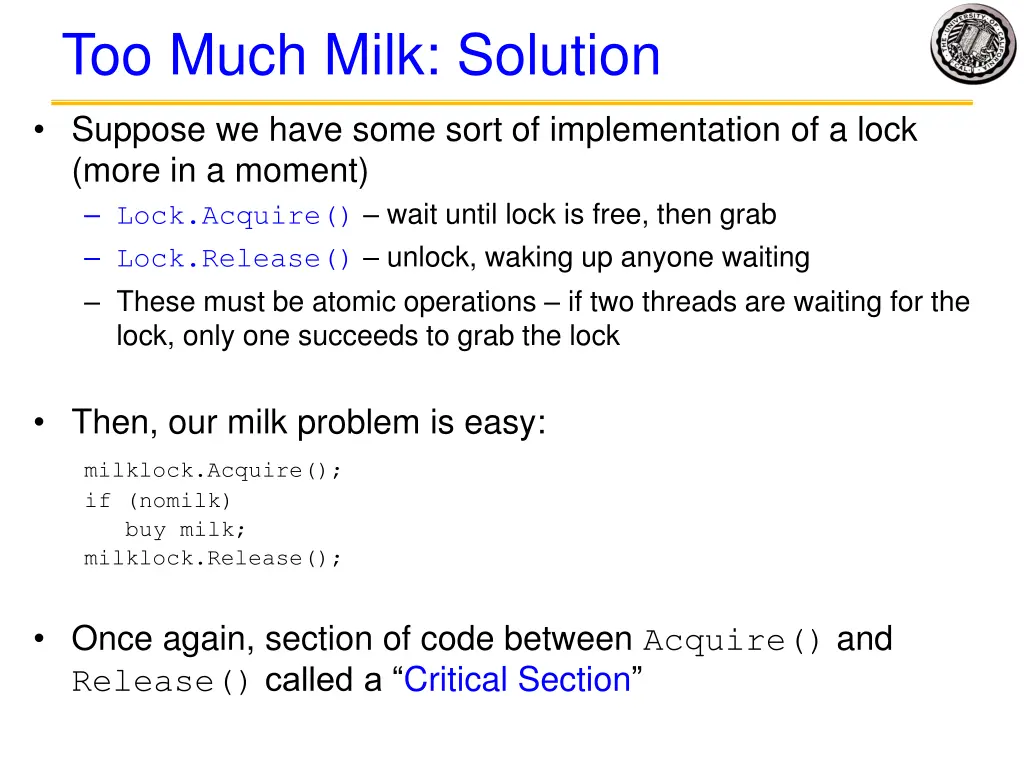
Too Much Milk: Solution Suppose we have some sort of implementation of a lock (more in a moment) Lock.Acquire() wait until lock is free, then grab Lock.Release() unlock, waking up anyone waiting These must be atomic operations if two threads are waiting for the lock, only one succeeds to grab the lock Then, our milk problem is easy: milklock.Acquire(); if (nomilk) buy milk; milklock.Release(); Once again, section of code between Acquire() and Release()called a Critical Section
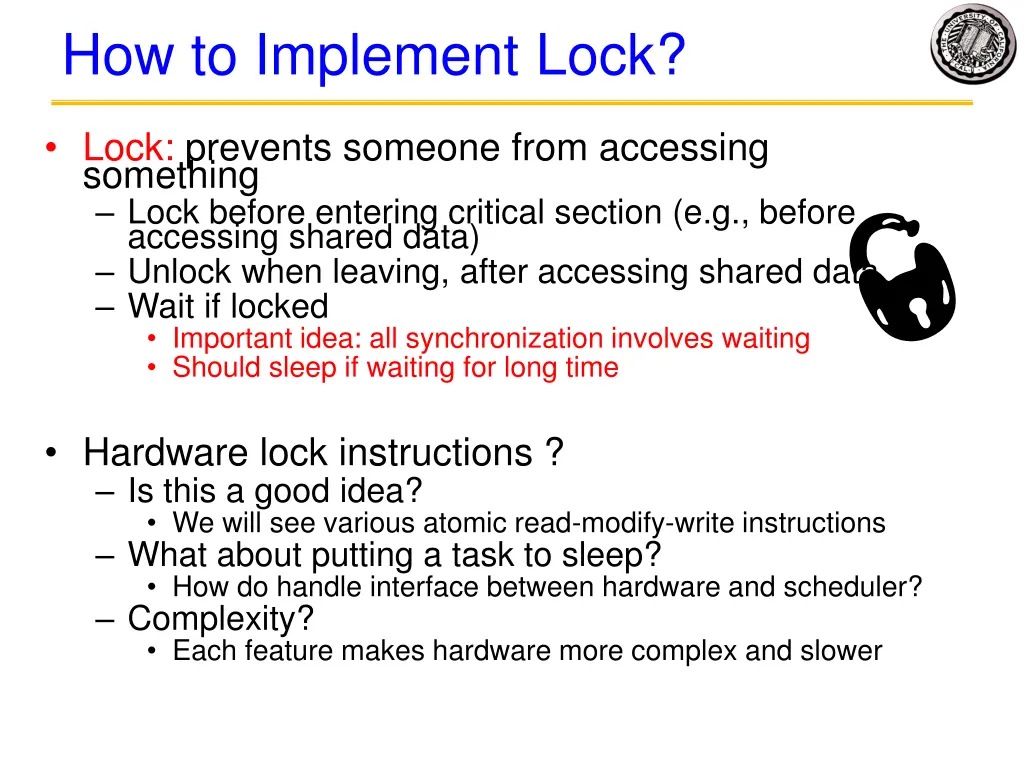
How to Implement Lock? Lock: prevents someone from accessing something Lock before entering critical section (e.g., before accessing shared data) Unlock when leaving, after accessing shared data Wait if locked Important idea: all synchronization involves waiting Should sleep if waiting for long time Hardware lock instructions ? Is this a good idea? We will see various atomic read-modify-write instructions What about putting a task to sleep? How do handle interface between hardware and scheduler? Complexity? Each feature makes hardware more complex and slower
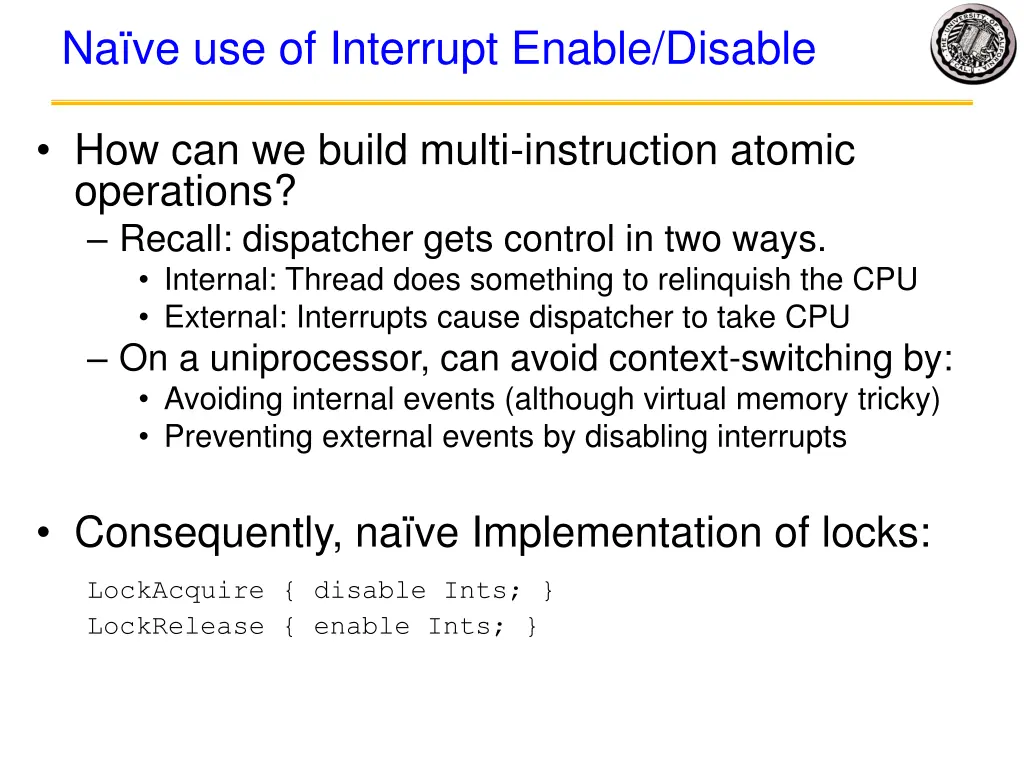
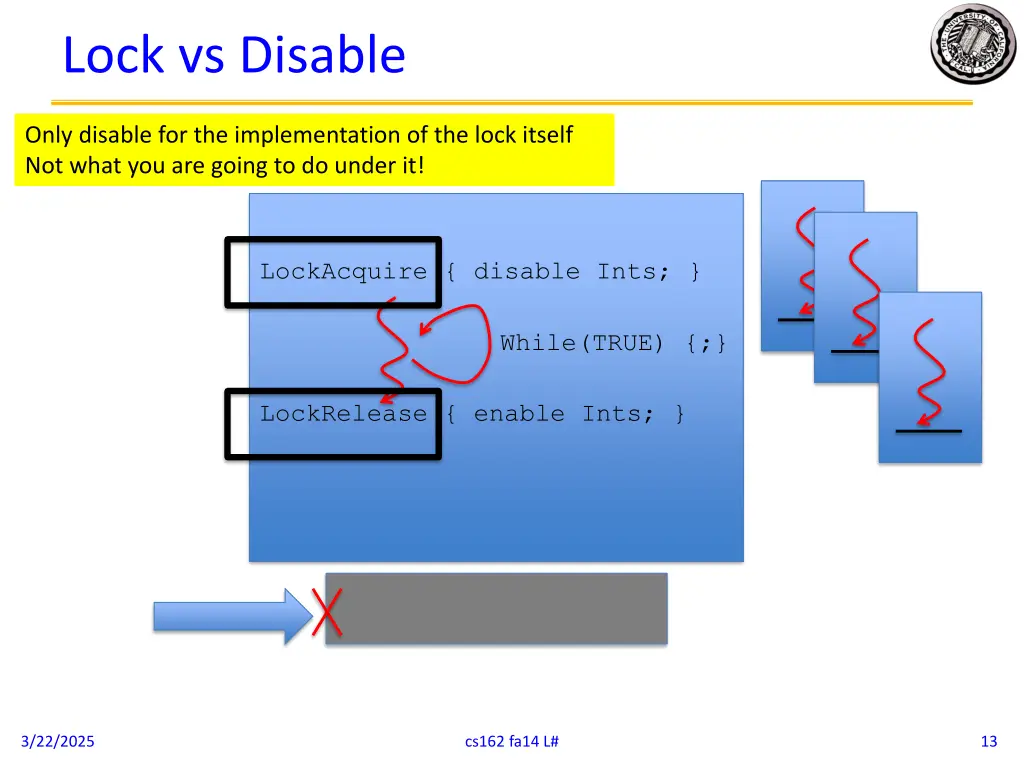
Nave use of Interrupt Enable/Disable How can we build multi-instruction atomic operations? Recall: dispatcher gets control in two ways. Internal: Thread does something to relinquish the CPU External: Interrupts cause dispatcher to take CPU On a uniprocessor, can avoid context-switching by: Avoiding internal events (although virtual memory tricky) Preventing external events by disabling interrupts Consequently, na ve Implementation of locks: LockAcquire { disable Ints; } LockRelease { enable Ints; }
Lock vs Disable Only disable for the implementation of the lock itself Not what you are going to do under it! LockAcquire { disable Ints; } While(TRUE) {;} LockRelease { enable Ints; } 3/22/2025 cs162 fa14 L# 13
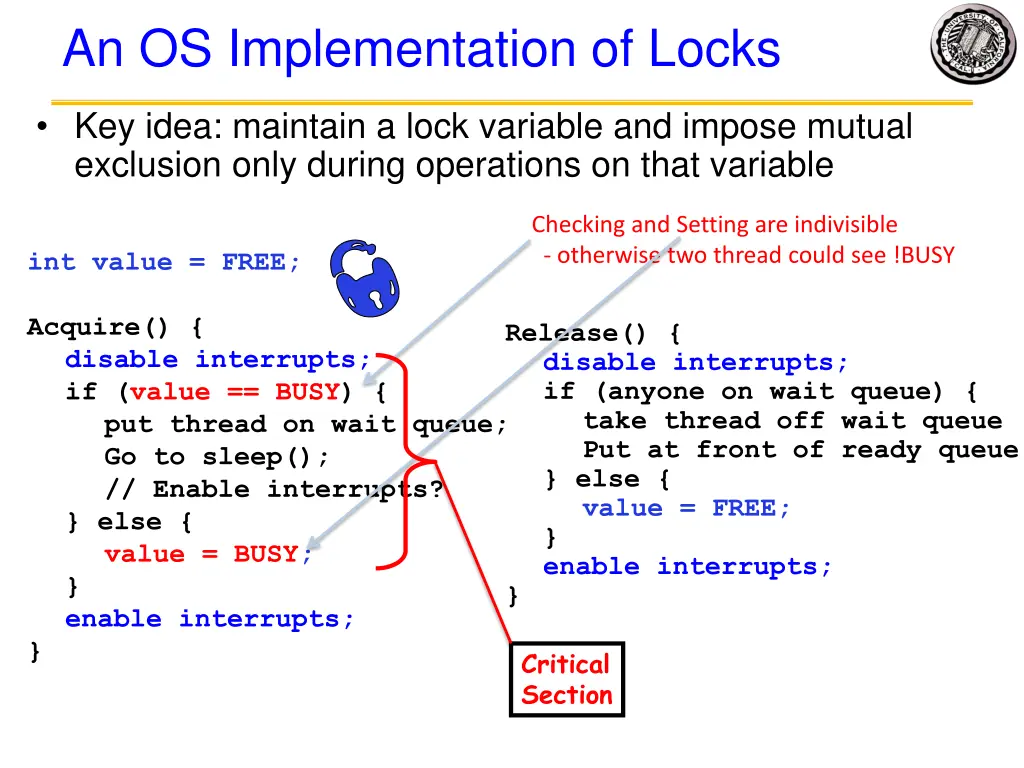
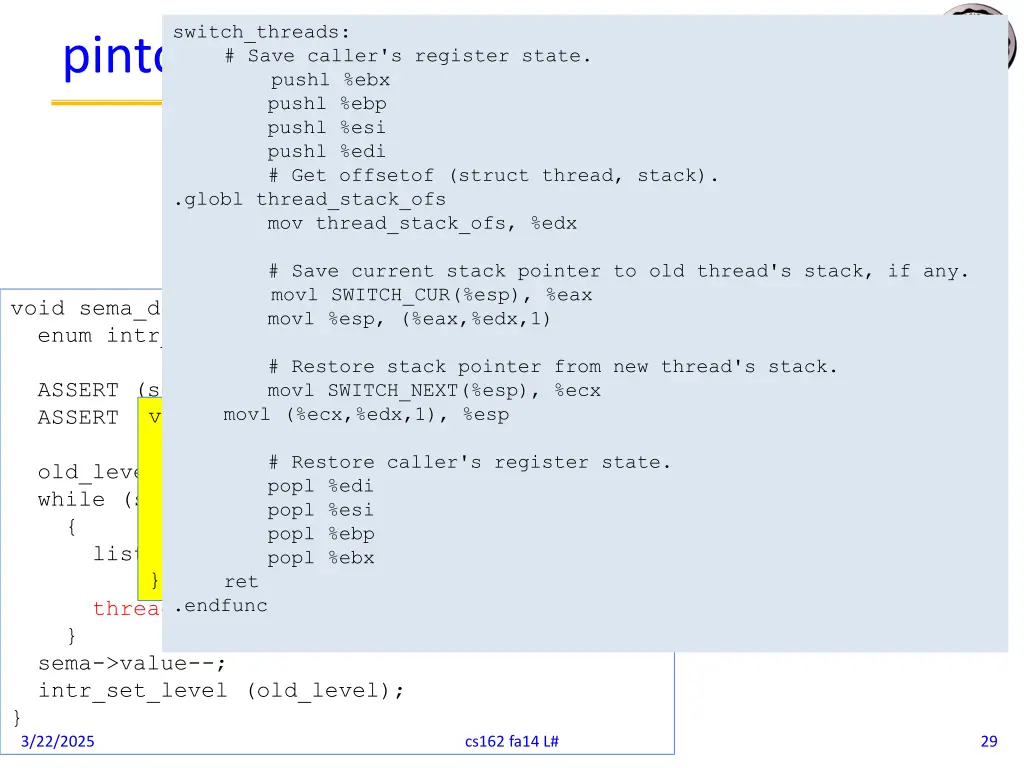
An OS Implementation of Locks Key idea: maintain a lock variable and impose mutual exclusion only during operations on that variable Checking and Setting are indivisible - otherwise two thread could see !BUSY int value = FREE; Acquire() { disable interrupts; if (value == BUSY) { put thread on wait queue; Go to sleep(); // Enable interrupts? } else { value = BUSY; } enable interrupts; } Release() { disable interrupts; if (anyone on wait queue) { take thread off wait queue Put at front of ready queue } else { value = FREE; } enable interrupts; } Critical Section
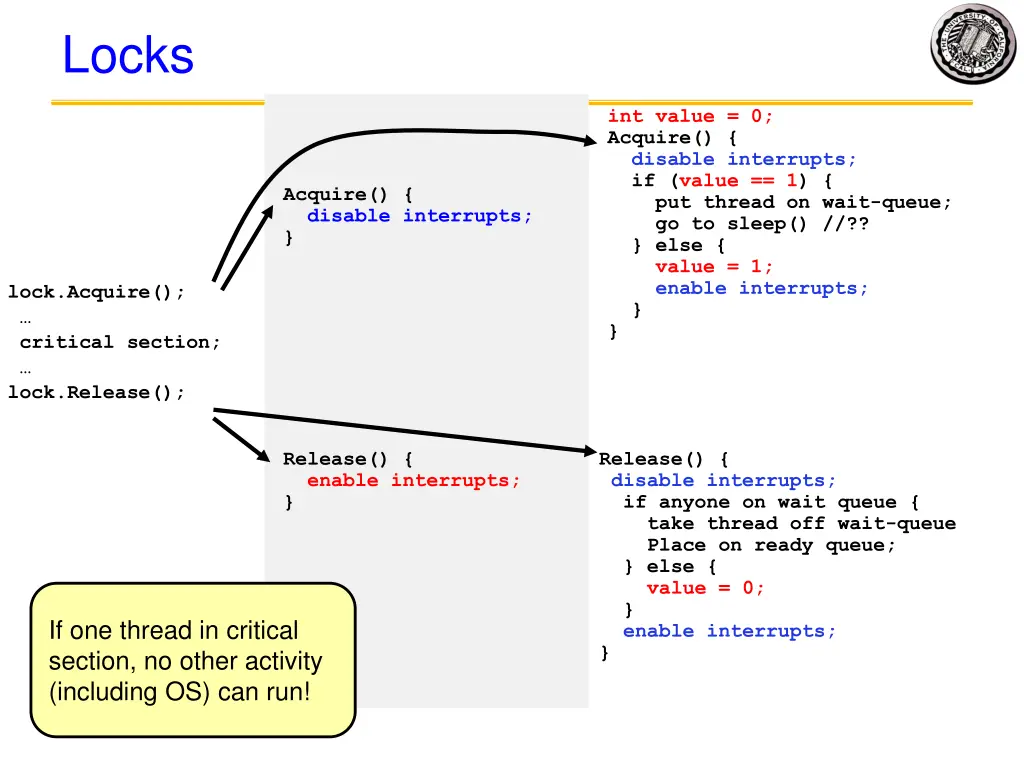
Locks int value = 0; Acquire() { disable interrupts; if (value == 1) { put thread on wait-queue; go to sleep() //?? } else { value = 1; enable interrupts; } } Acquire() { disable interrupts; } lock.Acquire(); critical section; lock.Release(); Release() { enable interrupts; } Release() { disable interrupts; if anyone on wait queue { take thread off wait-queue Place on ready queue; } else { value = 0; } enable interrupts; } If one thread in critical section, no other activity (including OS) can run!
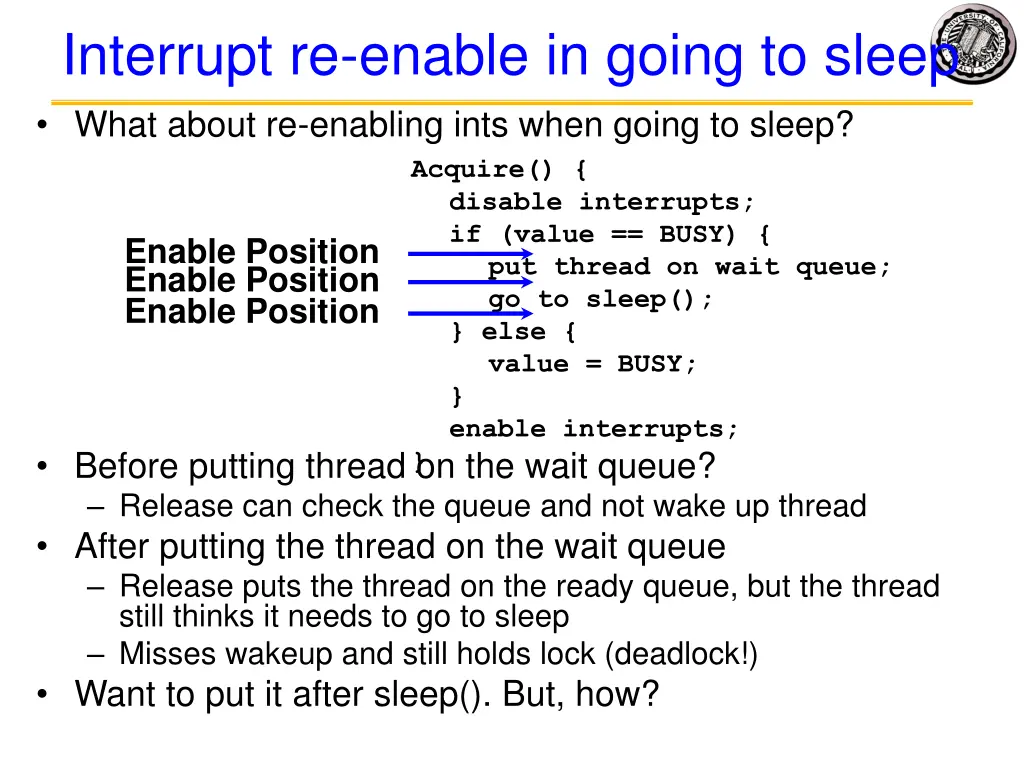
Interrupt re-enable in going to sleep What about re-enabling ints when going to sleep? Acquire() { disable interrupts; if (value == BUSY) { put thread on wait queue; go to sleep(); } else { value = BUSY; } enable interrupts; } Enable Position Enable Position Enable Position Before putting thread on the wait queue? Release can check the queue and not wake up thread After putting the thread on the wait queue Release puts the thread on the ready queue, but the thread still thinks it needs to go to sleep Misses wakeup and still holds lock (deadlock!) Want to put it after sleep(). But, how?
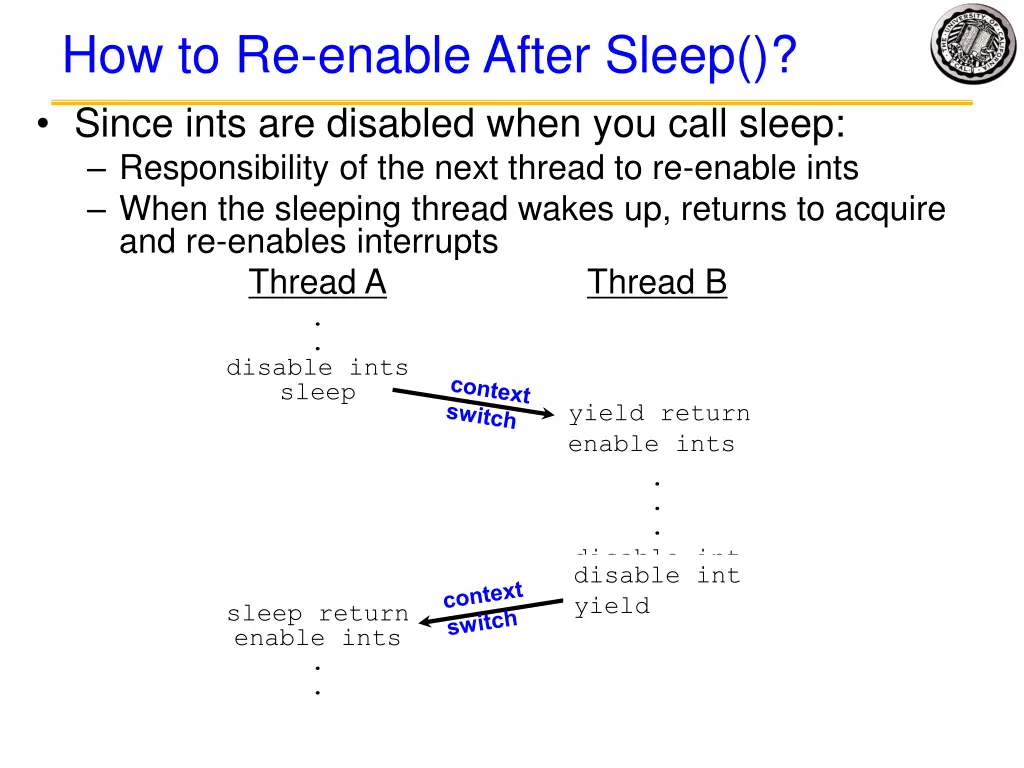
How to Re-enable After Sleep()? Since ints are disabled when you call sleep: Responsibility of the next thread to re-enable ints When the sleeping thread wakes up, returns to acquire and re-enables interrupts Thread A . . disable ints sleep sleep return enable ints . . Thread B yield return enable ints sleep return enable ints . . . disable int sleep disable int yield
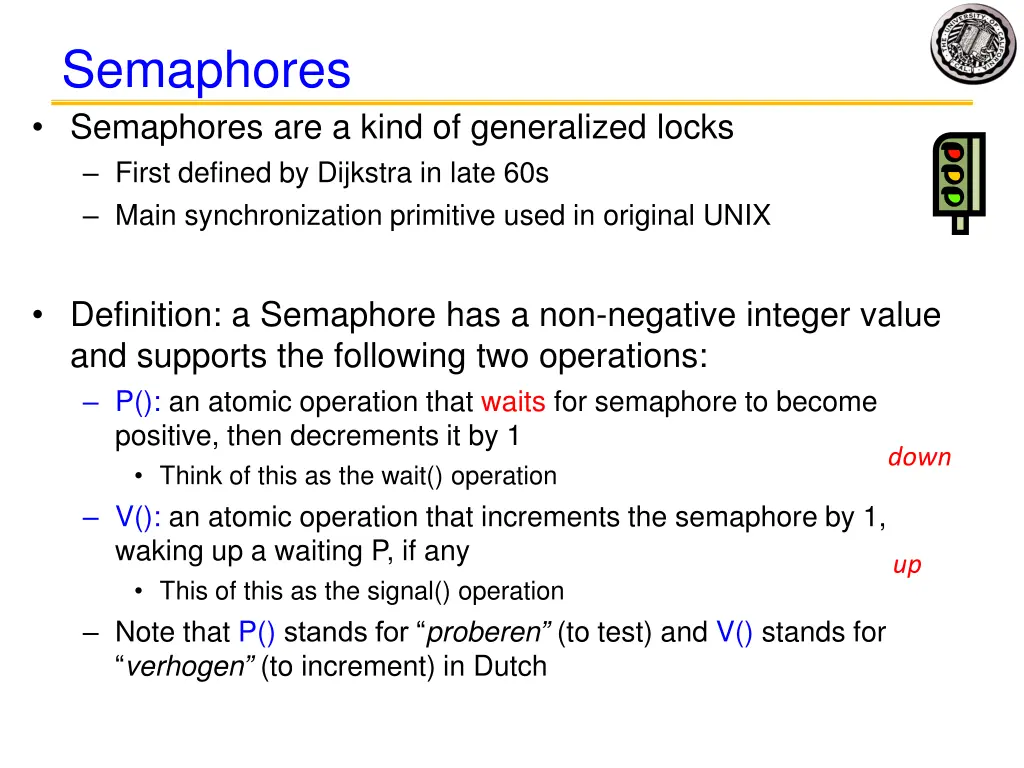
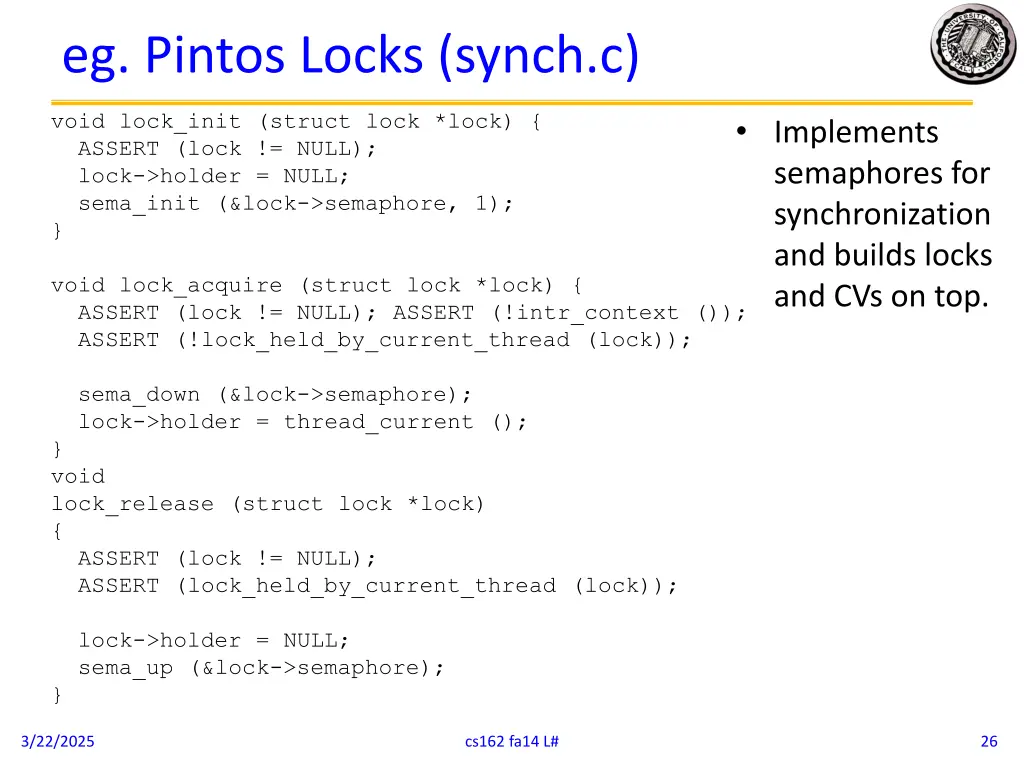
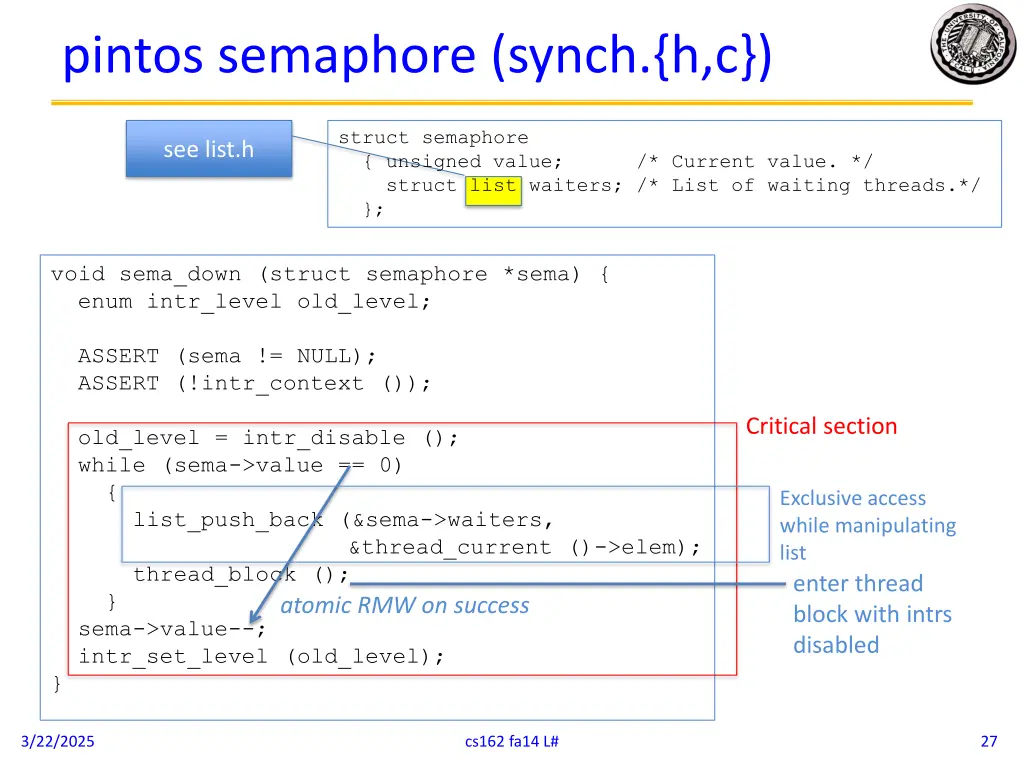
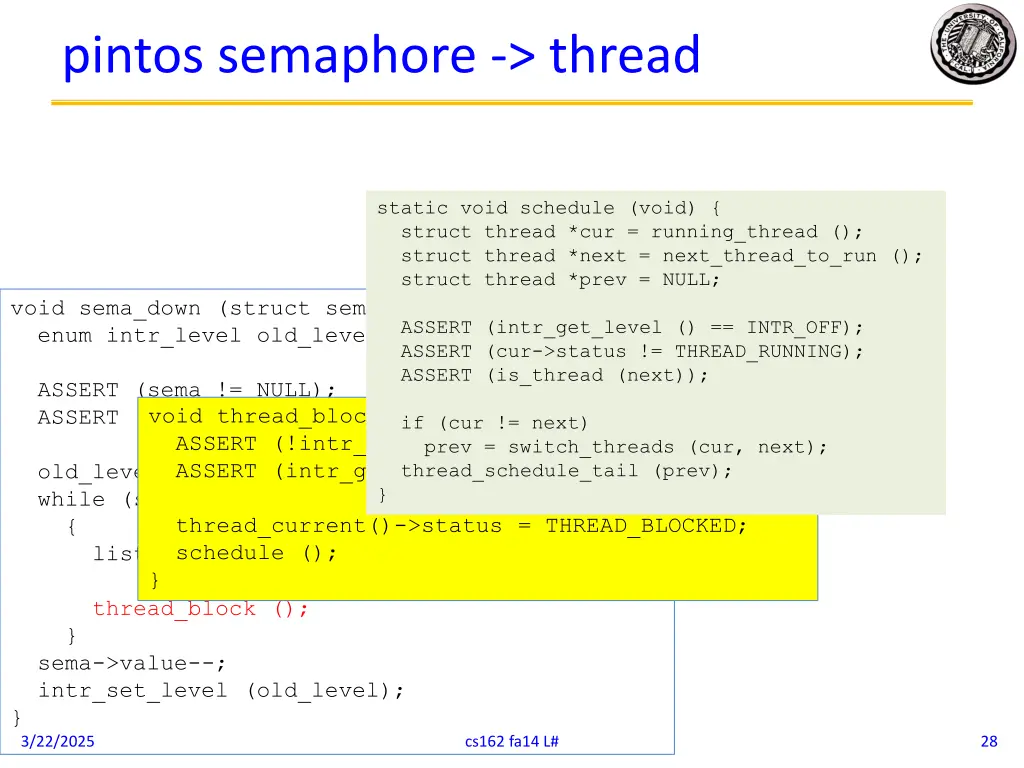
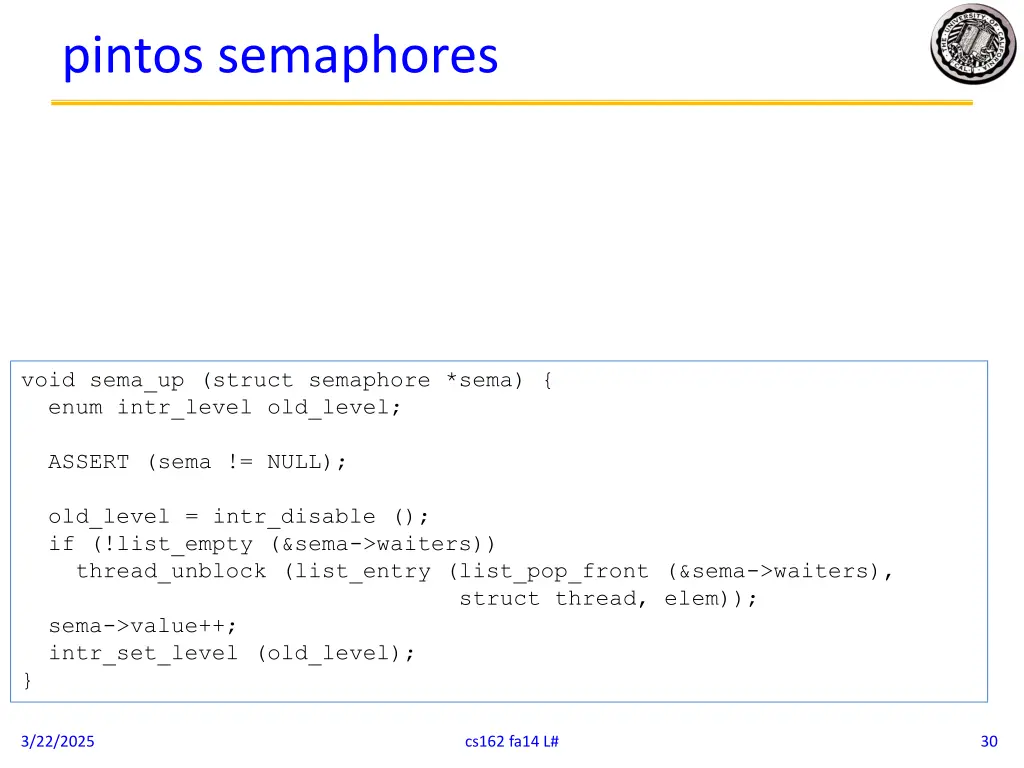
Semaphores Semaphores are a kind of generalized locks First defined by Dijkstra in late 60s Main synchronization primitive used in original UNIX Definition: a Semaphore has a non-negative integer value and supports the following two operations: P(): an atomic operation that waits for semaphore to become positive, then decrements it by 1 Think of this as the wait() operation V(): an atomic operation that increments the semaphore by 1, waking up a waiting P, if any This of this as the signal() operation Note that P() stands for proberen (to test) and V() stands for verhogen (to increment) in Dutch down up
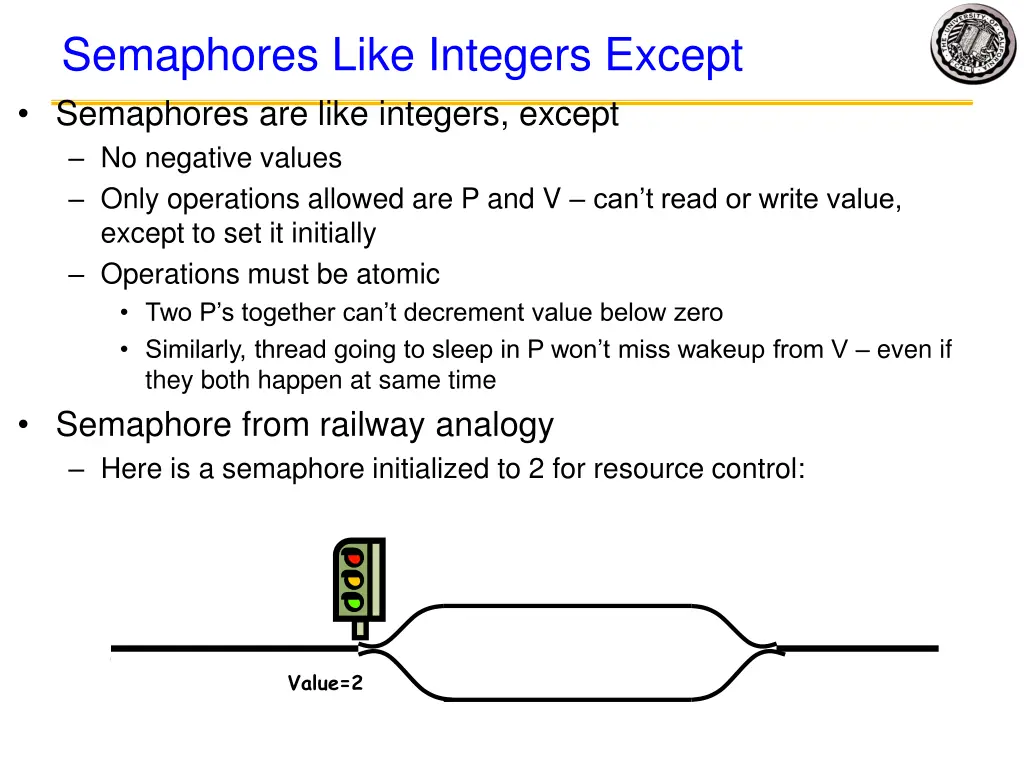
Semaphores Like Integers Except Semaphores are like integers, except No negative values Only operations allowed are P and V can t read or write value, except to set it initially Operations must be atomic Two P s together can t decrement value below zero Similarly, thread going to sleep in P won t miss wakeup from V even if they both happen at same time Semaphore from railway analogy Here is a semaphore initialized to 2 for resource control: Value=2 Value=1 Value=0 Value=1 Value=0 Value=2
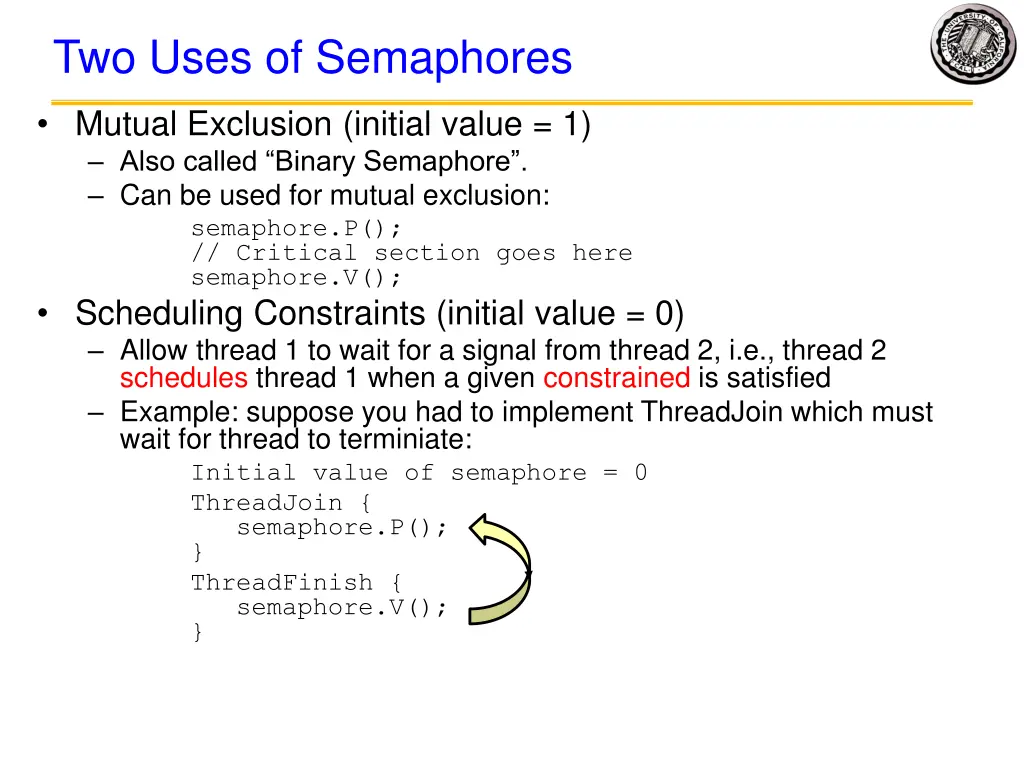
Two Uses of Semaphores Mutual Exclusion (initial value = 1) Also called Binary Semaphore . Can be used for mutual exclusion: semaphore.P(); // Critical section goes here semaphore.V(); Scheduling Constraints (initial value = 0) Allow thread 1 to wait for a signal from thread 2, i.e., thread 2 schedules thread 1 when a given constrained is satisfied Example: suppose you had to implement ThreadJoin which must wait for thread to terminiate: Initial value of semaphore = 0 ThreadJoin { semaphore.P(); } ThreadFinish { semaphore.V(); }
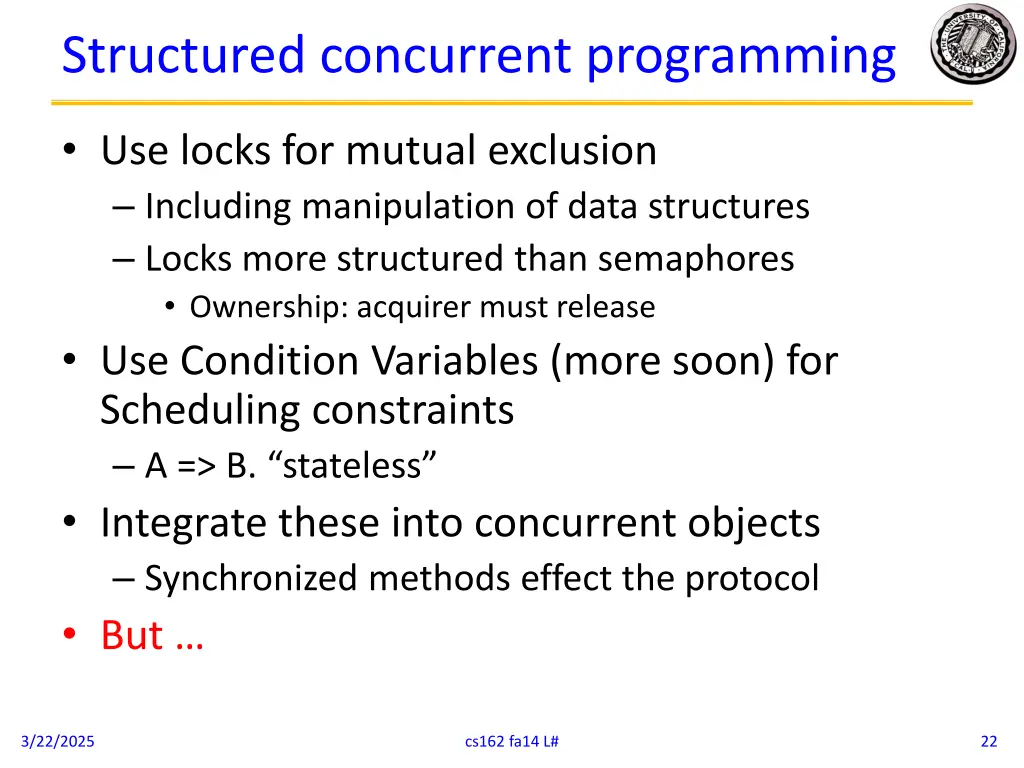
Structured concurrent programming Use locks for mutual exclusion Including manipulation of data structures Locks more structured than semaphores Ownership: acquirer must release Use Condition Variables (more soon) for Scheduling constraints A => B. stateless Integrate these into concurrent objects Synchronized methods effect the protocol But 3/22/2025 cs162 fa14 L# 22
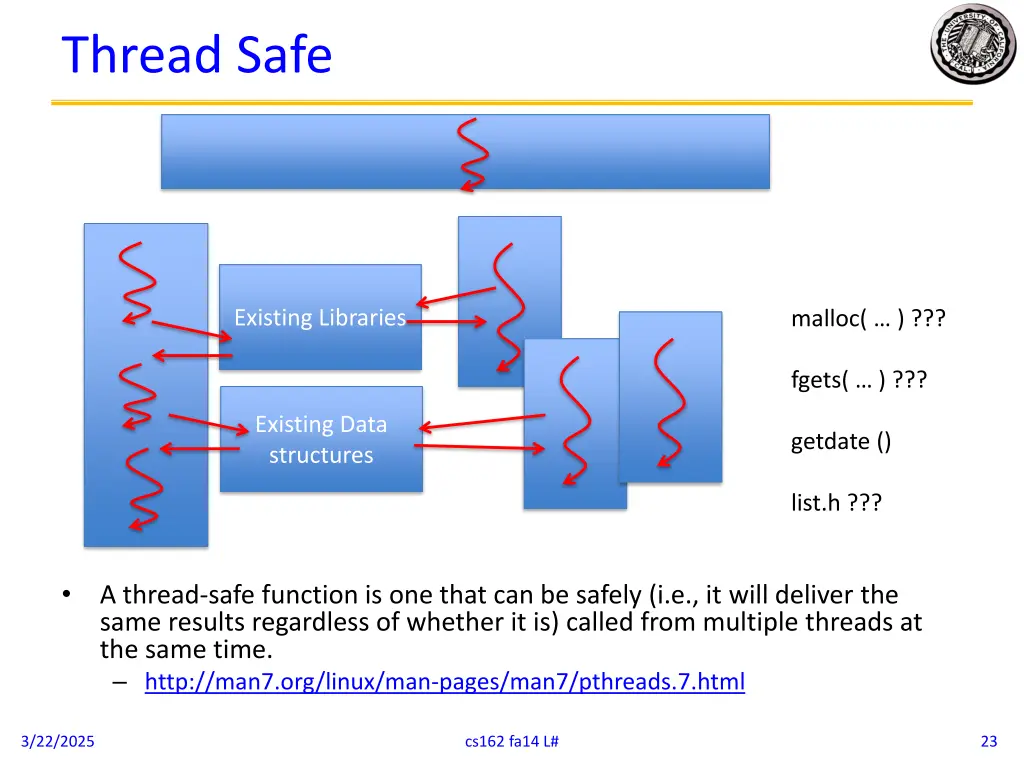
Thread Safe Existing Libraries malloc( ) ??? fgets( ) ??? Existing Data structures getdate () list.h ??? A thread-safe function is one that can be safely (i.e., it will deliver the same results regardless of whether it is) called from multiple threads at the same time. http://man7.org/linux/man-pages/man7/pthreads.7.html 3/22/2025 cs162 fa14 L# 23
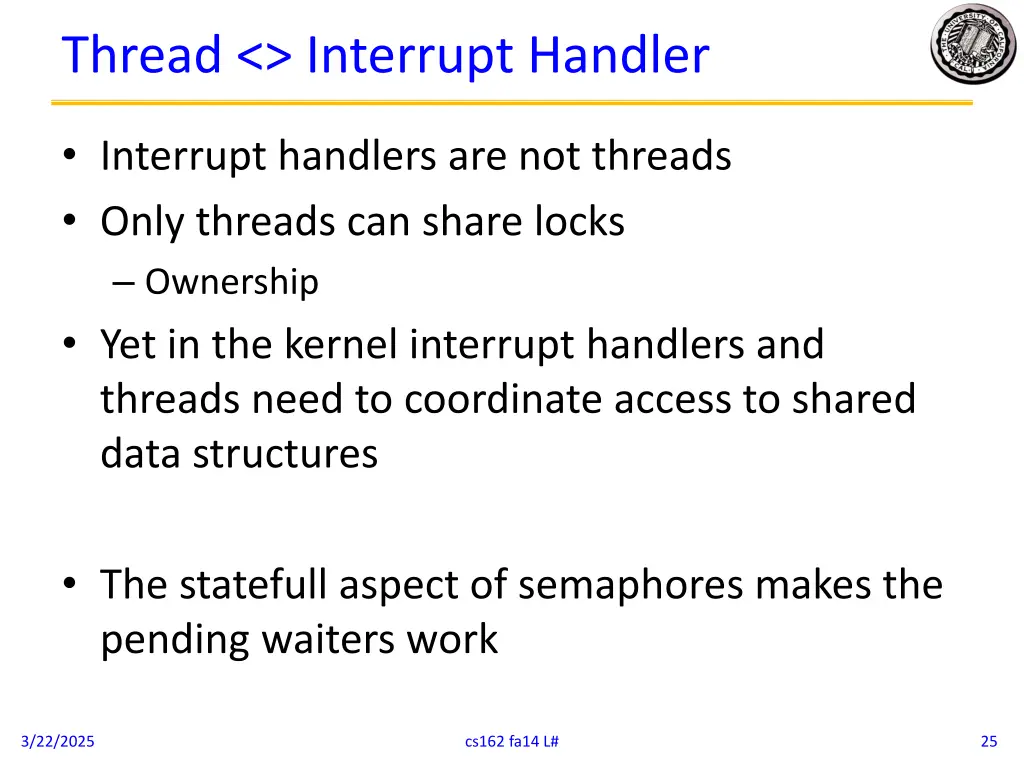
Thread <> Interrupt Handler Interrupt handlers are not threads Only threads can share locks Ownership Yet in the kernel interrupt handlers and threads need to coordinate access to shared data structures The statefull aspect of semaphores makes the pending waiters work 3/22/2025 cs162 fa14 L# 25